{"title":"Farming with Hand and Hoe over the Last Millennia: Traditional Terracing and the Agricultural Economy in Konso Zone, Southern Ethiopia","authors":"Alemseged Beldados Aleho, Fikadu Adugna","doi":"10.1007/s10437-025-09641-9","DOIUrl":null,"url":null,"abstract":"<div><p>In the Konso agricultural system, terracing is one of the most significant traditional techniques used to protect soil from erosion and to accumulate water in agricultural fields. With the objectives of understanding climate resilient agriculture, dry land farming and traditional agricultural terraces, ethno-botanic and ethno-archaeological investigations were conducted in different parts of the Konso Zone between 2021 and 2023. Based on archaeological surveys, six abandoned and active terraced agricultural fields were identified and described. The local inhabitants in the terraced lands commonly plant trees like, <i>Moringa stenopetala</i> (cabbage tree), and <i>Terminalia brownii</i> (tropical almond); cultivate crops as <i>Eragrostis tef</i> (teff), <i>Sorghum bicolor</i> (sorghum), <i>Zea mays</i> (maize), <i>Eleusine coracana</i> (finger millet), <i>Cajanus caja</i> (pigeon pea), <i>Glycine max</i> (soybean), <i>Linum usitatissimum</i> (linseed), <i>Rhamnus prinoide</i> (Gesho), <i>Catha edulis</i> (chat), and <i>Coffee arabica</i> (coffee). The terraces in Konso are predominantly concentrated between 1400 and 2000 m above sea level on stony and steep slopes that are very fragile and susceptible to erosion. Because the terraced land is narrow, fragmentary and eroded, it is not conducive for ox-plough or mechanized agriculture. Instead, the Konso people use their hands and hoe (locally known as payra) to cultivate the land. The technological construction of Konso traditional terracing and agricultural practices are reflections of altitude and topography. The Konso people have endured hostile conditions, difficult terrain, and unpredictable rain by adopting terrace farming methods. They have changed their fragile ecology and difficult mountainous topography and remain to be examples of resilience and adaptation to hostile environment for almost millennia. Radio-carbon dating on charcoal from excavation of one of the abandoned agricultural terraces in Konso zone provided a date of 1235 ± 30 BP, hinting us to a long history of traditional terrace agriculture.</p></div>","PeriodicalId":46493,"journal":{"name":"African Archaeological Review","volume":"42 4","pages":"635 - 658"},"PeriodicalIF":1.1000,"publicationDate":"2026-01-16","publicationTypes":"Journal Article","fieldsOfStudy":null,"isOpenAccess":false,"openAccessPdf":"","citationCount":"0","resultStr":null,"platform":"Semanticscholar","paperid":null,"PeriodicalName":"African Archaeological Review","FirstCategoryId":"90","ListUrlMain":"https://link.springer.com/article/10.1007/s10437-025-09641-9","RegionNum":3,"RegionCategory":"社会学","ArticlePicture":[],"TitleCN":null,"AbstractTextCN":null,"PMCID":null,"EPubDate":"","PubModel":"","JCR":"Q1","JCRName":"ANTHROPOLOGY","Score":null,"Total":0}
引用次数: 0
Abstract
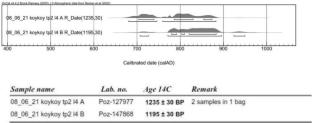
In the Konso agricultural system, terracing is one of the most significant traditional techniques used to protect soil from erosion and to accumulate water in agricultural fields. With the objectives of understanding climate resilient agriculture, dry land farming and traditional agricultural terraces, ethno-botanic and ethno-archaeological investigations were conducted in different parts of the Konso Zone between 2021 and 2023. Based on archaeological surveys, six abandoned and active terraced agricultural fields were identified and described. The local inhabitants in the terraced lands commonly plant trees like, Moringa stenopetala (cabbage tree), and Terminalia brownii (tropical almond); cultivate crops as Eragrostis tef (teff), Sorghum bicolor (sorghum), Zea mays (maize), Eleusine coracana (finger millet), Cajanus caja (pigeon pea), Glycine max (soybean), Linum usitatissimum (linseed), Rhamnus prinoide (Gesho), Catha edulis (chat), and Coffee arabica (coffee). The terraces in Konso are predominantly concentrated between 1400 and 2000 m above sea level on stony and steep slopes that are very fragile and susceptible to erosion. Because the terraced land is narrow, fragmentary and eroded, it is not conducive for ox-plough or mechanized agriculture. Instead, the Konso people use their hands and hoe (locally known as payra) to cultivate the land. The technological construction of Konso traditional terracing and agricultural practices are reflections of altitude and topography. The Konso people have endured hostile conditions, difficult terrain, and unpredictable rain by adopting terrace farming methods. They have changed their fragile ecology and difficult mountainous topography and remain to be examples of resilience and adaptation to hostile environment for almost millennia. Radio-carbon dating on charcoal from excavation of one of the abandoned agricultural terraces in Konso zone provided a date of 1235 ± 30 BP, hinting us to a long history of traditional terrace agriculture.
期刊介绍:
African Archaeological Review publishes original research articles, review essays, reports, book/media reviews, and forums/commentaries on African archaeology, highlighting the contributions of the African continent to critical global issues in the past and present. Relevant topics include the emergence of modern humans and earliest manifestations of human culture; subsistence, agricultural, and technological innovations; and social complexity, as well as topical issues on heritage. The journal features timely continental and subcontinental studies covering cultural and historical processes; interregional interactions; biocultural evolution; cultural dynamics and ecology; the role of cultural materials in politics, ideology, and religion; different dimensions of economic life; the application of historical, textual, ethnoarchaeological, and archaeometric data in archaeological interpretation; and the intersections of cultural heritage, information technology, and community/public archaeology.

 求助内容:
求助内容: 应助结果提醒方式:

 京公网安备 11010802042870号


