{"title":"Quantum long short-term memory for drug discovery","authors":"Liang Zhang, Yin Xu, Mohan Wu, Liang Wang, Hua Xu","doi":"10.1140/epjqt/s40507-026-00467-1","DOIUrl":null,"url":null,"abstract":"<div><p>Quantum computing combined with machine learning (ML) is a highly promising research area, with numerous studies demonstrating that quantum machine learning (QML) is expected to solve scientific problems more effectively than classical ML. In this work, we present Quantum Long Short-Term Memory (QLSTM), a QML architecture, and demonstrate its effectiveness in drug discovery. We evaluate QLSTM on five benchmark datasets (BBBP, BACE, SIDER, BCAP37, T-47D), and observe consistent performance gains over classical LSTM, with ROC-AUC improvements ranging from 3% to over 6%. Furthermore, QLSTM exhibits improved predictive accuracy as the number of qubits increases, and faster convergence than classical LSTM under the same training conditions. Notably, QLSTM maintains strong robustness against quantum computer noise, outperforming noise-free classical LSTM in certain settings. These findings highlight the potential of QLSTM as a scalable and noise-resilient model for scientific applications, particularly as quantum hardware continues to advance in qubit capacity and fidelity.</p></div>","PeriodicalId":547,"journal":{"name":"EPJ Quantum Technology","volume":"13 1","pages":""},"PeriodicalIF":4.5000,"publicationDate":"2026-01-12","publicationTypes":"Journal Article","fieldsOfStudy":null,"isOpenAccess":false,"openAccessPdf":"https://link.springer.com/content/pdf/10.1140/epjqt/s40507-026-00467-1.pdf","citationCount":"0","resultStr":null,"platform":"Semanticscholar","paperid":null,"PeriodicalName":"EPJ Quantum Technology","FirstCategoryId":"101","ListUrlMain":"https://link.springer.com/article/10.1140/epjqt/s40507-026-00467-1","RegionNum":2,"RegionCategory":"物理与天体物理","ArticlePicture":[],"TitleCN":null,"AbstractTextCN":null,"PMCID":null,"EPubDate":"","PubModel":"","JCR":"Q1","JCRName":"OPTICS","Score":null,"Total":0}
引用次数: 0
Abstract
Quantum computing combined with machine learning (ML) is a highly promising research area, with numerous studies demonstrating that quantum machine learning (QML) is expected to solve scientific problems more effectively than classical ML. In this work, we present Quantum Long Short-Term Memory (QLSTM), a QML architecture, and demonstrate its effectiveness in drug discovery. We evaluate QLSTM on five benchmark datasets (BBBP, BACE, SIDER, BCAP37, T-47D), and observe consistent performance gains over classical LSTM, with ROC-AUC improvements ranging from 3% to over 6%. Furthermore, QLSTM exhibits improved predictive accuracy as the number of qubits increases, and faster convergence than classical LSTM under the same training conditions. Notably, QLSTM maintains strong robustness against quantum computer noise, outperforming noise-free classical LSTM in certain settings. These findings highlight the potential of QLSTM as a scalable and noise-resilient model for scientific applications, particularly as quantum hardware continues to advance in qubit capacity and fidelity.
期刊介绍:
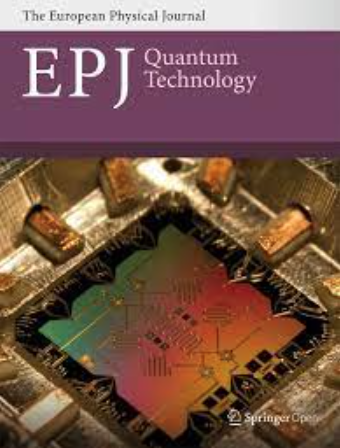
Driven by advances in technology and experimental capability, the last decade has seen the emergence of quantum technology: a new praxis for controlling the quantum world. It is now possible to engineer complex, multi-component systems that merge the once distinct fields of quantum optics and condensed matter physics.
EPJ Quantum Technology covers theoretical and experimental advances in subjects including but not limited to the following:
Quantum measurement, metrology and lithography
Quantum complex systems, networks and cellular automata
Quantum electromechanical systems
Quantum optomechanical systems
Quantum machines, engineering and nanorobotics
Quantum control theory
Quantum information, communication and computation
Quantum thermodynamics
Quantum metamaterials
The effect of Casimir forces on micro- and nano-electromechanical systems
Quantum biology
Quantum sensing
Hybrid quantum systems
Quantum simulations.

 求助内容:
 应助结果提醒方式:


 京公网安备 11010802042870号


