V. A. Troitskiy, M. A. Ponomar, R. M. Salikhov, N. V. Smirnova, K. G. Sabbatovskii, S. A. Mareev, D. Yu. Butylskii, V. V. Nikonenko
{"title":"Lithium Extraction by Selective Electrodialysis: Mechanism and Optimization of Monovalent and Multivalent Ion Separation","authors":"V. A. Troitskiy, M. A. Ponomar, R. M. Salikhov, N. V. Smirnova, K. G. Sabbatovskii, S. A. Mareev, D. Yu. Butylskii, V. V. Nikonenko","doi":"10.1134/S251775162560092X","DOIUrl":null,"url":null,"abstract":"<p>Selective electrodialysis with monovalent-ion-selective membranes has shown high efficiency for separating mono- and multivalent ions. However, the separation mechanism is not yet fully understood. This work studies two cation-exchange membranes from Astom, Japan: a standard-grade CSE membrane and a monovalent-cation-selective CIMS membrane. Based on the results of measurements of exchange capacity, water uptake, zeta potential, contact angle, specific electrical conductivity, and diffusion permeability of both membranes, it is suggested that the selective permeability of CIMS towards monovalent cations is provided both by an electrostatic barrier due to the presence of a selective layer with fixed amino groups and by its denser structure and smaller pore size. The latter necessitates partial dehydration of multivalent cations for their access to the pore space. The dependencies of Li<sup>+</sup> and Mg<sup>2+</sup> ion flux densities through CIMS on current density were studied during the electrodialytic extraction of Li<sup>+</sup> ions from a solution simulating the composition of the natural lithium-containing brine of the Angara–Lena basin. The experimental results indirectly confirmed a significant contribution of the dehydration mechanism to the selective transport of Li<sup>+</sup>. Based on the values of the CIMS selective permeability coefficient (<span>\\({P_{{\\text{L}}{{\\text{i}}^ + }{\\text{/M}}{{\\text{g}}^{2 + }}}}\\)</span>), energy consumption, and Li<sup>+</sup> extraction degree, the range of optimal current densities in the vicinity of half the partial limiting current density of lithium ions was determined.</p>","PeriodicalId":700,"journal":{"name":"Membranes and Membrane Technologies","volume":"7 5","pages":"246 - 257"},"PeriodicalIF":1.2000,"publicationDate":"2026-02-12","publicationTypes":"Journal Article","fieldsOfStudy":null,"isOpenAccess":false,"openAccessPdf":"","citationCount":"0","resultStr":null,"platform":"Semanticscholar","paperid":null,"PeriodicalName":"Membranes and Membrane Technologies","FirstCategoryId":"1085","ListUrlMain":"https://link.springer.com/article/10.1134/S251775162560092X","RegionNum":0,"RegionCategory":null,"ArticlePicture":[],"TitleCN":null,"AbstractTextCN":null,"PMCID":null,"EPubDate":"","PubModel":"","JCR":"Q4","JCRName":"CHEMISTRY, PHYSICAL","Score":null,"Total":0}
引用次数: 0
Abstract
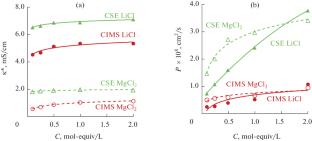
Selective electrodialysis with monovalent-ion-selective membranes has shown high efficiency for separating mono- and multivalent ions. However, the separation mechanism is not yet fully understood. This work studies two cation-exchange membranes from Astom, Japan: a standard-grade CSE membrane and a monovalent-cation-selective CIMS membrane. Based on the results of measurements of exchange capacity, water uptake, zeta potential, contact angle, specific electrical conductivity, and diffusion permeability of both membranes, it is suggested that the selective permeability of CIMS towards monovalent cations is provided both by an electrostatic barrier due to the presence of a selective layer with fixed amino groups and by its denser structure and smaller pore size. The latter necessitates partial dehydration of multivalent cations for their access to the pore space. The dependencies of Li+ and Mg2+ ion flux densities through CIMS on current density were studied during the electrodialytic extraction of Li+ ions from a solution simulating the composition of the natural lithium-containing brine of the Angara–Lena basin. The experimental results indirectly confirmed a significant contribution of the dehydration mechanism to the selective transport of Li+. Based on the values of the CIMS selective permeability coefficient (\({P_{{\text{L}}{{\text{i}}^ + }{\text{/M}}{{\text{g}}^{2 + }}}}\)), energy consumption, and Li+ extraction degree, the range of optimal current densities in the vicinity of half the partial limiting current density of lithium ions was determined.
期刊介绍:
The journal Membranes and Membrane Technologies publishes original research articles and reviews devoted to scientific research and technological advancements in the field of membranes and membrane technologies, including the following main topics:novel membrane materials and creation of highly efficient polymeric and inorganic membranes;hybrid membranes, nanocomposites, and nanostructured membranes;aqueous and nonaqueous filtration processes (micro-, ultra-, and nanofiltration; reverse osmosis);gas separation;electromembrane processes and fuel cells;membrane pervaporation and membrane distillation;membrane catalysis and membrane reactors;water desalination and wastewater treatment;hybrid membrane processes;membrane sensors;membrane extraction and membrane emulsification;mathematical simulation of porous structures and membrane separation processes;membrane characterization;membrane technologies in industry (energy, mineral extraction, pharmaceutics and medicine, chemistry and petroleum chemistry, food industry, and others);membranes and protection of environment (“green chemistry”).The journal has been published in Russian already for several years, English translations of the content used to be integrated in the journal Petroleum Chemistry. This journal is a split off with additional topics.

 求助内容:
求助内容: 应助结果提醒方式:

 京公网安备 11010802042870号


