Xiumin Wang, Zhong Huang, Xiangqian Zhou, Ralf Klasing, Yaping Mao
{"title":"Ramsey achievement games on graphs : algorithms and bounds","authors":"Xiumin Wang, Zhong Huang, Xiangqian Zhou, Ralf Klasing, Yaping Mao","doi":"10.1007/s00236-025-00516-9","DOIUrl":null,"url":null,"abstract":"<div><p>In 1982, Harary introduced the concept of Ramsey achievement game on graphs. Given a graph <i>F</i> with no isolated vertices, consider the following game played on the complete graph <span>\\(K_n\\)</span> by two players Alice and Bob. First, Alice colors one of the edges of <span>\\(K_n\\)</span> blue, then Bob colors a different edge red, and so on. The first player who can complete the formation of <i>F</i> in his color is the winner. The minimum <i>n</i> for which Alice has a winning strategy is the achievement number of <i>F</i>, denoted by <i>a</i>(<i>F</i>). If we replace <span>\\(K_n\\)</span> in the game by the complete bipartite graph <span>\\(K_{n,n}\\)</span>, we get the bipartite achievement number, denoted by <span>\\(\\operatorname {ba}(F)\\)</span>. In this paper, we correct <span>\\(\\operatorname {ba}(mK_2)=m+1\\)</span> to <i>m</i> and disprove <span>\\(\\operatorname {ba}(K_{1,m})=2m-2\\)</span> from Erickson and Harary (1983). We also find the exact values or upper and lower bounds of bipartite achievement numbers on matchings, stars, and double stars.</p></div>","PeriodicalId":7189,"journal":{"name":"Acta Informatica","volume":"63 1","pages":""},"PeriodicalIF":0.5000,"publicationDate":"2026-02-09","publicationTypes":"Journal Article","fieldsOfStudy":null,"isOpenAccess":false,"openAccessPdf":"","citationCount":"0","resultStr":null,"platform":"Semanticscholar","paperid":null,"PeriodicalName":"Acta Informatica","FirstCategoryId":"94","ListUrlMain":"https://link.springer.com/article/10.1007/s00236-025-00516-9","RegionNum":4,"RegionCategory":"计算机科学","ArticlePicture":[],"TitleCN":null,"AbstractTextCN":null,"PMCID":null,"EPubDate":"","PubModel":"","JCR":"Q4","JCRName":"COMPUTER SCIENCE, INFORMATION SYSTEMS","Score":null,"Total":0}
引用次数: 0
Abstract
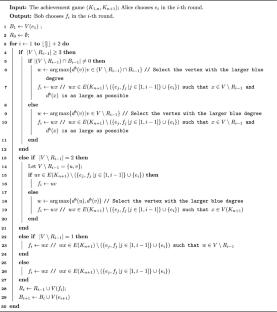
In 1982, Harary introduced the concept of Ramsey achievement game on graphs. Given a graph F with no isolated vertices, consider the following game played on the complete graph \(K_n\) by two players Alice and Bob. First, Alice colors one of the edges of \(K_n\) blue, then Bob colors a different edge red, and so on. The first player who can complete the formation of F in his color is the winner. The minimum n for which Alice has a winning strategy is the achievement number of F, denoted by a(F). If we replace \(K_n\) in the game by the complete bipartite graph \(K_{n,n}\), we get the bipartite achievement number, denoted by \(\operatorname {ba}(F)\). In this paper, we correct \(\operatorname {ba}(mK_2)=m+1\) to m and disprove \(\operatorname {ba}(K_{1,m})=2m-2\) from Erickson and Harary (1983). We also find the exact values or upper and lower bounds of bipartite achievement numbers on matchings, stars, and double stars.
期刊介绍:
Acta Informatica provides international dissemination of articles on formal methods for the design and analysis of programs, computing systems and information structures, as well as related fields of Theoretical Computer Science such as Automata Theory, Logic in Computer Science, and Algorithmics.
Topics of interest include:
• semantics of programming languages
• models and modeling languages for concurrent, distributed, reactive and mobile systems
• models and modeling languages for timed, hybrid and probabilistic systems
• specification, program analysis and verification
• model checking and theorem proving
• modal, temporal, first- and higher-order logics, and their variants
• constraint logic, SAT/SMT-solving techniques
• theoretical aspects of databases, semi-structured data and finite model theory
• theoretical aspects of artificial intelligence, knowledge representation, description logic
• automata theory, formal languages, term and graph rewriting
• game-based models, synthesis
• type theory, typed calculi
• algebraic, coalgebraic and categorical methods
• formal aspects of performance, dependability and reliability analysis
• foundations of information and network security
• parallel, distributed and randomized algorithms
• design and analysis of algorithms
• foundations of network and communication protocols.

 求助内容:
求助内容: 应助结果提醒方式:

 京公网安备 11010802042870号


