{"title":"Ionospheric Storm Effects during the 5–6 November 2023 Geomagnetic Storm Over South Africa","authors":"Tegegn Teferi Agago, Dejene Ambisa Terefe, Gebre Kalute Gebino","doi":"10.1134/S0016793225600201","DOIUrl":null,"url":null,"abstract":"<p>Geomagnetic storms, driven by solar wind–magnetosphere interactions, can significantly disturb the ionosphere, altering electron density and degrading satellite-based communication and navigation systems. The extended geomagnetic storm that occurred from November 5–6, 2023, presents a noteworthy but little-studied chance to investigate its multi-parameter impacts on the ionosphere of South Africa. Although previous research has examined ionospheric disturbances in the area, this event’s prolonged duration and dynamic solar wind solar wind parameters. The findings show significant TEC depletion at five GPS stations. The most noticeable decrease was seen at Springbok (SBOK) on November 6, when the minimum <span>\\(\\Delta \\)</span>TEC was –35.88 TECU in comparison to International Quiet Days for the case of severe geomagnetic storms and latitudinal positions. Magnetic field data from the Hartebeesthoek observatory showed significant storm-time disturbances in the northward (<i>X</i>), eastward (<i>Y</i>), and horizontal (<i>H</i>) components. These variations are attributed to intensified ionospheric Hall and Pedersen currents, where <i>X</i> reflects the dominant Pedersen current aligned with the geomagnetic field, <i>Y</i> indicates enhanced Hall currents due to zonal electric fields, and <i>H</i> captures the net horizontal current response. Furthermore, Global Ultraviolet Imager (GUVI) satellite measurements recorded a sharp decline in the thermospheric O/N<sub>2</sub> ratio over South Africa during the main phase of the storm, indicative of increased recombination rates that suppress electron density. These findings underscore the importance of continued space weather monitoring and ionospheric modeling in the African region to support GNSS reliability and regional forecasting capabilities.</p>","PeriodicalId":55597,"journal":{"name":"Geomagnetism and Aeronomy","volume":"65 7-8","pages":"132 - 145"},"PeriodicalIF":0.7000,"publicationDate":"2026-01-09","publicationTypes":"Journal Article","fieldsOfStudy":null,"isOpenAccess":false,"openAccessPdf":"","citationCount":"0","resultStr":null,"platform":"Semanticscholar","paperid":null,"PeriodicalName":"Geomagnetism and Aeronomy","FirstCategoryId":"89","ListUrlMain":"https://link.springer.com/article/10.1134/S0016793225600201","RegionNum":4,"RegionCategory":"地球科学","ArticlePicture":[],"TitleCN":null,"AbstractTextCN":null,"PMCID":null,"EPubDate":"","PubModel":"","JCR":"Q4","JCRName":"GEOCHEMISTRY & GEOPHYSICS","Score":null,"Total":0}
引用次数: 0
Abstract
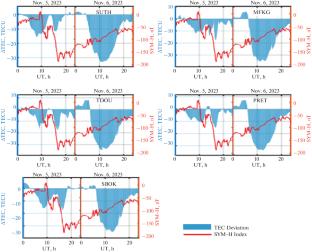
Geomagnetic storms, driven by solar wind–magnetosphere interactions, can significantly disturb the ionosphere, altering electron density and degrading satellite-based communication and navigation systems. The extended geomagnetic storm that occurred from November 5–6, 2023, presents a noteworthy but little-studied chance to investigate its multi-parameter impacts on the ionosphere of South Africa. Although previous research has examined ionospheric disturbances in the area, this event’s prolonged duration and dynamic solar wind solar wind parameters. The findings show significant TEC depletion at five GPS stations. The most noticeable decrease was seen at Springbok (SBOK) on November 6, when the minimum \(\Delta \)TEC was –35.88 TECU in comparison to International Quiet Days for the case of severe geomagnetic storms and latitudinal positions. Magnetic field data from the Hartebeesthoek observatory showed significant storm-time disturbances in the northward (X), eastward (Y), and horizontal (H) components. These variations are attributed to intensified ionospheric Hall and Pedersen currents, where X reflects the dominant Pedersen current aligned with the geomagnetic field, Y indicates enhanced Hall currents due to zonal electric fields, and H captures the net horizontal current response. Furthermore, Global Ultraviolet Imager (GUVI) satellite measurements recorded a sharp decline in the thermospheric O/N2 ratio over South Africa during the main phase of the storm, indicative of increased recombination rates that suppress electron density. These findings underscore the importance of continued space weather monitoring and ionospheric modeling in the African region to support GNSS reliability and regional forecasting capabilities.
期刊介绍:
Geomagnetism and Aeronomy is a bimonthly periodical that covers the fields of interplanetary space; geoeffective solar events; the magnetosphere; the ionosphere; the upper and middle atmosphere; the action of solar variability and activity on atmospheric parameters and climate; the main magnetic field and its secular variations, excursion, and inversion; and other related topics.

 求助内容:
求助内容: 应助结果提醒方式:

 京公网安备 11010802042870号


