S. D. Artamonova, O. V. Solovtsova, I. E. Menshchikov, A. E. Grinchenko, S. A. Tikhonov, A. V. Shkolin, A. A. Fomkin
{"title":"Direct Sorption Capture of CO2 from Air","authors":"S. D. Artamonova, O. V. Solovtsova, I. E. Menshchikov, A. E. Grinchenko, S. A. Tikhonov, A. V. Shkolin, A. A. Fomkin","doi":"10.1134/S2070205125701151","DOIUrl":null,"url":null,"abstract":"<p>The adsorption behaviors of microporous carbon adsorbent ASK-1 with respect to CO<sub>2</sub> capture from the CO<sub>2</sub>/N<sub>2</sub> mixtures were investigated at temperatures of 233, 273, and 313 K at pressures up to 1000 kPa. The activated carbon with the micropore pore volume of 0.53 cm<sup>3</sup>/g and the specific BET surface of 1440 m<sup>2</sup>/g was prepared from coal-tar raw materials of Kamchatka krai (Russia) by chemical activation using KOH at a temperature of 1173 K. The isotherms of one-component adsorption of gases were calculated using the Dubinin–Radushkevich equation of the theory of volume filling of micropores. The adsorption equilibrium of the СО<sub>2</sub>/N<sub>2</sub> mixtures with the CO<sub>2</sub> content ranging from 0.05 to 20 mol % were calculated using the ideal adsorption solution applied to the isotherms of individual gases in order to evaluate the efficiency of the adsorbent for capturing CO<sub>2</sub>, as well as to identify the optimal conditions for separating the СО<sub>2</sub>/N<sub>2</sub> mixture. The availability of ASK-1 to purify air from technogenic CO<sub>2</sub> was determined by analyzing the adsorption behaviors of the components and estimating the potential CO<sub>2</sub> selectivity of the adsorbent as a function of the mixture composition, pressure, and temperature.</p>","PeriodicalId":745,"journal":{"name":"Protection of Metals and Physical Chemistry of Surfaces","volume":"61 6","pages":"1239 - 1246"},"PeriodicalIF":0.8000,"publicationDate":"2026-02-06","publicationTypes":"Journal Article","fieldsOfStudy":null,"isOpenAccess":false,"openAccessPdf":"","citationCount":"0","resultStr":null,"platform":"Semanticscholar","paperid":null,"PeriodicalName":"Protection of Metals and Physical Chemistry of Surfaces","FirstCategoryId":"88","ListUrlMain":"https://link.springer.com/article/10.1134/S2070205125701151","RegionNum":4,"RegionCategory":"材料科学","ArticlePicture":[],"TitleCN":null,"AbstractTextCN":null,"PMCID":null,"EPubDate":"","PubModel":"","JCR":"Q3","JCRName":"METALLURGY & METALLURGICAL ENGINEERING","Score":null,"Total":0}
引用次数: 0
Abstract
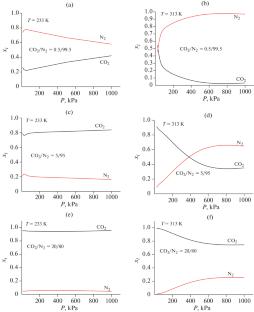
The adsorption behaviors of microporous carbon adsorbent ASK-1 with respect to CO2 capture from the CO2/N2 mixtures were investigated at temperatures of 233, 273, and 313 K at pressures up to 1000 kPa. The activated carbon with the micropore pore volume of 0.53 cm3/g and the specific BET surface of 1440 m2/g was prepared from coal-tar raw materials of Kamchatka krai (Russia) by chemical activation using KOH at a temperature of 1173 K. The isotherms of one-component adsorption of gases were calculated using the Dubinin–Radushkevich equation of the theory of volume filling of micropores. The adsorption equilibrium of the СО2/N2 mixtures with the CO2 content ranging from 0.05 to 20 mol % were calculated using the ideal adsorption solution applied to the isotherms of individual gases in order to evaluate the efficiency of the adsorbent for capturing CO2, as well as to identify the optimal conditions for separating the СО2/N2 mixture. The availability of ASK-1 to purify air from technogenic CO2 was determined by analyzing the adsorption behaviors of the components and estimating the potential CO2 selectivity of the adsorbent as a function of the mixture composition, pressure, and temperature.
期刊介绍:
Protection of Metals and Physical Chemistry of Surfaces is an international peer reviewed journal that publishes articles covering all aspects of the physical chemistry of materials and interfaces in various environments. The journal covers all related problems of modern physical chemistry and materials science, including: physicochemical processes at interfaces; adsorption phenomena; complexing from molecular and supramolecular structures at the interfaces to new substances, materials and coatings; nanoscale and nanostructured materials and coatings, composed and dispersed materials; physicochemical problems of corrosion, degradation and protection; investigation methods for surface and interface systems, processes, structures, materials and coatings. No principe restrictions exist related systems, types of processes, methods of control and study. The journal welcomes conceptual, theoretical, experimental, methodological, instrumental, environmental, and all other possible studies.

 求助内容:
求助内容: 应助结果提醒方式:

 京公网安备 11010802042870号


