N. G. Skvortsova, A. V. Berleva, B. S. Akhmadeev, S. N. Podyachev, A. R. Mustafina, S. L. Selektor
{"title":"The Synergistic Effect of Introducing Hemicurcuminoid into a Planar Polydiacetylene Platform for Optical Detection of Lead Ions","authors":"N. G. Skvortsova, A. V. Berleva, B. S. Akhmadeev, S. N. Podyachev, A. R. Mustafina, S. L. Selektor","doi":"10.1134/S2070205125701199","DOIUrl":null,"url":null,"abstract":"<p>This study investigated the effect of the modifying additive hemicurcuminoid HCur on the sensory ability of monolayers and ultrathin films based on polydiacetylene 10,12-pentacosadiynoic acid (PCDA; the polymerized form is denoted as polyPCDA). Using UV-Vis and fluorescence spectroscopy, it was established that in both the monocomponent and modified systems, when exposed to a lead perchlorate solution, either in the monolayer at the air–water interface and in the films formed from it, a chromatic transition from the blue nonfluorescent form of polydiacetylene (PDA) to the red fluorescent form occurs. The presence of the hemicurcuminoid HCur in the system leads to an increase in the colorimetric response of the transition and a significant growth of the fluorescent response. It has been demonstrated that the optical sensory responses of mixed polyPCDA–HCur monolayers and films are significantly higher than those of similar monocomponent Langmuir polyPCDA systems. It has been shown that the hemicurcuminoid HCur actively participates in the coordination binding of lead ions, apparently through the deprotonated enol form, as evidenced by the quenching of the dye fluorescence with a simultaneous increase in the intensity of its absorption bands. Moreover, the presence of HCur significantly enhances the optical response of polyPCDA to lead cations, indicating the manifestation of a synergistic effect of such modification. The described results may serve as a reason for further study of this system in order to develop a highly sensitive, selective two-signal sensor for lead ions in an aqueous environment.</p>","PeriodicalId":745,"journal":{"name":"Protection of Metals and Physical Chemistry of Surfaces","volume":"61 6","pages":"1263 - 1277"},"PeriodicalIF":0.8000,"publicationDate":"2026-02-06","publicationTypes":"Journal Article","fieldsOfStudy":null,"isOpenAccess":false,"openAccessPdf":"","citationCount":"0","resultStr":null,"platform":"Semanticscholar","paperid":null,"PeriodicalName":"Protection of Metals and Physical Chemistry of Surfaces","FirstCategoryId":"88","ListUrlMain":"https://link.springer.com/article/10.1134/S2070205125701199","RegionNum":4,"RegionCategory":"材料科学","ArticlePicture":[],"TitleCN":null,"AbstractTextCN":null,"PMCID":null,"EPubDate":"","PubModel":"","JCR":"Q3","JCRName":"METALLURGY & METALLURGICAL ENGINEERING","Score":null,"Total":0}
引用次数: 0
Abstract
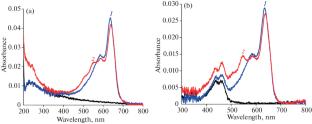
This study investigated the effect of the modifying additive hemicurcuminoid HCur on the sensory ability of monolayers and ultrathin films based on polydiacetylene 10,12-pentacosadiynoic acid (PCDA; the polymerized form is denoted as polyPCDA). Using UV-Vis and fluorescence spectroscopy, it was established that in both the monocomponent and modified systems, when exposed to a lead perchlorate solution, either in the monolayer at the air–water interface and in the films formed from it, a chromatic transition from the blue nonfluorescent form of polydiacetylene (PDA) to the red fluorescent form occurs. The presence of the hemicurcuminoid HCur in the system leads to an increase in the colorimetric response of the transition and a significant growth of the fluorescent response. It has been demonstrated that the optical sensory responses of mixed polyPCDA–HCur monolayers and films are significantly higher than those of similar monocomponent Langmuir polyPCDA systems. It has been shown that the hemicurcuminoid HCur actively participates in the coordination binding of lead ions, apparently through the deprotonated enol form, as evidenced by the quenching of the dye fluorescence with a simultaneous increase in the intensity of its absorption bands. Moreover, the presence of HCur significantly enhances the optical response of polyPCDA to lead cations, indicating the manifestation of a synergistic effect of such modification. The described results may serve as a reason for further study of this system in order to develop a highly sensitive, selective two-signal sensor for lead ions in an aqueous environment.
期刊介绍:
Protection of Metals and Physical Chemistry of Surfaces is an international peer reviewed journal that publishes articles covering all aspects of the physical chemistry of materials and interfaces in various environments. The journal covers all related problems of modern physical chemistry and materials science, including: physicochemical processes at interfaces; adsorption phenomena; complexing from molecular and supramolecular structures at the interfaces to new substances, materials and coatings; nanoscale and nanostructured materials and coatings, composed and dispersed materials; physicochemical problems of corrosion, degradation and protection; investigation methods for surface and interface systems, processes, structures, materials and coatings. No principe restrictions exist related systems, types of processes, methods of control and study. The journal welcomes conceptual, theoretical, experimental, methodological, instrumental, environmental, and all other possible studies.

 求助内容:
求助内容: 应助结果提醒方式:

 京公网安备 11010802042870号


