{"title":"On the Formation of Hollow Metal-Oxide Particles in the Oxidation of Compacted Iron Powder","authors":"V. A. Kotenev","doi":"10.1134/S2070205125701163","DOIUrl":null,"url":null,"abstract":"<p>Thermogravimetry, differential scanning calorimetry, and scanning electron microscopy were used to study the change in the structure of particles of metal-oxide composites obtained by compacting iron powder and subsequent annealing with an increase in temperature from 20 to 800°C in air and in an argon atmosphere. It is shown that, after high-temperature annealing, vacancy pores and cavities are formed in the volume of metal-oxide particles of the composite, which are associated with the external diffusion of metal ions through the oxide layer and counterdiffusion and injection of vacancies into the metal with their subsequent condensation into pores in the internal volume of metal-oxide particles (the Kirkendall effect). The reason for the acceleration of diffusion of metal cations and vacancies is associated with the presence of a difference in internal stresses in the growing oxide layer on the surface of the metal particles of the composite. It has been shown that differences in the diffusion coefficients of cations and anions through the oxide layer (the Kirkendall effect) can be used to synthesize hollow iron-oxide particles and composite materials based on them, which can be used for encapsulation and as adsorbents, as well as to create new types of hybrid materials for catalytic or biological applications.</p>","PeriodicalId":745,"journal":{"name":"Protection of Metals and Physical Chemistry of Surfaces","volume":"61 6","pages":"1247 - 1255"},"PeriodicalIF":1.1000,"publicationDate":"2026-02-06","publicationTypes":"Journal Article","fieldsOfStudy":null,"isOpenAccess":false,"openAccessPdf":"","citationCount":"0","resultStr":null,"platform":"Semanticscholar","paperid":null,"PeriodicalName":"Protection of Metals and Physical Chemistry of Surfaces","FirstCategoryId":"88","ListUrlMain":"https://link.springer.com/article/10.1134/S2070205125701163","RegionNum":4,"RegionCategory":"材料科学","ArticlePicture":[],"TitleCN":null,"AbstractTextCN":null,"PMCID":null,"EPubDate":"","PubModel":"","JCR":"Q3","JCRName":"METALLURGY & METALLURGICAL ENGINEERING","Score":null,"Total":0}
引用次数: 0
Abstract
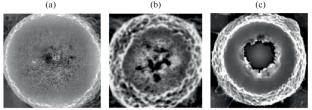
Thermogravimetry, differential scanning calorimetry, and scanning electron microscopy were used to study the change in the structure of particles of metal-oxide composites obtained by compacting iron powder and subsequent annealing with an increase in temperature from 20 to 800°C in air and in an argon atmosphere. It is shown that, after high-temperature annealing, vacancy pores and cavities are formed in the volume of metal-oxide particles of the composite, which are associated with the external diffusion of metal ions through the oxide layer and counterdiffusion and injection of vacancies into the metal with their subsequent condensation into pores in the internal volume of metal-oxide particles (the Kirkendall effect). The reason for the acceleration of diffusion of metal cations and vacancies is associated with the presence of a difference in internal stresses in the growing oxide layer on the surface of the metal particles of the composite. It has been shown that differences in the diffusion coefficients of cations and anions through the oxide layer (the Kirkendall effect) can be used to synthesize hollow iron-oxide particles and composite materials based on them, which can be used for encapsulation and as adsorbents, as well as to create new types of hybrid materials for catalytic or biological applications.
期刊介绍:
Protection of Metals and Physical Chemistry of Surfaces is an international peer reviewed journal that publishes articles covering all aspects of the physical chemistry of materials and interfaces in various environments. The journal covers all related problems of modern physical chemistry and materials science, including: physicochemical processes at interfaces; adsorption phenomena; complexing from molecular and supramolecular structures at the interfaces to new substances, materials and coatings; nanoscale and nanostructured materials and coatings, composed and dispersed materials; physicochemical problems of corrosion, degradation and protection; investigation methods for surface and interface systems, processes, structures, materials and coatings. No principe restrictions exist related systems, types of processes, methods of control and study. The journal welcomes conceptual, theoretical, experimental, methodological, instrumental, environmental, and all other possible studies.

 求助内容:
求助内容: 应助结果提醒方式:

 京公网安备 11010802042870号


