Restructuring of the Phase Boundary during the Implementation of High-Energy Chemical and Electrochemical Reactions and the Influence of Restructuring on Characteristics of Coatings
IF 0.8 4区 材料科学Q3 METALLURGY & METALLURGICAL ENGINEERING
{"title":"Restructuring of the Phase Boundary during the Implementation of High-Energy Chemical and Electrochemical Reactions and the Influence of Restructuring on Characteristics of Coatings","authors":"A. I. Mamaev, V. A. Mamaeva, Yu. N. Bespalova","doi":"10.1134/S2070205125701187","DOIUrl":null,"url":null,"abstract":"<p>It is shown that high-energy impact on the phase boundary by the method of pulsed microplasma oxidation with a trapezoidal pulse shape leads to localization of high-density energy in the near-electrode layer, bifurcation of the electrolyte flow, restructuring of the phase boundary, and fragmentation of the boundary hydrodynamic layer. The processes of phase-boundary restructuring and boundary-layer fragmentation, which affect the structure of porous oxide coatings, were determined and modeled. It has been shown that fragmentation leads to the appearance of ring structures, which are then reconstructed into more complex and larger structures, inside which small-diameter pores remain, with a porous oxide coating being formed. Differences have been identified elemental composition in the center and at the boundary of the boundary-layer fragment, caused by different rates of electrochemical reactions in different parts of the fragment.</p>","PeriodicalId":745,"journal":{"name":"Protection of Metals and Physical Chemistry of Surfaces","volume":"61 6","pages":"1421 - 1431"},"PeriodicalIF":0.8000,"publicationDate":"2026-02-06","publicationTypes":"Journal Article","fieldsOfStudy":null,"isOpenAccess":false,"openAccessPdf":"","citationCount":"0","resultStr":null,"platform":"Semanticscholar","paperid":null,"PeriodicalName":"Protection of Metals and Physical Chemistry of Surfaces","FirstCategoryId":"88","ListUrlMain":"https://link.springer.com/article/10.1134/S2070205125701187","RegionNum":4,"RegionCategory":"材料科学","ArticlePicture":[],"TitleCN":null,"AbstractTextCN":null,"PMCID":null,"EPubDate":"","PubModel":"","JCR":"Q3","JCRName":"METALLURGY & METALLURGICAL ENGINEERING","Score":null,"Total":0}
引用次数: 0
Abstract
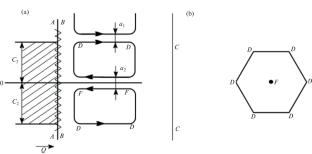
It is shown that high-energy impact on the phase boundary by the method of pulsed microplasma oxidation with a trapezoidal pulse shape leads to localization of high-density energy in the near-electrode layer, bifurcation of the electrolyte flow, restructuring of the phase boundary, and fragmentation of the boundary hydrodynamic layer. The processes of phase-boundary restructuring and boundary-layer fragmentation, which affect the structure of porous oxide coatings, were determined and modeled. It has been shown that fragmentation leads to the appearance of ring structures, which are then reconstructed into more complex and larger structures, inside which small-diameter pores remain, with a porous oxide coating being formed. Differences have been identified elemental composition in the center and at the boundary of the boundary-layer fragment, caused by different rates of electrochemical reactions in different parts of the fragment.
期刊介绍:
Protection of Metals and Physical Chemistry of Surfaces is an international peer reviewed journal that publishes articles covering all aspects of the physical chemistry of materials and interfaces in various environments. The journal covers all related problems of modern physical chemistry and materials science, including: physicochemical processes at interfaces; adsorption phenomena; complexing from molecular and supramolecular structures at the interfaces to new substances, materials and coatings; nanoscale and nanostructured materials and coatings, composed and dispersed materials; physicochemical problems of corrosion, degradation and protection; investigation methods for surface and interface systems, processes, structures, materials and coatings. No principe restrictions exist related systems, types of processes, methods of control and study. The journal welcomes conceptual, theoretical, experimental, methodological, instrumental, environmental, and all other possible studies.

 求助内容:
求助内容: 应助结果提醒方式:

 京公网安备 11010802042870号


