{"title":"Enhanced Antibacterial Activity of Co2O3 Nanoparticles Functionalized with Curcuma: A Synergistic Approach","authors":"Lakehal Sihem","doi":"10.1134/S2070205125701126","DOIUrl":null,"url":null,"abstract":"<p>The increasing threat of antibiotic resistance and the demand for eco-friendly nanomaterials have driven significant interest in metal oxide nanoparticles, particularly cobalt oxide (Co<sub>2</sub>O<sub>3</sub>), due to their unique structural, magnetic, and biological properties. In this study, Co<sub>2</sub>O<sub>3</sub> nanoparticles were synthesized via chemical precipitation and functionalized with curcumin, a bioactive polyphenol with known antimicrobial and therapeutic potential. The nanomaterials were characterized using X-ray diffraction (XRD), UV–Visible spectroscopy (UV–Vis), Fourier-transform infrared spectroscopy (FTIR), and scanning electron microscopy (SEM), confirming the successful formation of spinel-phase Co<sub>2</sub>O<sub>3</sub> and its surface modification by curcuma. Antibacterial activity was assessed against both Gram-positive (<i>Staphylococcus aureus</i>) and Gram-negative (<i>Escherichia coli</i>) bacteria using the disk diffusion method. Co<sub>2</sub>O<sub>3</sub> nanoparticles exhibited moderate antimicrobial activity, which was notably enhanced upon functionalization with curcuma. Furthermore, combining nanoparticles with conventional antibiotics led to significantly increased inhibition zones, indicating a synergistic antibacterial effect. These findings highlight the potential of curcuma-functionalized Co<sub>2</sub>O<sub>3</sub> nanoparticles as multifunctional agents in nanomedicine, environmental remediation, and pharmaceutical applications, offering a promising strategy for combating antibiotic-resistant pathogens while preserving beneficial microbiota.</p>","PeriodicalId":745,"journal":{"name":"Protection of Metals and Physical Chemistry of Surfaces","volume":"61 6","pages":"1289 - 1296"},"PeriodicalIF":1.1000,"publicationDate":"2026-02-06","publicationTypes":"Journal Article","fieldsOfStudy":null,"isOpenAccess":false,"openAccessPdf":"","citationCount":"0","resultStr":null,"platform":"Semanticscholar","paperid":null,"PeriodicalName":"Protection of Metals and Physical Chemistry of Surfaces","FirstCategoryId":"88","ListUrlMain":"https://link.springer.com/article/10.1134/S2070205125701126","RegionNum":4,"RegionCategory":"材料科学","ArticlePicture":[],"TitleCN":null,"AbstractTextCN":null,"PMCID":null,"EPubDate":"","PubModel":"","JCR":"Q3","JCRName":"METALLURGY & METALLURGICAL ENGINEERING","Score":null,"Total":0}
引用次数: 0
Abstract
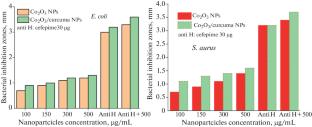
The increasing threat of antibiotic resistance and the demand for eco-friendly nanomaterials have driven significant interest in metal oxide nanoparticles, particularly cobalt oxide (Co2O3), due to their unique structural, magnetic, and biological properties. In this study, Co2O3 nanoparticles were synthesized via chemical precipitation and functionalized with curcumin, a bioactive polyphenol with known antimicrobial and therapeutic potential. The nanomaterials were characterized using X-ray diffraction (XRD), UV–Visible spectroscopy (UV–Vis), Fourier-transform infrared spectroscopy (FTIR), and scanning electron microscopy (SEM), confirming the successful formation of spinel-phase Co2O3 and its surface modification by curcuma. Antibacterial activity was assessed against both Gram-positive (Staphylococcus aureus) and Gram-negative (Escherichia coli) bacteria using the disk diffusion method. Co2O3 nanoparticles exhibited moderate antimicrobial activity, which was notably enhanced upon functionalization with curcuma. Furthermore, combining nanoparticles with conventional antibiotics led to significantly increased inhibition zones, indicating a synergistic antibacterial effect. These findings highlight the potential of curcuma-functionalized Co2O3 nanoparticles as multifunctional agents in nanomedicine, environmental remediation, and pharmaceutical applications, offering a promising strategy for combating antibiotic-resistant pathogens while preserving beneficial microbiota.
期刊介绍:
Protection of Metals and Physical Chemistry of Surfaces is an international peer reviewed journal that publishes articles covering all aspects of the physical chemistry of materials and interfaces in various environments. The journal covers all related problems of modern physical chemistry and materials science, including: physicochemical processes at interfaces; adsorption phenomena; complexing from molecular and supramolecular structures at the interfaces to new substances, materials and coatings; nanoscale and nanostructured materials and coatings, composed and dispersed materials; physicochemical problems of corrosion, degradation and protection; investigation methods for surface and interface systems, processes, structures, materials and coatings. No principe restrictions exist related systems, types of processes, methods of control and study. The journal welcomes conceptual, theoretical, experimental, methodological, instrumental, environmental, and all other possible studies.

 求助内容:
求助内容: 应助结果提醒方式:

 京公网安备 11010802042870号


