A. A. Anarbaev, A. M. Korzhenkov, A. N. Sandibaev, M. M. Saidov, L. A. Korzhenkova, A. A. Sentsov
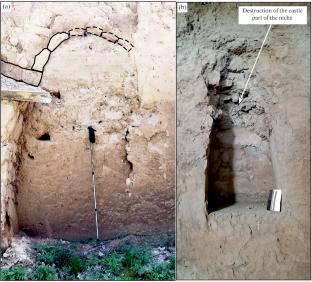
{"title":"Earthquake-Induced Deformations in the Zoroastrian Temple of Kurgantepa, Samarkand Region","authors":"A. A. Anarbaev, A. M. Korzhenkov, A. N. Sandibaev, M. M. Saidov, L. A. Korzhenkova, A. A. Sentsov","doi":"10.1134/S0742046325700630","DOIUrl":null,"url":null,"abstract":"<p>Kurgantepa is a multilayered ancient settlement lying in the Urgut Area of the Samarkand Region. It consists of ruins of the center of a rustak (rural district) in the Sogd during early medieval times. The settlement is identified to be the same as the center of rustak Sanjarfagn. It was shown that the population center which was formerly in the territory of the modern Kurgantepa hill is the classic threefold structure of a medieval city: the ark (the citadel), shakhristan (the inner city), and rabad (the suburbs). The archeological excavations which were carried out there in 2022–2024 revealed architectural remains interpreted as a Zoroastrian temple. Its monumental structure, the presence of columns, decorated walls, and the altar, as well as the ritual orientation of internal furnishings, all point to a sacral destination of the building. One of the more interesting features in the temple consists in traces of destruction whose morphology indicates a strong seismic excitation. The study of these deformations, including failures and displacements of fragments of structural elements and the collapses of arch systems, provide data from which to reconstruct the parameters of a possible mediaeval earthquake (local seismic intensity and the direction to the epicentral zone), as well as to expand our knowledge of the region’s earthquake history.</p>","PeriodicalId":56112,"journal":{"name":"Journal of Volcanology and Seismology","volume":"20 1","pages":"51 - 65"},"PeriodicalIF":0.9000,"publicationDate":"2026-03-02","publicationTypes":"Journal Article","fieldsOfStudy":null,"isOpenAccess":false,"openAccessPdf":"","citationCount":"0","resultStr":null,"platform":"Semanticscholar","paperid":null,"PeriodicalName":"Journal of Volcanology and Seismology","FirstCategoryId":"89","ListUrlMain":"https://link.springer.com/article/10.1134/S0742046325700630","RegionNum":4,"RegionCategory":"地球科学","ArticlePicture":[],"TitleCN":null,"AbstractTextCN":null,"PMCID":null,"EPubDate":"","PubModel":"","JCR":"Q4","JCRName":"GEOCHEMISTRY & GEOPHYSICS","Score":null,"Total":0}
引用次数: 0
Abstract
Kurgantepa is a multilayered ancient settlement lying in the Urgut Area of the Samarkand Region. It consists of ruins of the center of a rustak (rural district) in the Sogd during early medieval times. The settlement is identified to be the same as the center of rustak Sanjarfagn. It was shown that the population center which was formerly in the territory of the modern Kurgantepa hill is the classic threefold structure of a medieval city: the ark (the citadel), shakhristan (the inner city), and rabad (the suburbs). The archeological excavations which were carried out there in 2022–2024 revealed architectural remains interpreted as a Zoroastrian temple. Its monumental structure, the presence of columns, decorated walls, and the altar, as well as the ritual orientation of internal furnishings, all point to a sacral destination of the building. One of the more interesting features in the temple consists in traces of destruction whose morphology indicates a strong seismic excitation. The study of these deformations, including failures and displacements of fragments of structural elements and the collapses of arch systems, provide data from which to reconstruct the parameters of a possible mediaeval earthquake (local seismic intensity and the direction to the epicentral zone), as well as to expand our knowledge of the region’s earthquake history.
期刊介绍:
Journal of Volcanology and Seismology publishes theoretical and experimental studies, communications, and reports on volcanic, seismic, geodynamic, and magmatic processes occurring in the areas of island arcs and other active regions of the Earth. In particular, the journal looks at present-day land and submarine volcanic activity; Neogene–Quaternary volcanism; mechanisms of plutonic activity; the geochemistry of volcanic and postvolcanic processes; geothermal systems in volcanic regions; and seismological monitoring. In addition, the journal surveys earthquakes, volcanic eruptions, and techniques for predicting them.

 求助内容:
求助内容: 应助结果提醒方式:

 京公网安备 11010802042870号


