A. Paul, S. Sarkar, K. Raj, P. Kumar, P. R. L. Raj
{"title":"Droplet Impact Physics of Ammonium Dinitramide (ADN)-Based Monopropellants on Solid Substrates of Varying Roughness","authors":"A. Paul, S. Sarkar, K. Raj, P. Kumar, P. R. L. Raj","doi":"10.1134/S0015462825602013","DOIUrl":null,"url":null,"abstract":"<p>This study explores the impact dynamics and morphological evolution of ADN-based green liquid propellant droplets on flat, non-heated surfaces with systematically varied surface roughness <i>Ra</i> from 0.015 to 2.166 µm. Using high-speed imaging, the droplet interactions were captured across three Weber numbers (We = 46.29, 104.15, and 186.15), corresponding to the impact velocities of 1, 1.5, and 2 m/s for the 2 mm diameter droplets. The spreading behaviour was quantified through time-resolved measurements of the spreading ratio β, while morphological features, such as lamella expansion, rim formation, and contact line stability, were evaluated. Results reveal that surface roughness critically controls the maximum spreading, retraction rate, and energy dissipation. The maximum spreading ratio β<sub>max</sub> was found to scale with the Weber number, with rapid retraction observed. A curve fitting analysis was performed for this scaling relationship, aligning well with classical inertial-capillary dynamics. Moderately rough surfaces (<i>Ra</i> = 0.2915 µm) enhanced spreading due to optimal capillary attachment, but beyond the roughness <i>Ra</i> = 0.318 µm, micro texture-induced damping suppressed further spreading, reduced β–We sensitivity, and halted retraction. Compared to conventional fluids, ADN droplets exhibited higher maximum spreading on smooth substrates and sharper saturation on rough ones.</p>","PeriodicalId":560,"journal":{"name":"Fluid Dynamics","volume":"61 1","pages":""},"PeriodicalIF":0.6000,"publicationDate":"2026-03-01","publicationTypes":"Journal Article","fieldsOfStudy":null,"isOpenAccess":false,"openAccessPdf":"","citationCount":"0","resultStr":null,"platform":"Semanticscholar","paperid":null,"PeriodicalName":"Fluid Dynamics","FirstCategoryId":"5","ListUrlMain":"https://link.springer.com/article/10.1134/S0015462825602013","RegionNum":4,"RegionCategory":"工程技术","ArticlePicture":[],"TitleCN":null,"AbstractTextCN":null,"PMCID":null,"EPubDate":"","PubModel":"","JCR":"Q4","JCRName":"MECHANICS","Score":null,"Total":0}
引用次数: 0
Abstract
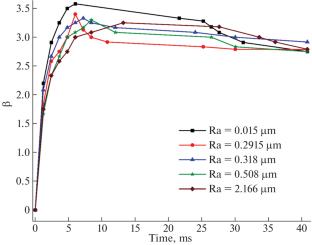
This study explores the impact dynamics and morphological evolution of ADN-based green liquid propellant droplets on flat, non-heated surfaces with systematically varied surface roughness Ra from 0.015 to 2.166 µm. Using high-speed imaging, the droplet interactions were captured across three Weber numbers (We = 46.29, 104.15, and 186.15), corresponding to the impact velocities of 1, 1.5, and 2 m/s for the 2 mm diameter droplets. The spreading behaviour was quantified through time-resolved measurements of the spreading ratio β, while morphological features, such as lamella expansion, rim formation, and contact line stability, were evaluated. Results reveal that surface roughness critically controls the maximum spreading, retraction rate, and energy dissipation. The maximum spreading ratio βmax was found to scale with the Weber number, with rapid retraction observed. A curve fitting analysis was performed for this scaling relationship, aligning well with classical inertial-capillary dynamics. Moderately rough surfaces (Ra = 0.2915 µm) enhanced spreading due to optimal capillary attachment, but beyond the roughness Ra = 0.318 µm, micro texture-induced damping suppressed further spreading, reduced β–We sensitivity, and halted retraction. Compared to conventional fluids, ADN droplets exhibited higher maximum spreading on smooth substrates and sharper saturation on rough ones.
期刊介绍:
Fluid Dynamics is an international peer reviewed journal that publishes theoretical, computational, and experimental research on aeromechanics, hydrodynamics, plasma dynamics, underground hydrodynamics, and biomechanics of continuous media. Special attention is given to new trends developing at the leading edge of science, such as theory and application of multi-phase flows, chemically reactive flows, liquid and gas flows in electromagnetic fields, new hydrodynamical methods of increasing oil output, new approaches to the description of turbulent flows, etc.

 求助内容:
求助内容: 应助结果提醒方式:

 京公网安备 11010802042870号


