Wing-Keung Wong, Riffat Mughal, Mustafa Afeef, Naveed Khan, Hassan Zada
{"title":"Human Capital Based Six-Factor Asset Pricing Model in the Era of Covid-19","authors":"Wing-Keung Wong, Riffat Mughal, Mustafa Afeef, Naveed Khan, Hassan Zada","doi":"10.1007/s10690-025-09579-7","DOIUrl":null,"url":null,"abstract":"<div>\n \n <p>In recent years, the COVID-19 pandemic has heightened trade tensions and geopolitical risks, affecting stock market volatility and the factors that determine the pricing of financial securities. This study examines the role of human capital in the Fama-French (2015) five-factor model to explain excess portfolio returns. For this purpose, we collected daily stock prices data for 73 non-financial firms listed on the Pakistan Stock Exchange from July 2018 to June 2023. For estimation, we employed two models: first, the Fama-French time-series regression, second, the Fama–Macbeth (1973) rolling-window two-pass regression. We find that the six-factor model significantly explains time-series variations in excess portfolio returns. Notably, the human capital premium is significantly and negatively related to excess portfolio returns. However, a significant and positive coefficient for the COVID-19 dummy and a significant and negative coefficient for the interaction between human capital and COVID-19 across several portfolios indicate that, on average, during COVID-19, excess portfolio returns have improved. In contrast, increased expenditures on human capital are negatively related to excess portfolio returns. The results have meaningful implications for investors, portfolio managers, and policymakers. It is suggested that the human capital factor be incorporated into asset pricing. Further, it emphasizes developing strategies to maintain investor confidence during crises like the COVID-19 pandemic.</p>\n </div>","PeriodicalId":54095,"journal":{"name":"Asia-Pacific Financial Markets","volume":"33 1","pages":"25 - 63"},"PeriodicalIF":2.6000,"publicationDate":"2025-12-02","publicationTypes":"Journal Article","fieldsOfStudy":null,"isOpenAccess":false,"openAccessPdf":"","citationCount":"0","resultStr":null,"platform":"Semanticscholar","paperid":null,"PeriodicalName":"Asia-Pacific Financial Markets","FirstCategoryId":"1085","ListUrlMain":"https://link.springer.com/article/10.1007/s10690-025-09579-7","RegionNum":0,"RegionCategory":null,"ArticlePicture":[],"TitleCN":null,"AbstractTextCN":null,"PMCID":null,"EPubDate":"","PubModel":"","JCR":"Q2","JCRName":"ECONOMICS","Score":null,"Total":0}
引用次数: 0
Abstract
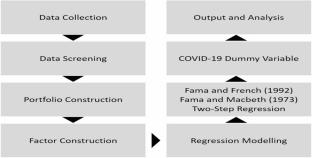
In recent years, the COVID-19 pandemic has heightened trade tensions and geopolitical risks, affecting stock market volatility and the factors that determine the pricing of financial securities. This study examines the role of human capital in the Fama-French (2015) five-factor model to explain excess portfolio returns. For this purpose, we collected daily stock prices data for 73 non-financial firms listed on the Pakistan Stock Exchange from July 2018 to June 2023. For estimation, we employed two models: first, the Fama-French time-series regression, second, the Fama–Macbeth (1973) rolling-window two-pass regression. We find that the six-factor model significantly explains time-series variations in excess portfolio returns. Notably, the human capital premium is significantly and negatively related to excess portfolio returns. However, a significant and positive coefficient for the COVID-19 dummy and a significant and negative coefficient for the interaction between human capital and COVID-19 across several portfolios indicate that, on average, during COVID-19, excess portfolio returns have improved. In contrast, increased expenditures on human capital are negatively related to excess portfolio returns. The results have meaningful implications for investors, portfolio managers, and policymakers. It is suggested that the human capital factor be incorporated into asset pricing. Further, it emphasizes developing strategies to maintain investor confidence during crises like the COVID-19 pandemic.
期刊介绍:
The current remarkable growth in the Asia-Pacific financial markets is certain to continue. These markets are expected to play a further important role in the world capital markets for investment and risk management. In accordance with this development, Asia-Pacific Financial Markets (formerly Financial Engineering and the Japanese Markets), the official journal of the Japanese Association of Financial Econometrics and Engineering (JAFEE), is expected to provide an international forum for researchers and practitioners in academia, industry, and government, who engage in empirical and/or theoretical research into the financial markets. We invite submission of quality papers on all aspects of finance and financial engineering.
Here we interpret the term ''financial engineering'' broadly enough to cover such topics as financial time series, portfolio analysis, global asset allocation, trading strategy for investment, optimization methods, macro monetary economic analysis and pricing models for various financial assets including derivatives We stress that purely theoretical papers, as well as empirical studies that use Asia-Pacific market data, are welcome.
Officially cited as: Asia-Pac Financ Markets

 求助内容:
求助内容: 应助结果提醒方式:

 京公网安备 11010802042870号


