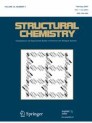
{"title":"Structural arrangement and computational exploration of guanidinium-based hydrogen-bonded organic frameworks","authors":"Lina Jia, Qiang Ma, Yitong Deng, Shixian Wang, Guoying Zhao, Changyu Sun","doi":"10.1007/s11224-025-02614-3","DOIUrl":null,"url":null,"abstract":"<div><p>The directional modulation of hydrogen-bonding networks serves as a pivotal strategy for optimizing the thermal stability of crystalline materials. In this study, four guanidinium-based hydrogen-bonded organic frameworks (HOFs)—guanidinium hydroquinone ([GUA][HYD]), guanidinium phloroglucinol ([GUA][PHL]), guanidinium terephthalic acid ([GUA][TER]), and guanidinium trimesic acid ([GUA][TRI])—were designed and synthesized by tailoring the acidic strength and substituent topology of anionic ligands, systematically investigating the hydrogen-bonding network’s impact on their crystal structures and properties. Single-crystal X-ray diffraction combined with Hirshfeld surface analysis revealed that N-H···O hydrogen bonds dominate the assembly of all HOFs, yielding two distinct topologies: a periodically layered framework ([GUA][HYD]) and a highly symmetric octameric cage-like architecture ([GUA][TRI]). In contrast, [GUA][PHL] and [GUA][TER] formed guest-incorporated configurations due to disordered hydrogen-bond directionality. Thermogravimetric analysis and density functional theory (DFT, B3LYP/6-311++G(d,p)) demonstrated that hydrogen-bond strength, density, and network symmetry critically govern thermal stability. Carboxylate-substituted systems ([GUA][TER]/[GUA][TRI]) exhibited better stability over phenolic hydroxyl analogs ([GUA][HYD]/[GUA][PHL]), attributed to enhanced hydrogen-bond interactions and three-dimensional ionic synergy. Furthermore, high-symmetry frameworks ([GUA][HYD] and [GUA][TRI]) outperformed their counterparts ([GUA][PHL] and [GUA][TER], respectively) in stability due to their highly ordered packing modes. This work reveals the inherent correlation between hydrogen-bond coordination, topological configuration, and thermodynamic behavior, probably providing theoretical support for the rational design of HOFs and advancing their applications in energy storage, catalysis, and controlled drug delivery.</p><h3>Graphical Abstract</h3>\n<div><figure><div><div><picture><source><img></source></picture></div></div></figure></div></div>","PeriodicalId":780,"journal":{"name":"Structural Chemistry","volume":"37 2","pages":"963 - 978"},"PeriodicalIF":2.2000,"publicationDate":"2025-09-19","publicationTypes":"Journal Article","fieldsOfStudy":null,"isOpenAccess":false,"openAccessPdf":"","citationCount":"0","resultStr":null,"platform":"Semanticscholar","paperid":null,"PeriodicalName":"Structural Chemistry","FirstCategoryId":"92","ListUrlMain":"https://link.springer.com/article/10.1007/s11224-025-02614-3","RegionNum":4,"RegionCategory":"化学","ArticlePicture":[],"TitleCN":null,"AbstractTextCN":null,"PMCID":null,"EPubDate":"","PubModel":"","JCR":"Q3","JCRName":"CHEMISTRY, MULTIDISCIPLINARY","Score":null,"Total":0}
引用次数: 0
Abstract
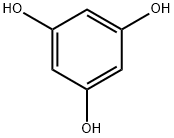
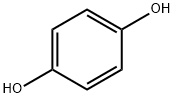
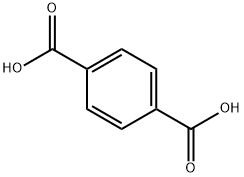
The directional modulation of hydrogen-bonding networks serves as a pivotal strategy for optimizing the thermal stability of crystalline materials. In this study, four guanidinium-based hydrogen-bonded organic frameworks (HOFs)—guanidinium hydroquinone ([GUA][HYD]), guanidinium phloroglucinol ([GUA][PHL]), guanidinium terephthalic acid ([GUA][TER]), and guanidinium trimesic acid ([GUA][TRI])—were designed and synthesized by tailoring the acidic strength and substituent topology of anionic ligands, systematically investigating the hydrogen-bonding network’s impact on their crystal structures and properties. Single-crystal X-ray diffraction combined with Hirshfeld surface analysis revealed that N-H···O hydrogen bonds dominate the assembly of all HOFs, yielding two distinct topologies: a periodically layered framework ([GUA][HYD]) and a highly symmetric octameric cage-like architecture ([GUA][TRI]). In contrast, [GUA][PHL] and [GUA][TER] formed guest-incorporated configurations due to disordered hydrogen-bond directionality. Thermogravimetric analysis and density functional theory (DFT, B3LYP/6-311++G(d,p)) demonstrated that hydrogen-bond strength, density, and network symmetry critically govern thermal stability. Carboxylate-substituted systems ([GUA][TER]/[GUA][TRI]) exhibited better stability over phenolic hydroxyl analogs ([GUA][HYD]/[GUA][PHL]), attributed to enhanced hydrogen-bond interactions and three-dimensional ionic synergy. Furthermore, high-symmetry frameworks ([GUA][HYD] and [GUA][TRI]) outperformed their counterparts ([GUA][PHL] and [GUA][TER], respectively) in stability due to their highly ordered packing modes. This work reveals the inherent correlation between hydrogen-bond coordination, topological configuration, and thermodynamic behavior, probably providing theoretical support for the rational design of HOFs and advancing their applications in energy storage, catalysis, and controlled drug delivery.
期刊介绍:
Structural Chemistry is an international forum for the publication of peer-reviewed original research papers that cover the condensed and gaseous states of matter and involve numerous techniques for the determination of structure and energetics, their results, and the conclusions derived from these studies. The journal overcomes the unnatural separation in the current literature among the areas of structure determination, energetics, and applications, as well as builds a bridge to other chemical disciplines. Ist comprehensive coverage encompasses broad discussion of results, observation of relationships among various properties, and the description and application of structure and energy information in all domains of chemistry.
We welcome the broadest range of accounts of research in structural chemistry involving the discussion of methodologies and structures,experimental, theoretical, and computational, and their combinations. We encourage discussions of structural information collected for their chemicaland biological significance.

 求助内容:
求助内容: 应助结果提醒方式:

 京公网安备 11010802042870号


