Preparation and Characterization of Quaternized Polystyrene-Divinylbenzene Stationary Phases in Deep Eutectic Solvents for Anion-Exchange Chromatography
Zhongping Huang, Jianfeng Zou, Junhao Zhang, Haodong Wang, Huijun Liu
{"title":"Preparation and Characterization of Quaternized Polystyrene-Divinylbenzene Stationary Phases in Deep Eutectic Solvents for Anion-Exchange Chromatography","authors":"Zhongping Huang, Jianfeng Zou, Junhao Zhang, Haodong Wang, Huijun Liu","doi":"10.1007/s10337-025-04471-y","DOIUrl":null,"url":null,"abstract":"<div><p>In this study, quaternized cationic polyelectrolytes were successfully decorated on polystyrene-divinylbenzene (PS-DVB) microspheres in deep eutectic solvents (DESs). Quaternized cationic polyelectrolytes and hyperbranched layers were prepared using 1,4-butanediol diglycidyl ether (BDDE) and methylamine (MA) as monomers. The effects of different reaction solvents, the amount of agglomerated polyelectrolytes, and the number of hyperbranched layers on the chromatographic performance of the stationary phase were investigated. The surface morphological feature and chemical composition of the PS-DVB microspheres were characterized by SEM, FT-IR, and elemental analysis. The results showed that the optimized anion exchanger had a good chromatographic performance by choosing a mixture of 2.0 mmol/L sodium carbonate and 2.0 mmol/L sodium bicarbonate as the mobile phase at a flow rate of 1.0 mL/min. Seven common anions (fluoride ion, chloride ion, nitrite ion, bromide ion, nitrate ion, phosphate ion, and sulfate ion) were well separated within 25 min. The average numbers of theoretical plates per meter for three batches of columns prepared in DESs increased by 5% ~ 20%, as compared with those of the columns prepared in deionized water. Additionally, the asymmetry factors of detected anions were also improved for the columns prepared in DESs.</p></div>","PeriodicalId":518,"journal":{"name":"Chromatographia","volume":"89 3","pages":"239 - 245"},"PeriodicalIF":1.6000,"publicationDate":"2025-12-20","publicationTypes":"Journal Article","fieldsOfStudy":null,"isOpenAccess":false,"openAccessPdf":"","citationCount":"0","resultStr":null,"platform":"Semanticscholar","paperid":null,"PeriodicalName":"Chromatographia","FirstCategoryId":"92","ListUrlMain":"https://link.springer.com/article/10.1007/s10337-025-04471-y","RegionNum":4,"RegionCategory":"化学","ArticlePicture":[],"TitleCN":null,"AbstractTextCN":null,"PMCID":null,"EPubDate":"","PubModel":"","JCR":"Q4","JCRName":"BIOCHEMICAL RESEARCH METHODS","Score":null,"Total":0}
引用次数: 0
Abstract
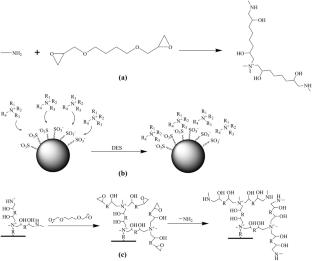
In this study, quaternized cationic polyelectrolytes were successfully decorated on polystyrene-divinylbenzene (PS-DVB) microspheres in deep eutectic solvents (DESs). Quaternized cationic polyelectrolytes and hyperbranched layers were prepared using 1,4-butanediol diglycidyl ether (BDDE) and methylamine (MA) as monomers. The effects of different reaction solvents, the amount of agglomerated polyelectrolytes, and the number of hyperbranched layers on the chromatographic performance of the stationary phase were investigated. The surface morphological feature and chemical composition of the PS-DVB microspheres were characterized by SEM, FT-IR, and elemental analysis. The results showed that the optimized anion exchanger had a good chromatographic performance by choosing a mixture of 2.0 mmol/L sodium carbonate and 2.0 mmol/L sodium bicarbonate as the mobile phase at a flow rate of 1.0 mL/min. Seven common anions (fluoride ion, chloride ion, nitrite ion, bromide ion, nitrate ion, phosphate ion, and sulfate ion) were well separated within 25 min. The average numbers of theoretical plates per meter for three batches of columns prepared in DESs increased by 5% ~ 20%, as compared with those of the columns prepared in deionized water. Additionally, the asymmetry factors of detected anions were also improved for the columns prepared in DESs.
期刊介绍:
Separation sciences, in all their various forms such as chromatography, field-flow fractionation, and electrophoresis, provide some of the most powerful techniques in analytical chemistry and are applied within a number of important application areas, including archaeology, biotechnology, clinical, environmental, food, medical, petroleum, pharmaceutical, polymer and biopolymer research. Beyond serving analytical purposes, separation techniques are also used for preparative and process-scale applications. The scope and power of separation sciences is significantly extended by combination with spectroscopic detection methods (e.g., laser-based approaches, nuclear-magnetic resonance, Raman, chemiluminescence) and particularly, mass spectrometry, to create hyphenated techniques. In addition to exciting new developments in chromatography, such as ultra high-pressure systems, multidimensional separations, and high-temperature approaches, there have also been great advances in hybrid methods combining chromatography and electro-based separations, especially on the micro- and nanoscale. Integrated biological procedures (e.g., enzymatic, immunological, receptor-based assays) can also be part of the overall analytical process.

 求助内容:
求助内容: 应助结果提醒方式:

 京公网安备 11010802042870号


