
Temperature dependence of two or more water species in delignified wood and lignocellulosic, tracked by LFNMR relaxometry

IF 1.7
Magnetic Resonance Letters Pub Date : 2026-02-01 Epub Date: 2025-06-07 DOI:10.1016/j.mrl.2025.200221
Long Zhou , Wenjing Liu , Zhihong Zhao , Rui Tan , Xiaofeng Zhu , Shen Wang , Zonghai Harry Xie , Minghui Zhang
{"title":"Temperature dependence of two or more water species in delignified wood and lignocellulosic, tracked by LFNMR relaxometry","authors":"Long Zhou ,&nbsp;Wenjing Liu ,&nbsp;Zhihong Zhao ,&nbsp;Rui Tan ,&nbsp;Xiaofeng Zhu ,&nbsp;Shen Wang ,&nbsp;Zonghai Harry Xie ,&nbsp;Minghui Zhang","doi":"10.1016/j.mrl.2025.200221","DOIUrl":null,"url":null,"abstract":"<div><div>Distributions of nuclear magnetic resonance (NMR) relaxation times provide detailed information about the water in wood. This study documents the water dynamics analysis of <em>T</em><sub>2</sub> and <em>T</em><sub>1</sub> distributions for saturated delignified sapwood (DSW), delignified heartwood (DHW) and lignocellulose (LC) samples at different temperatures. Results indicate that below the freezing point of bulk water, free water freezes, causing its signal to disappear from the distribution. Then, the low temperature distributions of the unfrozen bound water contain more information about its components, with DSW, DHW and LC containing two distinct states of bound water (OH bound water (B-water) and more freely bound water (C-water)). Furthermore, it was observed that within the temperature range of −3°C to −60°C, B-water in DSW, DHW and LC maintained a higher unfrozen water content (UWC) value than C-water, and the <em>T</em><sub>1</sub>/<em>T</em><sub>2</sub> ratios for B-water were consistently higher than that for C-water, indicating that B-water has a greater antifreeze capacity. <em>T</em><sub>2</sub> and <em>T</em><sub>1</sub> distributions offer different kinds of information about water components, and all peaks within the distribution have been assigned.</div></div>","PeriodicalId":93594,"journal":{"name":"Magnetic Resonance Letters","volume":"6 1","pages":"Article 200221"},"PeriodicalIF":1.7000,"publicationDate":"2026-02-01","publicationTypes":"Journal Article","fieldsOfStudy":null,"isOpenAccess":false,"openAccessPdf":"","citationCount":"0","resultStr":null,"platform":"Semanticscholar","paperid":null,"PeriodicalName":"Magnetic Resonance Letters","FirstCategoryId":"1085","ListUrlMain":"https://www.sciencedirect.com/science/article/pii/S2772516225000464","RegionNum":0,"RegionCategory":null,"ArticlePicture":[],"TitleCN":null,"AbstractTextCN":null,"PMCID":null,"EPubDate":"2025/6/7 0:00:00","PubModel":"Epub","JCR":"","JCRName":"","Score":null,"Total":0}
引用次数: 0

Abstract

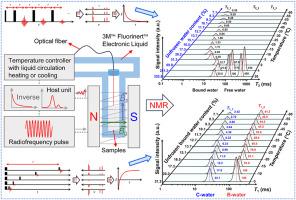
Distributions of nuclear magnetic resonance (NMR) relaxation times provide detailed information about the water in wood. This study documents the water dynamics analysis of T2 and T1 distributions for saturated delignified sapwood (DSW), delignified heartwood (DHW) and lignocellulose (LC) samples at different temperatures. Results indicate that below the freezing point of bulk water, free water freezes, causing its signal to disappear from the distribution. Then, the low temperature distributions of the unfrozen bound water contain more information about its components, with DSW, DHW and LC containing two distinct states of bound water (OH bound water (B-water) and more freely bound water (C-water)). Furthermore, it was observed that within the temperature range of −3°C to −60°C, B-water in DSW, DHW and LC maintained a higher unfrozen water content (UWC) value than C-water, and the T1/T2 ratios for B-water were consistently higher than that for C-water, indicating that B-water has a greater antifreeze capacity. T2 and T1 distributions offer different kinds of information about water components, and all peaks within the distribution have been assigned.
Abstract Image

脱木质素木材和木质纤维素中两种或两种以上水种的温度依赖性,用LFNMR弛豫仪跟踪
核磁共振弛豫时间的分布提供了木材中水分的详细信息。本文对饱和脱木质素边材(DSW)、脱木质素心材(DHW)和木质纤维素(LC)样品在不同温度下的t1和t1分布进行了水动力学分析。结果表明,在散装水的冰点以下,自由水发生冻结,使其信号从分布中消失。未冻结合水的低温分布包含了更多的组分信息,DSW、DHW和LC含有两种不同状态的结合水(OH -结合水(B-water)和更自由的结合水(C-water))。此外,在−3℃~−60℃的温度范围内,DSW、DHW和LC中的b -水保持着高于C-水的未冻水含量(UWC)值,且b -水的t1 / t2比始终高于C-水,说明b -水具有更强的防冻能力。t2和t1分布提供了不同种类的水组分信息,并且分布内的所有峰都已被分配。
本文章由计算机程序翻译,如有差异,请以英文原文为准。
求助全文
约1分钟内获得全文 求助全文
来源期刊
Magnetic Resonance Letters
Magnetic Resonance Letters Analytical Chemistry, Spectroscopy, Radiology and Imaging, Biochemistry, Genetics and Molecular Biology (General)
自引率
0.00%
发文量
0

×
引用
GB/T 7714-2015
复制
MLA
复制
APA
复制
导出至
BibTeX EndNote RefMan NoteFirst NoteExpress
×
提示
您的信息不完整,为了账户安全,请先补充。
现在去补充
×
提示
您因"违规操作"
具体请查看互助需知
我知道了
×
提示
确定
请完成安全验证×
copy
已复制链接
快去分享给好友吧!
我知道了
右上角分享
点击右上角分享
0
联系我们:info@booksci.cn Book学术提供免费学术资源搜索服务,方便国内外学者检索中英文文献。致力于提供最便捷和优质的服务体验。 Copyright © 2023 布克学术 All rights reserved.
京ICP备2023020795号-1
ghs 京公网安备 11010802042870号
Book学术文献互助
Book学术文献互助群
群 号:604180095
Book学术官方微信
小红书


