
Cu(i)-catalyzed 1,2-carbofluorination of unactivated alkenes enabled by N-fluorobenzamides via free radical relay
Organic chemistry frontiers : an international journal of organic chemistry
Pub Date : 2026-04-21
Epub Date: 2026-03-02
DOI:10.1039/d5qo01763g
引用次数: 0
Abstract
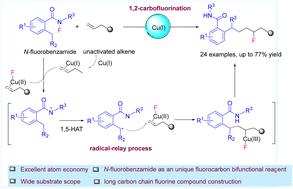
The construction of carbon–fluorine bonds has long been a challenging task. This work presents a two-component 1,2-carbofluorination bifunctionalization of unactivated alkenes via a radical-relay process. N-Fluorobenzamide was employed as a unique carbofluoro-bifunctional reagent that adds across unactivated alkenes, enabling simultaneous formation of C–C and C–F bonds. The reaction proceeds through homolytic cleavage of the N–F bond to generate a nitrogen-centered radical, followed by a 1,5-H atom transfer to produce a remote benzylic carbon radical. This carbon radical adds to the alkene, forming a new alkyl radical, which then undergoes single-electron transfer mediated by an active copper species, ultimately affording a series of β-fluoroamides in moderate yields. Notable features of this transformation include excellent atom economy (with no atom loss), mild reaction conditions and operational simplicity.
Cu(I)催化的n -氟苯酰胺通过自由基接力使未活化烯烃1,2-碳氟化
碳氟键的构造一直是一个挑战。本文描述了一种通过自由基接力反应的非活化烯烃的双组分1,2碳氟化双官能化反应。n -氟苯甲酰胺首次被用作一种独特的碳氟双功能分子来攻击未活化的烯烃,并伴随形成C-C键和C-F键。该反应首先经过N-F键均解生成氮自由基,随后发生1,5- h原子转移生成远端苯基碳自由基,并进一步攻击烯烃生成新的烷基自由基,接着进行活性金属铜类的单电子转移,最后以中等收率得到一系列β-氟酰胺。该反应具有原子经济性好、无原子损失、反应条件温和、操作简便等特点。
本文章由计算机程序翻译,如有差异,请以英文原文为准。
求助全文
约1分钟内获得全文
求助全文
来源期刊

CiteScore
7.80
自引率
0.00%
发文量
0
 求助内容:
求助内容: 应助结果提醒方式:

 京公网安备 11010802042870号


