
Endothelin-1/endothelin B receptor signalling mediates Prx1+ skeletal stem cells senescence: A driver of osteoporotic bone loss
IF 5.9
1区 医学
Q1 ORTHOPEDICS
Journal of Orthopaedic Translation
Pub Date : 2026-03-01
Epub Date: 2026-02-18
DOI:10.1016/j.jot.2026.101048
引用次数: 0
Abstract
Background
Stem cells residing in the perivascular niche are critical for skeletal homeostasis. Vascular endothelin-1 (ET-1) controls stem cell fate in development, but its role in the exhaustion of skeletal stem cells (SSCs) and subsequent bone degeneration in osteoporosis remains poorly understood. This study aimed to determine whether ET-1 signalling drives SSCs senescence and to elucidate the underlying mechanisms.
Methods
We utilised a combination of human single-cell RNA sequencing datasets, murine models of ageing and ovariectomy (OVX), and an endothelial-specific ET-1 overexpression transgenic (TET-1) mouse model. In vitro studies on mesenchymal stem cells (MSCs) employed ET-1 challenge with and without receptor-specific antagonists (BQ123 for ETAR, BQ788 for ETBR). The mechanism was further probed using transcriptomic profiling and validated in vivo through Prx1+ SSCs-specific ETBR knockout (Prx1-Cre;ETBRfl/fl) and pharmacological inhibition with the ETBR antagonist BQ788.
Results
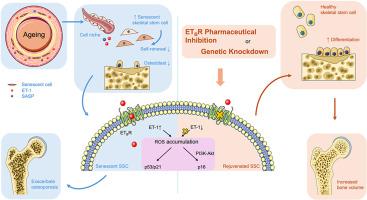
In aged and OVX mice, ETBR expression was significantly upregulated in SSCs concurrent with bone loss. Transgenic ET-1 overexpression recapitulated an aged bone phenotype, inducing SSCs senescence and accelerating bone loss. In vitro, ET-1 triggered MSCs senescence and reactive oxygen species (ROS) accumulation. Such effects were specifically abrogated by ETBR, but not ETAR. Transcriptomic analysis revealed that ET-1/ETBR signalling synergistically dysregulates the PI3K-AKT and p53 pathways to orchestrate senescence. Critically, both genetic knockout of ETBR in Prx1+ SSCs and pharmacological inhibition with BQ788 mitigated oxidative stress, reduced cellular senescence, and preserved bone mass in OVX and aged mice.
Conclusion
This study identified the ET-1/ETBR signalling axis as a critical driver of osteoporosis by promoting ROS-mediated SSCs senescence. We established a link between vascular ageing and skeletal decline.
The translational potential of this article
This study positioned ETBR blockade as a promising novel therapeutic strategy for osteoporosis. By targeting the upstream driver of SSCs exhaustion, ETBR inhibition offers a potential paradigm shift from palliative care to proactive rejuvenation of the osteogenic niche. This approach could counteract both postmenopausal and age-related bone loss by restoring the bone-forming potential of the skeleton, addressing a significant unmet clinical need.
内皮素-1/内皮素B受体信号介导Prx1+骨干细胞衰老:骨质疏松性骨质流失的驱动因素。
背景:居住在血管周围生态位的干细胞对骨骼稳态至关重要。血管内皮素-1 (ET-1)在发育过程中控制着干细胞的命运,但其在骨质疏松症中骨骼干细胞(SSCs)耗竭和随后的骨变性中的作用仍然知之甚少。本研究旨在确定ET-1信号是否驱动ssc衰老并阐明其潜在机制。方法:我们利用人类单细胞RNA测序数据集、小鼠衰老和卵巢切除术模型(OVX)以及内皮特异性ET-1过表达转基因(ET-1)小鼠模型的组合。在间充质干细胞(MSCs)的体外研究中,使用ET-1攻击,有或没有受体特异性拮抗剂(BQ123用于ETAR, BQ788用于ETBR)。利用转录组学分析进一步探讨了其机制,并通过Prx1+ sscs特异性ETBR敲除(Prx1- cre;ETBR fl/fl)和ETBR拮抗剂BQ788的药理抑制在体内进行了验证。结果:在老年和OVX小鼠中,ETBR在ssc中表达显著上调,同时伴有骨质流失。转基因ET-1过表达重现骨老化表型,诱导ssc衰老,加速骨质流失。体外,ET-1触发MSCs衰老和活性氧(ROS)积累。ETBR特别废除了这些影响,但ETAR没有。转录组学分析显示,ET-1/ETBR信号通路协同失调PI3K-AKT和p53通路,协调衰老。关键的是,Prx1+ SSCs中ETBR的基因敲除和BQ788的药理抑制都可以减轻OVX和衰老小鼠的氧化应激,减少细胞衰老,并保存骨量。结论:本研究发现ET-1/ETBR信号轴通过促进ros介导的ssc衰老而成为骨质疏松症的关键驱动因素。我们建立了血管老化和骨骼衰退之间的联系。本文的转化潜力:该研究将ETBR阻断定位为一种有前景的骨质疏松症治疗新策略。通过靶向ssc耗竭的上游驱动因素,ETBR抑制提供了从姑息治疗到成骨生态位主动恢复的潜在范式转变。这种方法可以通过恢复骨骼的骨形成潜力来抵消绝经后和年龄相关的骨质流失,解决了一个重要的未满足的临床需求。
本文章由计算机程序翻译,如有差异,请以英文原文为准。
求助全文
约1分钟内获得全文
求助全文
来源期刊
Journal of Orthopaedic Translation
Medicine-Orthopedics and Sports Medicine
CiteScore
11.80
自引率
13.60%
发文量
91
审稿时长
29 days
期刊介绍:
The Journal of Orthopaedic Translation (JOT) is the official peer-reviewed, open access journal of the Chinese Speaking Orthopaedic Society (CSOS) and the International Chinese Musculoskeletal Research Society (ICMRS). It is published quarterly, in January, April, July and October, by Elsevier.
 求助内容:
求助内容: 应助结果提醒方式:

 京公网安备 11010802042870号


