
Formation and spontaneous oxidation of neutral [4Fe–4S] clusters in prebiotic oceans
IF 3.2
2区 化学
Q2 BIOCHEMISTRY & MOLECULAR BIOLOGY
Journal of Inorganic Biochemistry
Pub Date : 2026-06-01
Epub Date: 2026-02-05
DOI:10.1016/j.jinorgbio.2026.113259
引用次数: 0
Abstract
Iron‑sulfur clusters are enzyme cofactors essential to life and are proposed to form the basis of earliest metabolisms. Fe–S rhomb and cubane clusters require both Fe(II) and Fe(III) for stability, but the Archean ocean was dominated by reduced Fe(II). We hypothesize that protons could have served as an oxidant of Fe(II) to Fe(III) during cluster assembly. Concomitantly, coordinating ligands that complete the tetrahedral geometry of the iron sites in the molecular cubane clusters may have assured cluster stability and facilitated proton reduction. Density functional theory calculations suggest that protons delivered by H3O+, Fe(SH)+, or H2S can oxidize [2Fe–2S] clusters and promote the formation of cationic [4Fe–4S] clusters. The relative energetics of mackinawite-like (FeS)n(aq) neutral nanoparticle sheets and ligated cationic [4Fe–4S] cubanes further indicate that ligands, such as water, bisulfide, and bioligands (such as short peptides) indeed play a key role in trapping cubane cluster states along the process of mackinawite-like nanoparticle sheet formation. Together, the redox reaction by protons and ligand coordination could have enabled molecular Fe–S cluster cofactor assembly directly from the Fe(II)-rich, sulfide-bearing waters of early Earth.
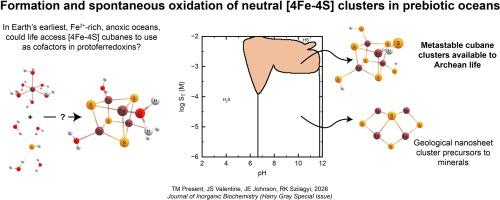
益生元海洋中中性[4Fe-4S]簇的形成和自发氧化。
铁硫簇是生命必需的酶辅因子,被认为是形成早期代谢的基础。Fe- s菱形团簇和立方体团簇同时需要Fe(II)和Fe(III)来保持稳定,但太古宙海洋以还原性Fe(II)为主。我们假设质子可能在团簇组装过程中作为Fe(II)到Fe(III)的氧化剂。同时,配位体完成了分子立方簇中铁位点的四面体几何结构,可以确保簇的稳定性并促进质子还原。密度泛函理论计算表明,由h30 +、Fe(SH)+或H2S传递的质子可以氧化[2Fe-2S]簇,促进阳离子[4Fe-4S]簇的形成。类mackinawite (FeS)n(aq)中性纳米颗粒片和连接阳离子[4Fe-4S]立方烷的相对能量学进一步表明,在类mackinawite纳米颗粒片形成过程中,水、二硫化物和生物配体(如短肽)等配体确实在捕获立方烷簇态方面发挥了关键作用。质子的氧化还原反应和配体的配位可以使分子Fe- s簇辅因子直接从地球早期富含Fe(II)、含硫化物的水中组装起来。
本文章由计算机程序翻译,如有差异,请以英文原文为准。
求助全文
约1分钟内获得全文
求助全文
来源期刊
Journal of Inorganic Biochemistry
生物-生化与分子生物学
CiteScore
7.00
自引率
10.30%
发文量
336
审稿时长
41 days
期刊介绍:
The Journal of Inorganic Biochemistry is an established international forum for research in all aspects of Biological Inorganic Chemistry. Original papers of a high scientific level are published in the form of Articles (full length papers), Short Communications, Focused Reviews and Bioinorganic Methods. Topics include: the chemistry, structure and function of metalloenzymes; the interaction of inorganic ions and molecules with proteins and nucleic acids; the synthesis and properties of coordination complexes of biological interest including both structural and functional model systems; the function of metal- containing systems in the regulation of gene expression; the role of metals in medicine; the application of spectroscopic methods to determine the structure of metallobiomolecules; the preparation and characterization of metal-based biomaterials; and related systems. The emphasis of the Journal is on the structure and mechanism of action of metallobiomolecules.
 求助内容:
求助内容: 应助结果提醒方式:

 京公网安备 11010802042870号


