
Xpro®1595 alleviates neuropathic pain by targeting spinal dorsal horn ADAM17-mediated inflammation
IF 3.4
Q2 Medicine
引用次数: 0
Abstract
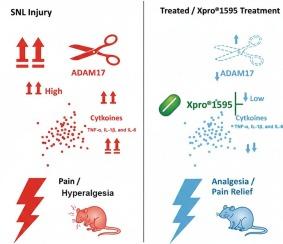
A disintegrin and metalloprotease 17 (ADAM17) mediates the shedding of key pro-inflammatory cytokines, yet its specific contribution to neuropathic pain remains elusive. Here, we investigated the role of ADAM17 in the rat spinal nerve ligation (SNL) model. Following nerve injury, ADAM17 expression was significantly upregulated in the spinal dorsal horn (SDH) and dorsal root ganglion (DRG). Specifically, ADAM17 colocalized with TRPV1 and IB4 positive afferents in the superficial SDH, and with IB4, CGRP, and TRPV1 positive neurons in the DRG. Intrathecal administration of exogenous ADAM17 to naive rats recapitulated neuropathic pain behaviors—inducing mechanical and thermal hypersensitivity—and significantly increased the levels of TNF-α, IL-1β, and IL-6 in the SDH. Conversely, therapeutic treatment with Xpro®1595 markedly attenuated SNL-induced pain behaviors. This analgesic effect correlated with the suppression of injury-induced ADAM17 upregulation and a consequent reduction in proinflammatory cytokines. These findings demonstrate that ADAM17 is a critical driver of the neuroinflammatory cascade in neuropathic pain. Moreover, our data suggest that the analgesic efficacy of Xpro®1595 is mediated, at least in part, by disrupting this ADAM17-dependent inflammatory feedback loop.
Xpro®1595通过靶向脊髓背角adam17介导的炎症减轻神经性疼痛。
崩解素和金属蛋白酶17 (ADAM17)介导关键促炎细胞因子的脱落,但其在神经性疼痛中的具体作用尚不明确。在此,我们研究了ADAM17在大鼠脊神经结扎(SNL)模型中的作用。神经损伤后,ADAM17在脊髓背角(SDH)和背根神经节(DRG)中的表达显著上调。具体而言,ADAM17与浅表SDH中的TRPV1和IB4阳性传入神经以及DRG中的IB4、CGRP和TRPV1阳性神经元共定位。鞘内给药外源性ADAM17会重现幼年大鼠的神经性疼痛行为,引起机械和热超敏反应,并显著增加SDH中TNF-α、IL-1β和IL-6的水平。相反,Xpro®1595治疗显著减轻snl引起的疼痛行为。这种镇痛作用与抑制损伤诱导的ADAM17上调和随后的促炎细胞因子减少有关。这些发现表明,ADAM17是神经性疼痛中神经炎症级联的关键驱动因素。此外,我们的数据表明,Xpro®1595的镇痛效果至少部分是通过破坏这种adam17依赖性炎症反馈循环来介导的。
本文章由计算机程序翻译,如有差异,请以英文原文为准。
求助全文
约1分钟内获得全文
求助全文
来源期刊

Neurobiology of Pain
Medicine-Anesthesiology and Pain Medicine
CiteScore
4.40
自引率
0.00%
发文量
29
审稿时长
54 days
 求助内容:
求助内容: 应助结果提醒方式:

 京公网安备 11010802042870号


