
Synergistic experimental and theoretical investigation of carbazole–cyanopyridine-based hole-transporting materials
Organic chemistry frontiers : an international journal of organic chemistry
Pub Date : 2026-04-21
Epub Date: 2026-02-17
DOI:10.1039/d6qo00076b
引用次数: 0
Abstract
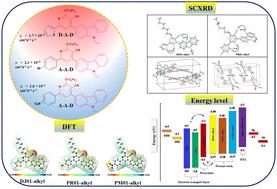
This work highlights the design, synthesis, and characterization of three new hole-transporting materials (, , and ) based on donor–acceptor–donor (D–A–D) and acceptor–acceptor–donor (A–A–D) concepts. Crystals of two compounds, and , were obtained under similar crystallization conditions. The molecular structures were thoroughly examined using DFT, photophysical, electrochemical, and thermal methods. The UV-vis absorption spectrum of displayed a significant bathochromic effect compared to its counterparts and . This could be because the thiophene units enhance conjugation and lead to a bathochromic shift. Compared to (1.7 × 10⁻⁵ cm2 V−1 s−1) and (1.6 × 10⁻⁵ cm2 V−1 s−1), was found to have a higher hole mobility value of 2.1 × 10⁻⁵ cm2 V−1 s−1. To further explain and complement the experimental data, DFT calculations of the geometry, electronic structure, absorption, reorganization energy, transition density matrix, and density of states of compounds were performed. These characteristics make it abundantly evident that compounds based on carbazoles and cyanopyridines are very attractive materials for use as hole-transporting materials in perovskite solar cells.
咔唑-氰吡啶基空穴输运材料协同实验与理论研究
本研究重点介绍了基于供体-受体-供体(D-A-D)和受体-受体-供体(A-A-D)概念的三种新型空穴传输材料(DJ01-alkyl, PR01-alkyl和PM01-alkyl)的设计、合成和表征。在相似的结晶条件下,得到了dj01 -烷基和pr01 -烷基两种晶体。分子结构是彻底检查使用DFT,光物理,电化学和热方法。与pr01 -烷基和pm01 -烷基相比,dj01 -烷基的紫外-可见吸收光谱显示出明显的显色效应。这可能是因为噻吩单位增强了偶联并导致了色移。与dj01 -烷基(1.7 × 10⁻⁵ cm2 V−1 s−1)和pm01 -烷基(1.6 × 10⁻⁵ cm2 V−1 s−1)相比,pr01 -烷基具有更高的空穴迁移率值,为2.1 × 10⁻⁵ cm2 V−1 s−1。为了进一步解释和补充实验数据,对化合物的几何形状、电子结构、吸收、重组能、过渡密度矩阵和态密度进行了DFT计算。这些特性充分表明,基于咔唑和氰吡啶的化合物是非常有吸引力的材料,可以用作钙钛矿太阳能电池中的空穴传输材料。
本文章由计算机程序翻译,如有差异,请以英文原文为准。
求助全文
约1分钟内获得全文
求助全文
来源期刊

CiteScore
7.80
自引率
0.00%
发文量
0
 求助内容:
求助内容: 应助结果提醒方式:

 京公网安备 11010802042870号


