
From Data Mirror to Smart Copilot: A Survey on NextG Semantic Communication for Propelling Digital Twin World Into Cognitive Stage
IF 34.4
1区 计算机科学
Q1 COMPUTER SCIENCE, INFORMATION SYSTEMS
引用次数: 0
Abstract
The revolution of information technologies is blurring the boundary between physical and virtual worlds, with digital twin (DT) at the forefront of this transformation. Meanwhile, DT is evolving from offering simple data mirrors to smart copilots, capable of understanding users’ intents and proactively providing profound insights. This ushers in the pivotal cognitive stage of the DT, where humans or embodied artificial intelligence agents (EAIs) can obtain cognitive perceptions within the DT world. Among various issues, in the cognitive stage, establishing strong interactions between the physical and DT worlds is critical. This paper thus explores the Next-Generation Semantic Communication (NextG-SemCom), well-suited for this issue, to fully enable the DT world with human-like cognitive capabilities. NextG-SemCom is envisioned as a cognitive-native paradigm that leverages Large AI Models (LAMs) as its core engine to perform intent understanding, contextual planning, and intent-oriented generative extraction. NextG-SemCom establishes a closed cognitive loop that shifts communication from data-driven to cognitive-driven, thereby not only reducing the traffic overhead, but also achieving cognitive comprehension of the transmitted information. This paper provides the first survey of the NextG-SemCom driven DT world, focusing on the advancement, trend and vision. We start by tracing the evolution of the DT from the initial virtual mapping stage to the current cognitive stage, and detail the distinguishing features of NextG-SemCom. We then present a holistic framework of cognitive interactions in the DT world, analyzing its core components, including the NextG-SemCom codec and network management, along with its design requirements and challenges. Furthermore, we discuss potential applications across a spectrum of human-human, human-EAI, and EAI-EAI interactive scenarios. Finally, we outline future research directions to provide a roadmap and inspire further studies in this promising field.从数据镜像到智能副驾驶:推动数字孪生世界进入认知阶段的下一代语义交流研究
信息技术革命正在模糊物理世界和虚拟世界之间的界限,数字孪生(DT)处于这一转变的最前沿。与此同时,DT正在从提供简单的数据镜像向智能副驾驶发展,能够理解用户的意图并主动提供深刻的见解。这就迎来了DT的关键认知阶段,人类或具身人工智能体(embodied artificial intelligence agents, EAIs)可以在DT世界中获得认知感知。在各种问题中,在认知阶段,在物理世界和虚拟世界之间建立强大的互动是至关重要的。因此,本文探讨了非常适合此问题的下一代语义通信(NextG-SemCom),以充分实现具有类似人类认知能力的DT世界。NextG-SemCom被设想为一种认知原生范式,利用大型人工智能模型(lam)作为其核心引擎来执行意图理解、上下文规划和面向意图的生成提取。NextG-SemCom建立了一个封闭的认知循环,将通信从数据驱动转变为认知驱动,不仅减少了流量开销,而且实现了对传输信息的认知理解。本文首次对NextG-SemCom驱动的DT世界进行了调查,重点介绍了进展、趋势和愿景。我们首先追溯了DT从最初的虚拟映射阶段到当前的认知阶段的演变,并详细介绍了NextG-SemCom的显著特征。然后,我们提出了DT世界中认知交互的整体框架,分析了其核心组件,包括NextG-SemCom编解码器和网络管理,以及其设计要求和挑战。此外,我们还讨论了人类-人类、人类- eai和EAI-EAI交互场景的潜在应用。最后,我们概述了未来的研究方向,为这一前景广阔的领域的进一步研究提供了路线图和启发。
本文章由计算机程序翻译,如有差异,请以英文原文为准。
求助全文
约1分钟内获得全文
求助全文
来源期刊
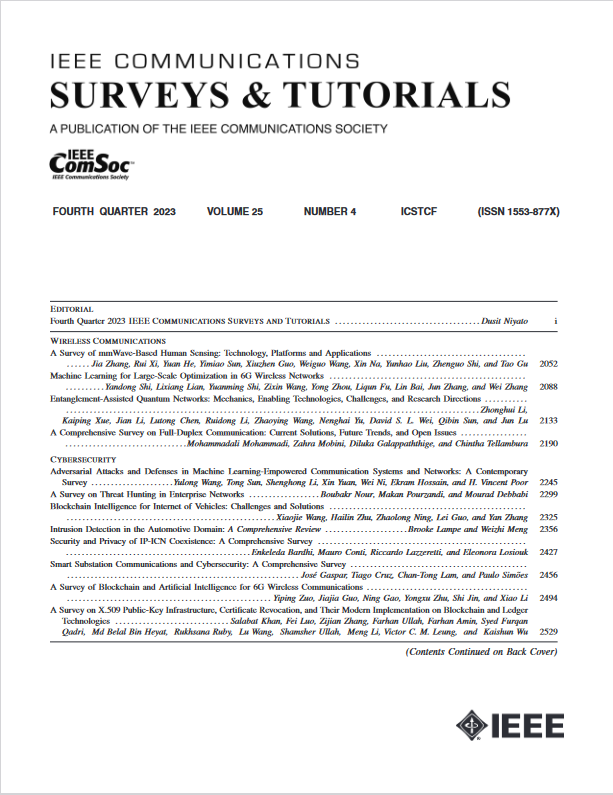
IEEE Communications Surveys and Tutorials
COMPUTER SCIENCE, INFORMATION SYSTEMS-TELECOMMUNICATIONS
CiteScore
80.20
自引率
2.50%
发文量
84
审稿时长
6 months
期刊介绍:
IEEE Communications Surveys & Tutorials is an online journal published by the IEEE Communications Society for tutorials and surveys covering all aspects of the communications field. Telecommunications technology is progressing at a rapid pace, and the IEEE Communications Society is committed to providing researchers and other professionals the information and tools to stay abreast. IEEE Communications Surveys and Tutorials focuses on integrating and adding understanding to the existing literature on communications, putting results in context. Whether searching for in-depth information about a familiar area or an introduction into a new area, IEEE Communications Surveys & Tutorials aims to be the premier source of peer-reviewed, comprehensive tutorials and surveys, and pointers to further sources. IEEE Communications Surveys & Tutorials publishes only articles exclusively written for IEEE Communications Surveys & Tutorials and go through a rigorous review process before their publication in the quarterly issues.
A tutorial article in the IEEE Communications Surveys & Tutorials should be designed to help the reader to become familiar with and learn something specific about a chosen topic. In contrast, the term survey, as applied here, is defined to mean a survey of the literature. A survey article in IEEE Communications Surveys & Tutorials should provide a comprehensive review of developments in a selected area, covering its development from its inception to its current state and beyond, and illustrating its development through liberal citations from the literature. Both tutorials and surveys should be tutorial in nature and should be written in a style comprehensible to readers outside the specialty of the article.
 求助内容:
求助内容: 应助结果提醒方式:

 京公网安备 11010802042870号


