{"title":"Hope, Optimism, and Expectations for the Political Future.","authors":"Matthew Barnfield, Rob Johns","doi":"10.1007/s11109-025-10027-5","DOIUrl":null,"url":null,"abstract":"<p><p>Expectations of what the future holds are a significant driver of political behavior. It is therefore important to understand the sources of those expectations. In this paper, we explore the psychological dispositions driving positivity about the political future. We draw on psychologists' distinction between optimism-a dispositional belief that good things will happen, come what may-and hope-a trait of envisioning, pursuing and believing one's goals to be achievable. We assess pre-registered hypotheses about the distinct influences of optimism and hope on valence expectations-beliefs about whether there will be good or bad societal outcomes-and electoral expectations-beliefs about likely election outcomes-in a representative-sample survey experiment in the United Kingdom. We find that optimism drives positive valence expectations, but hope drives partisan electoral expectations. Indeed, partisan bias in electoral expectations is exhibited only by those scoring higher in hope. We show experimentally that positive information from polls and expert commentary dampens this impact of hope by raising the expectations of the otherwise unhopeful. Our findings suggest that so-called 'wishful thinking' about election outcomes might stem from a sense of agency around electoral politics, but that this sense of agency does not extend to how citizens envision society's prospects.</p><p><strong>Supplementary information: </strong>The online version contains supplementary material available at 10.1007/s11109-025-10027-5.</p>","PeriodicalId":48166,"journal":{"name":"Political Behavior","volume":"48 1","pages":"205-228"},"PeriodicalIF":3.5000,"publicationDate":"2026-01-01","publicationTypes":"Journal Article","fieldsOfStudy":null,"isOpenAccess":false,"openAccessPdf":"https://www.ncbi.nlm.nih.gov/pmc/articles/PMC12904912/pdf/","citationCount":"0","resultStr":null,"platform":"Semanticscholar","paperid":null,"PeriodicalName":"Political Behavior","FirstCategoryId":"90","ListUrlMain":"https://doi.org/10.1007/s11109-025-10027-5","RegionNum":1,"RegionCategory":"社会学","ArticlePicture":[],"TitleCN":null,"AbstractTextCN":null,"PMCID":null,"EPubDate":"2025/3/13 0:00:00","PubModel":"Epub","JCR":"Q1","JCRName":"POLITICAL SCIENCE","Score":null,"Total":0}
引用次数: 0
Abstract
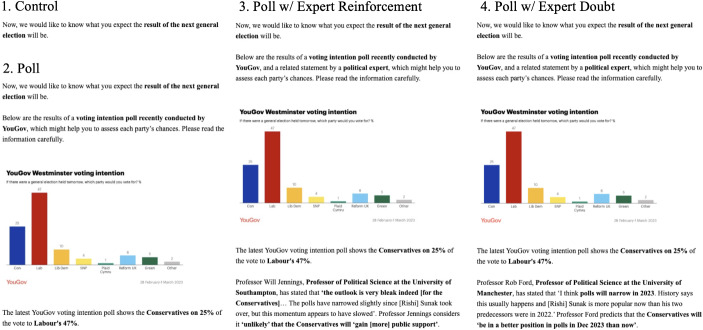
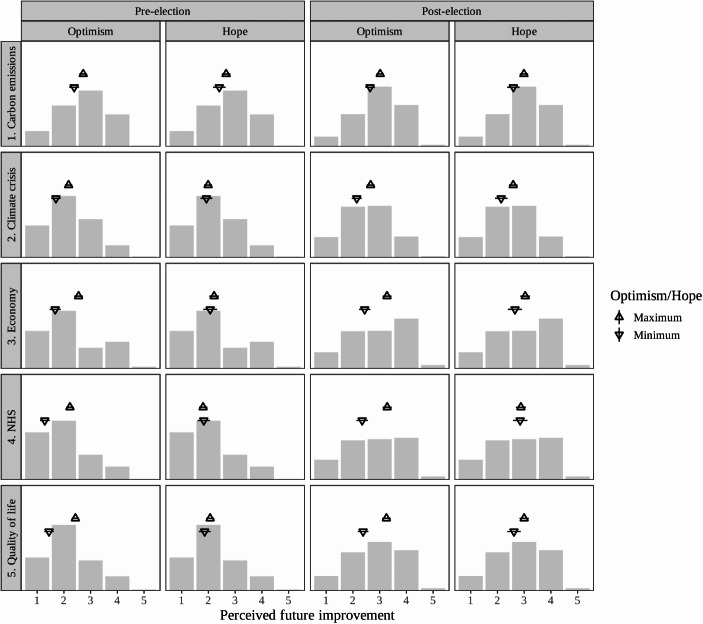
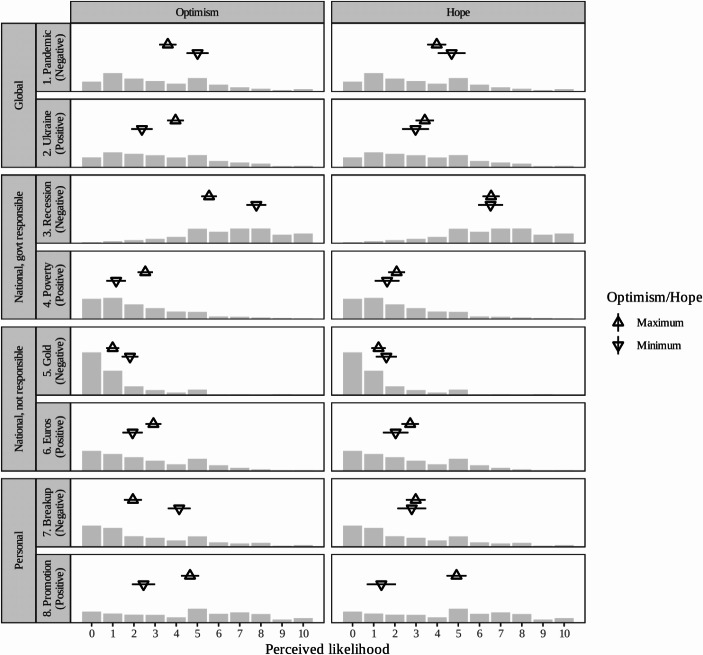
Expectations of what the future holds are a significant driver of political behavior. It is therefore important to understand the sources of those expectations. In this paper, we explore the psychological dispositions driving positivity about the political future. We draw on psychologists' distinction between optimism-a dispositional belief that good things will happen, come what may-and hope-a trait of envisioning, pursuing and believing one's goals to be achievable. We assess pre-registered hypotheses about the distinct influences of optimism and hope on valence expectations-beliefs about whether there will be good or bad societal outcomes-and electoral expectations-beliefs about likely election outcomes-in a representative-sample survey experiment in the United Kingdom. We find that optimism drives positive valence expectations, but hope drives partisan electoral expectations. Indeed, partisan bias in electoral expectations is exhibited only by those scoring higher in hope. We show experimentally that positive information from polls and expert commentary dampens this impact of hope by raising the expectations of the otherwise unhopeful. Our findings suggest that so-called 'wishful thinking' about election outcomes might stem from a sense of agency around electoral politics, but that this sense of agency does not extend to how citizens envision society's prospects.
Supplementary information: The online version contains supplementary material available at 10.1007/s11109-025-10027-5.
期刊介绍:
Political Behavior publishes original research in the general fields of political behavior, institutions, processes, and policies. Approaches include economic (preference structuring, bargaining), psychological (attitude formation and change, motivations, perceptions), sociological (roles, group, class), or political (decision making, coalitions, influence). Articles focus on the political behavior (conventional or unconventional) of the individual person or small group (microanalysis), or of large organizations that participate in the political process such as parties, interest groups, political action committees, governmental agencies, and mass media (macroanalysis). As an interdisciplinary journal, Political Behavior integrates various approaches across different levels of theoretical abstraction and empirical domain (contextual analysis).
Officially cited as: Polit Behav

 求助内容:
求助内容: 应助结果提醒方式:

 京公网安备 11010802042870号


