Christophe Benjamin, Jaclyn Hill, Anthony Ricciardi
{"title":"Thermal effects on feeding efficiency and body condition in invasive and native benthivorous freshwater fishes.","authors":"Christophe Benjamin, Jaclyn Hill, Anthony Ricciardi","doi":"10.1007/s10530-026-03767-w","DOIUrl":null,"url":null,"abstract":"<p><p>Predictive information on invasive species impacts under climate warming is critical for risk assessment. The comparative functional response approach-an experimental method measuring feeding efficiency of a predator along a prey gradient-can forecast ecological impacts of an invader by quantifying its resource consumption under varying conditions. This approach was applied to the Tench <i>Tinca tinca</i>, an invasive benthivorous fish currently spreading in the St Lawrence River, and two native benthivorous species, the White Sucker <i>Catostomus commersonii</i> and the Brown Bullhead <i>Ameiurus nebulosus</i>. Body condition was used as a measure of long-term fitness under a given temperature treatment, and the Functional Response Ratio (FRR) and Relative Impact Potential (RIP) were used as metrics describing trophic impact. All species were acclimated to 18 °C and 25 °C; the former temperature represents the physiological optimum for the chosen native species, whereas the latter temperature is the projected near-future mean summer maximum for the lower Great Lakes. Feeding rates on larval chironomids were measured in 3-h trials at prey densities ranging from 2 to 500. White Sucker feeding efficiency was unaffected by temperature and consistently higher than the Tench, whereas the Tench exhibited a lower maximum feeding rate at 25 °C compared to 18 °C. Despite superior feeding rates, White Suckers showed diminished body condition at the elevated temperature, suggesting their foraging advantage might not persist under warming conditions. These findings suggest Tench possess greater thermal compensation capacity than White Suckers, indicated by their stable condition factors at elevated temperatures despite lower maximum feeding rates. In a second set of experiments, Tench achieved greater feeding efficiency than Brown Bullhead, but both species showed reduced efficiency at elevated temperatures. However, Brown Bullhead had increased body condition indices following experiments. FRR and RIP metrics indicated that Tench holds a competitive feeding advantage over Brown Bullhead that is reduced under elevated temperatures. Tench impact depends on both feeding efficiency and its capacity to maintain fitness in warm waters. Our results highlight the necessity of considering thermal adaptation in ecological forecasting. Climate warming may reshape competitive dynamics and ecosystem impact pathways beyond direct consumption effects.</p><p><strong>Supplementary information: </strong>The online version contains supplementary material available at 10.1007/s10530-026-03767-w.</p>","PeriodicalId":9202,"journal":{"name":"Biological Invasions","volume":"28 2","pages":"51"},"PeriodicalIF":2.7000,"publicationDate":"2026-01-01","publicationTypes":"Journal Article","fieldsOfStudy":null,"isOpenAccess":false,"openAccessPdf":"https://www.ncbi.nlm.nih.gov/pmc/articles/PMC12901266/pdf/","citationCount":"0","resultStr":null,"platform":"Semanticscholar","paperid":null,"PeriodicalName":"Biological Invasions","FirstCategoryId":"93","ListUrlMain":"https://doi.org/10.1007/s10530-026-03767-w","RegionNum":3,"RegionCategory":"环境科学与生态学","ArticlePicture":[],"TitleCN":null,"AbstractTextCN":null,"PMCID":null,"EPubDate":"2026/2/12 0:00:00","PubModel":"Epub","JCR":"Q1","JCRName":"BIODIVERSITY CONSERVATION","Score":null,"Total":0}
引用次数: 0
Abstract
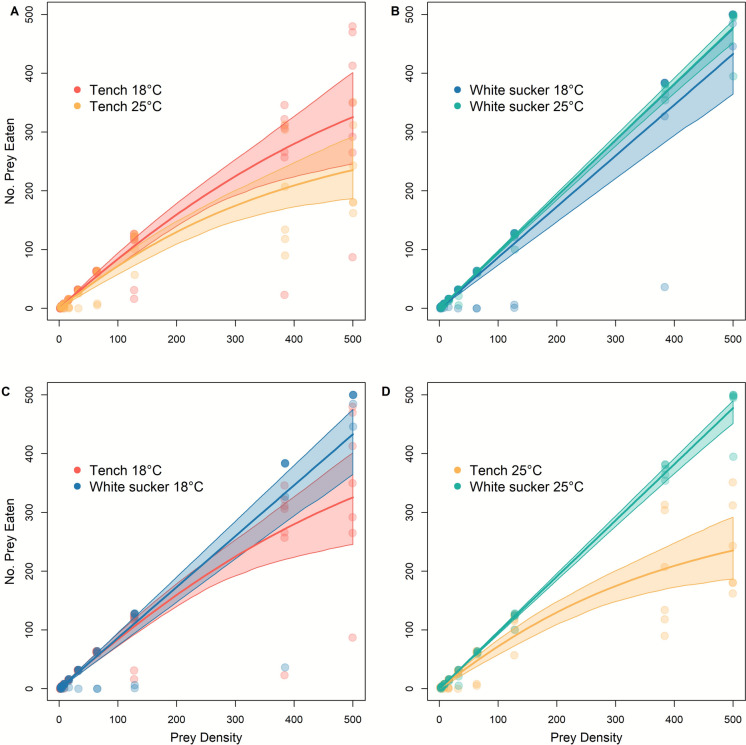
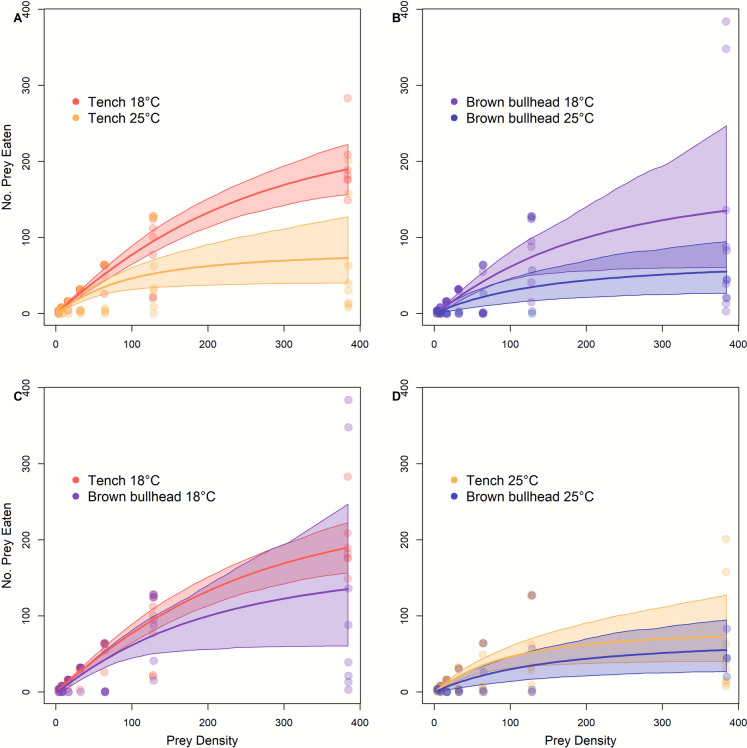
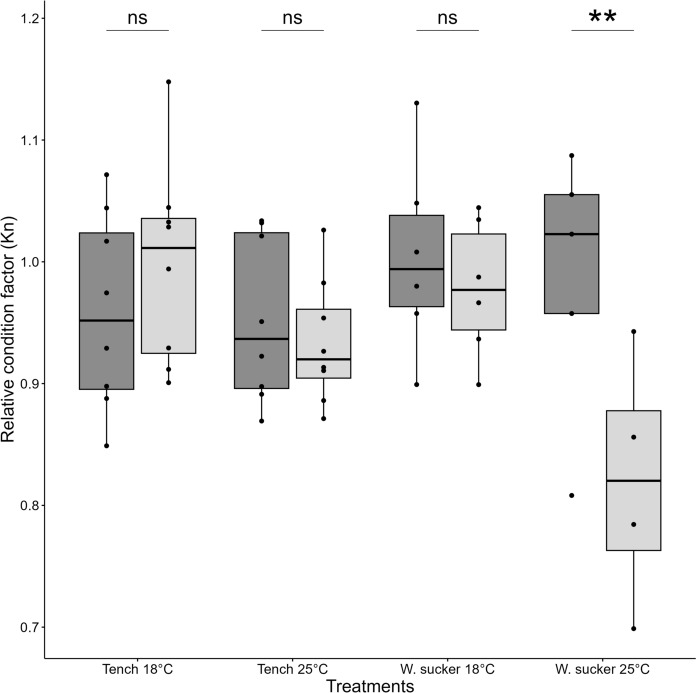
Predictive information on invasive species impacts under climate warming is critical for risk assessment. The comparative functional response approach-an experimental method measuring feeding efficiency of a predator along a prey gradient-can forecast ecological impacts of an invader by quantifying its resource consumption under varying conditions. This approach was applied to the Tench Tinca tinca, an invasive benthivorous fish currently spreading in the St Lawrence River, and two native benthivorous species, the White Sucker Catostomus commersonii and the Brown Bullhead Ameiurus nebulosus. Body condition was used as a measure of long-term fitness under a given temperature treatment, and the Functional Response Ratio (FRR) and Relative Impact Potential (RIP) were used as metrics describing trophic impact. All species were acclimated to 18 °C and 25 °C; the former temperature represents the physiological optimum for the chosen native species, whereas the latter temperature is the projected near-future mean summer maximum for the lower Great Lakes. Feeding rates on larval chironomids were measured in 3-h trials at prey densities ranging from 2 to 500. White Sucker feeding efficiency was unaffected by temperature and consistently higher than the Tench, whereas the Tench exhibited a lower maximum feeding rate at 25 °C compared to 18 °C. Despite superior feeding rates, White Suckers showed diminished body condition at the elevated temperature, suggesting their foraging advantage might not persist under warming conditions. These findings suggest Tench possess greater thermal compensation capacity than White Suckers, indicated by their stable condition factors at elevated temperatures despite lower maximum feeding rates. In a second set of experiments, Tench achieved greater feeding efficiency than Brown Bullhead, but both species showed reduced efficiency at elevated temperatures. However, Brown Bullhead had increased body condition indices following experiments. FRR and RIP metrics indicated that Tench holds a competitive feeding advantage over Brown Bullhead that is reduced under elevated temperatures. Tench impact depends on both feeding efficiency and its capacity to maintain fitness in warm waters. Our results highlight the necessity of considering thermal adaptation in ecological forecasting. Climate warming may reshape competitive dynamics and ecosystem impact pathways beyond direct consumption effects.
Supplementary information: The online version contains supplementary material available at 10.1007/s10530-026-03767-w.
期刊介绍:
Biological Invasions publishes research and synthesis papers on patterns and processes of biological invasions in terrestrial, freshwater, and marine (including brackish) ecosystems. Also of interest are scholarly papers on management and policy issues as they relate to conservation programs and the global amelioration or control of invasions. The journal will consider proposals for special issues resulting from conferences or workshops on invasions.There are no page charges to publish in this journal.

 求助内容:
求助内容: 应助结果提醒方式:

 京公网安备 11010802042870号


