
The mechanism of honeysuckle peptides in ameliorating hyperuricemia in mice via the PGC-1α/PPARγ/ABCG2 pathway
IF 6.8
2区 医学
Q1 CHEMISTRY, MEDICINAL
Journal of ethnopharmacology
Pub Date : 2026-05-10
Epub Date: 2026-02-11
DOI:10.1016/j.jep.2026.121358
引用次数: 0
Abstract
Ethnopharmacological relevance
Lonicera japonica Thunb (honeysuckle), a traditional Chinese medicine, has been historically used to clear heat, detoxify, and dispel wind-heat. Modern research has identified various bioactive constituents from honeysuckle, supporting its potential in managing inflammatory and metabolic disorders. However, the anti-hyperuricemic activity and mechanism of its peptide components remain unexplored.
Aim of the study: This study aimed to investigate the anti-hyperuricemic effect of honeysuckle-derived peptides and the underlying mechanisms, with a focus on uric acid production, excretion, and gut microbiota modulation.
Materials and methods
Nine novel peptides were identified from honeysuckle by HPLC-MS/MS and screened through molecular docking against xanthine oxidase (XOD). In vitro XOD inhibition and antioxidant assays were performed. A hyperuricemic mouse model was induced by potassium oxonate and hypoxanthine. Mice were treated with honeysuckle peptides at low, medium, and high doses. Serum biomarkers, renal and ileal histopathology, protein and mRNA expression of PGC-1α/PPARγ/ABCG2 pathway components, and gut microbiota composition (16S rRNA sequencing) were analyzed.
Results
Molecular docking confirmed strong binding between the peptides and XOD. In vitro, honeysuckle peptides significantly inhibited XOD activity and exhibited potent antioxidant capacity. In vivo, peptide treatment effectively reduced serum uric acid, XOD, creatinine, and blood urea nitrogen levels, alleviated renal and intestinal tissue damage, and suppressed inflammatory cytokines. The treatment also significantly upregulated the renal PGC-1α/PPARγ/ABCG2 pathway at both protein and mRNA levels. Furthermore, the peptides restored gut microbial diversity and corrected the Firmicutes/Bacteroidota ratio.
Conclusion
Honeysuckle peptides ameliorate hyperuricemia through a dual mechanism: inhibiting uric acid production by suppressing XOD activity and promoting its renal excretion by activating the PGC-1α/PPARγ/ABCG2 pathway, coupled with restoring gut microbiota homeostasis. This study provides a pharmacological basis for the traditional use of honeysuckle and highlights its peptides as promising candidates for managing hyperuricemia.
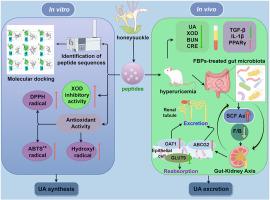
金银花肽通过PGC-1α/PPARγ/ABCG2通路改善小鼠高尿酸血症的机制
民族药理学相关性:金银花(Lonicera japonica Thunb)是一种传统中药,历史上用于清热、解毒、祛风热。现代研究已经从金银花中鉴定出各种生物活性成分,支持其在控制炎症和代谢紊乱方面的潜力。然而,其肽组分的抗高尿酸血症活性及其机制尚不清楚。研究目的:本研究旨在探讨金银花衍生肽的抗高尿酸血症作用及其机制,重点关注尿酸的产生、排泄和肠道微生物群的调节。材料与方法:利用高效液相色谱-质谱联用技术从金银花中鉴定出9个新的抗黄嘌呤氧化酶(xanthine oxidase, XOD)肽,并进行分子对接筛选。体外进行XOD抑制和抗氧化实验。采用氧酸钾和次黄嘌呤诱导高尿酸血症小鼠模型。小鼠分别接受低、中、高剂量的金银花肽治疗。分析血清生物标志物、肾脏和回肠组织病理学、PGC-1α/PPARγ/ABCG2通路组分的蛋白和mRNA表达以及肠道微生物群组成(16S rRNA测序)。结果:分子对接证实了多肽与XOD的强结合。金银花肽在体外显著抑制XOD活性,显示出较强的抗氧化能力。在体内,肽治疗可有效降低血清尿酸、XOD、肌酐和血尿素氮水平,减轻肾脏和肠道组织损伤,抑制炎症因子。治疗还在蛋白和mRNA水平上显著上调肾PGC-1α/PPARγ/ABCG2通路。此外,肽恢复肠道微生物多样性,纠正厚壁菌门/拟杆菌门比例。结论:金银花肽通过双重机制改善高尿酸血症:通过抑制XOD活性抑制尿酸生成,通过激活PGC-1α/PPARγ/ABCG2途径促进其肾脏排泄,同时恢复肠道微生物群稳态。该研究为金银花的传统用途提供了药理学基础,并强调了其肽作为治疗高尿酸血症的有希望的候选者。
本文章由计算机程序翻译,如有差异,请以英文原文为准。
求助全文
约1分钟内获得全文
求助全文
来源期刊
Journal of ethnopharmacology
医学-全科医学与补充医学
CiteScore
10.30
自引率
5.60%
发文量
967
审稿时长
77 days
期刊介绍:
The Journal of Ethnopharmacology is dedicated to the exchange of information and understandings about people''s use of plants, fungi, animals, microorganisms and minerals and their biological and pharmacological effects based on the principles established through international conventions. Early people confronted with illness and disease, discovered a wealth of useful therapeutic agents in the plant and animal kingdoms. The empirical knowledge of these medicinal substances and their toxic potential was passed on by oral tradition and sometimes recorded in herbals and other texts on materia medica. Many valuable drugs of today (e.g., atropine, ephedrine, tubocurarine, digoxin, reserpine) came into use through the study of indigenous remedies. Chemists continue to use plant-derived drugs (e.g., morphine, taxol, physostigmine, quinidine, emetine) as prototypes in their attempts to develop more effective and less toxic medicinals.
 求助内容:
求助内容: 应助结果提醒方式:

 京公网安备 11010802042870号


