
AMULETY: A Python package to embed adaptive immune receptor sequences

Meng Wang , Wengyao Jiang , Yuval Kluger , Steven H. Kleinstein , Gisela Gabernet
{"title":"AMULETY: A Python package to embed adaptive immune receptor sequences","authors":"Meng Wang ,&nbsp;Wengyao Jiang ,&nbsp;Yuval Kluger ,&nbsp;Steven H. Kleinstein ,&nbsp;Gisela Gabernet","doi":"10.1016/j.immuno.2026.100066","DOIUrl":null,"url":null,"abstract":"<div><div>Large language models have been developed to capture relevant features of adaptive immune receptors, each with unique potential applications. However, the diversity in available models presents challenges in accessibility and usability for downstream applications. Here we present AMULETY (Adaptive imMUne receptor Language model Embedding Tool), a Python-based software package to generate language model embeddings for adaptive immune receptor sequences, enabling users to leverage the strengths of different models without the need for complex configuration. AMULETY offers functions for embedding adaptive immune receptor amino acid sequences using pre-trained protein or antibody language models for paired B-cell receptor heavy-light, T-cell receptor alpha-beta or gamma-delta chains, or single chain sequences. We showcase the variability on the embedding space for several embeddings on a dataset of antibody binders to several SARS-CoV-2 epitopes as well as T-cell receptors binding to several epitopes and showed that different models may be effective at capturing different aspects of the distinctions between epitope groups. AMULETY is freely available under GPLv3 license from <span><span>https://github.com/immcantation/amulety</span><svg><path></path></svg></span> or via pip from the Python Package Index (PyPI) from <span><span>https://pypi.org/project/amulety/</span><svg><path></path></svg></span>.</div></div>","PeriodicalId":73343,"journal":{"name":"Immunoinformatics (Amsterdam, Netherlands)","volume":"21 ","pages":"Article 100066"},"PeriodicalIF":0.0000,"publicationDate":"2026-03-01","publicationTypes":"Journal Article","fieldsOfStudy":null,"isOpenAccess":false,"openAccessPdf":"","citationCount":"0","resultStr":null,"platform":"Semanticscholar","paperid":null,"PeriodicalName":"Immunoinformatics (Amsterdam, Netherlands)","FirstCategoryId":"1085","ListUrlMain":"https://www.sciencedirect.com/science/article/pii/S2667119026000029","RegionNum":0,"RegionCategory":null,"ArticlePicture":[],"TitleCN":null,"AbstractTextCN":null,"PMCID":null,"EPubDate":"2026/2/3 0:00:00","PubModel":"Epub","JCR":"","JCRName":"","Score":null,"Total":0}
引用次数: 0

Abstract

Large language models have been developed to capture relevant features of adaptive immune receptors, each with unique potential applications. However, the diversity in available models presents challenges in accessibility and usability for downstream applications. Here we present AMULETY (Adaptive imMUne receptor Language model Embedding Tool), a Python-based software package to generate language model embeddings for adaptive immune receptor sequences, enabling users to leverage the strengths of different models without the need for complex configuration. AMULETY offers functions for embedding adaptive immune receptor amino acid sequences using pre-trained protein or antibody language models for paired B-cell receptor heavy-light, T-cell receptor alpha-beta or gamma-delta chains, or single chain sequences. We showcase the variability on the embedding space for several embeddings on a dataset of antibody binders to several SARS-CoV-2 epitopes as well as T-cell receptors binding to several epitopes and showed that different models may be effective at capturing different aspects of the distinctions between epitope groups. AMULETY is freely available under GPLv3 license from https://github.com/immcantation/amulety or via pip from the Python Package Index (PyPI) from https://pypi.org/project/amulety/.
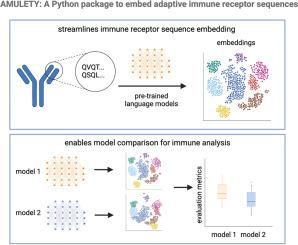
Abstract Image

AMULETY:嵌入适应性免疫受体序列的Python包
已经开发出大型语言模型来捕捉适应性免疫受体的相关特征,每个都具有独特的潜在应用。然而,可用模型的多样性对下游应用程序的可访问性和可用性提出了挑战。在这里,我们提出了AMULETY(适应性免疫受体语言模型嵌入工具),这是一个基于python的软件包,用于生成适应性免疫受体序列的语言模型嵌入,使用户能够在不需要复杂配置的情况下利用不同模型的优势。AMULETY提供嵌入适应性免疫受体氨基酸序列的功能,使用预先训练的蛋白质或抗体语言模型,用于配对b细胞受体重-轻,t细胞受体α - β或γ - δ链或单链序列。我们展示了几种嵌入到几种SARS-CoV-2表位的抗体结合物以及结合到几种表位的t细胞受体数据集的嵌入空间的可变性,并表明不同的模型可能有效地捕获表位组之间差异的不同方面。AMULETY在GPLv3许可下可从https://github.com/immcantation/amulety或通过pip从https://pypi.org/project/amulety/获得Python包索引(PyPI)。
本文章由计算机程序翻译,如有差异,请以英文原文为准。
求助全文
约1分钟内获得全文 求助全文
来源期刊
Immunoinformatics (Amsterdam, Netherlands)
Immunoinformatics (Amsterdam, Netherlands) Immunology, Computer Science Applications
自引率
0.00%
发文量
0
审稿时长
60 days

×
引用
GB/T 7714-2015
复制
MLA
复制
APA
复制
导出至
BibTeX EndNote RefMan NoteFirst NoteExpress
×
提示
您的信息不完整,为了账户安全,请先补充。
现在去补充
×
提示
您因"违规操作"
具体请查看互助需知
我知道了
×
提示
确定
请完成安全验证×
copy
已复制链接
快去分享给好友吧!
我知道了
右上角分享
点击右上角分享
0
联系我们:info@booksci.cn Book学术提供免费学术资源搜索服务,方便国内外学者检索中英文文献。致力于提供最便捷和优质的服务体验。 Copyright © 2023 布克学术 All rights reserved.
京ICP备2023020795号-1
ghs 京公网安备 11010802042870号
Book学术文献互助
Book学术文献互助群
群 号:604180095
Book学术官方微信
小红书


