
Behaviors salts of diammonium hydrogenphosphate or sulfate containing in fertilizers, solubility and thermodynamic study in aqueous solutions at various temperatures
IF 2.2
3区 工程技术
Q3 CHEMISTRY, PHYSICAL
Journal of Chemical Thermodynamics
Pub Date : 2026-05-01
Epub Date: 2026-02-05
DOI:10.1016/j.jct.2026.107641
引用次数: 0
Abstract
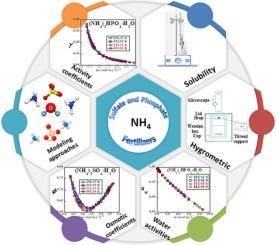
In this study, both experimental and calculated solubilities of binary aqueous solutions of diammonium (hydrogenphosphate or sulfate) were determined at various temperatures. The experimental solubilities of and ranged from = 5.260 to 8.641 and = 5.799 to 7.122 , respectively, between the temperatures of 298.15 K and 353.15 K. The thermodynamic properties of the studied systems were derived from water activity measurements. Thus, the water activities of these aqueous solutions were measured from dilute to saturated solutions using the hygrometric method at different temperatures. From the new experimental water activities, the osmotic coefficients of water for the electrolyte solutions were obtained at the temperature range. The treatment of the obtained coefficients was made by the expanded ion interaction models. The related thermodynamic properties of the sub-binary systems were assessed using the developed models of Pitzer and Clegg–Pitzer–Brimblecombe. Indeed, the binary parameters of diammonium hydrogenphosphate or sulfate aqueous solutions were calculated and used for the computation of solute activity and osmotic coefficients; a good description of the calculated activity coefficients is acquired by the adequate models. The dissolution Gibbs energies and the solubility product of and were also evaluated at different temperatures. In addition, excess thermodynamic functions such as , and , along with the partial molar entropies of solvent and solute, were obtained. Based on these results, the sulfate and phosphate systems exhibit opposite hydration behavior and thermodynamic stability.
肥料中含磷酸氢二铵盐或硫酸盐的行为,在不同温度下水溶液的溶解度和热力学研究
在这项研究中,实验和计算的溶解度的二元水溶液(氢磷酸或硫酸)在不同的温度下进行了测定。在298.15 ~ 353.15 K范围内,NH42HPO4aq和NH42SO4aq的实验溶解度分别为msexp = 5.260 ~ 8.641 mol·kg−1和msexp = 5.799 ~ 7.122 mol·kg−1。所研究体系的热力学性质是由水活度测量得出的。因此,用湿度计法在不同温度下测量了这些水溶液从稀溶液到饱和溶液的水活度。根据新的实验水活度,得到了电解质溶液在温度范围内的渗透系数。用扩展的离子相互作用模型对所得系数进行处理。利用开发的Pitzer和Clegg-Pitzer-Brimblecombe模型评估了亚二元系统的相关热力学性质。实际上,计算了磷酸氢二铵或硫酸盐水溶液的二元参数,并将其用于计算溶质活度和渗透系数;适当的模型可以很好地描述计算出的活度系数。测定了不同温度下NH42HPO4s和NH42SO4s的溶解吉布斯能和溶解度积。此外,还得到了过量热力学函数∆GE、∆HE和∆SE,以及溶剂和溶质的偏摩尔熵。基于这些结果,硫酸盐和磷酸盐体系表现出相反的水化行为和热力学稳定性。
本文章由计算机程序翻译,如有差异,请以英文原文为准。
求助全文
约1分钟内获得全文
求助全文
来源期刊
Journal of Chemical Thermodynamics
工程技术-热力学
CiteScore
5.60
自引率
15.40%
发文量
199
审稿时长
79 days
期刊介绍:
The Journal of Chemical Thermodynamics exists primarily for dissemination of significant new knowledge in experimental equilibrium thermodynamics and transport properties of chemical systems. The defining attributes of The Journal are the quality and relevance of the papers published.
The Journal publishes work relating to gases, liquids, solids, polymers, mixtures, solutions and interfaces. Studies on systems with variability, such as biological or bio-based materials, gas hydrates, among others, will also be considered provided these are well characterized and reproducible where possible. Experimental methods should be described in sufficient detail to allow critical assessment of the accuracy claimed.
Authors are encouraged to provide physical or chemical interpretations of the results. Articles can contain modelling sections providing representations of data or molecular insights into the properties or transformations studied. Theoretical papers on chemical thermodynamics using molecular theory or modelling are also considered.
The Journal welcomes review articles in the field of chemical thermodynamics but prospective authors should first consult one of the Editors concerning the suitability of the proposed review.
Contributions of a routine nature or reporting on uncharacterised materials are not accepted.
 求助内容:
求助内容: 应助结果提醒方式:

 京公网安备 11010802042870号


