
Community factors associated with the prevalence of pedestrian barrier removal plans in U.S. municipalities

IF 3.3 3区 工程技术 Q2 PUBLIC, ENVIRONMENTAL & OCCUPATIONAL HEALTH
Journal of Transport & Health Pub Date : 2026-05-01 Epub Date: 2026-02-14 DOI:10.1016/j.jth.2026.102277
Yochai Eisenberg , Sajad Askari
{"title":"Community factors associated with the prevalence of pedestrian barrier removal plans in U.S. municipalities","authors":"Yochai Eisenberg ,&nbsp;Sajad Askari","doi":"10.1016/j.jth.2026.102277","DOIUrl":null,"url":null,"abstract":"<div><h3>Introduction</h3><div>Safe and accessible pedestrian infrastructure is a necessity for supporting walking and wheeling among people with disabilities. Yet, progress towards improving accessibility is limited, as is the amount of walking and wheeling among people with disabilities. Furthermore, most communities lack a plan for removing pedestrian barriers known as an Americans with Disabilities Act (ADA) transition plan. Limited research has examined what community factors are associated with having a plan.</div></div><div><h3>Methods</h3><div>Using data from the 2021 Community-Based Policies and Environmental Supports for Healthy Eating and Active Living survey, this study investigates three objectives among a nationally representative sample of local governments: (1) estimate the national prevalence of ADA transition plans, (2) examine the relationship between socio-economic indicators and the odds of having such plans, and 3) explore the relationship between having a similar pedestrian safety focused plan and having an ADA transition plan. We ran descriptive analysis, bivariate, and multivariable statistical tests to examine associations with having a plan.</div></div><div><h3>Results</h3><div>Only 33.55% of municipalities reported having an ADA Transition Plan. Prevalence was lower in Northeast communities and municipalities with fewer than 2500 residents (non-urban areas). Communities with higher proportions of residents with disabilities had significantly greater odds of being in the process of plan development, but were not associated with having an adopted plan. The presence of pedestrian-oriented policies, such as Vision Zero and Complete Streets, was positively associated with the odds of having a plan. Poverty levels, median household income, and the percentage of residents with a bachelor's degree or higher were not associated with having an adopted plan.</div></div><div><h3>Conclusion</h3><div>Integrating ADA compliance within a broader, active mobility-focused planning framework could advance progress toward accessible pathways and support increased walking and wheeling among community members with and without disabilities. Smaller communities need additional support for ADA Transition Plan development and implementation.</div></div>","PeriodicalId":47838,"journal":{"name":"Journal of Transport & Health","volume":"48 ","pages":"Article 102277"},"PeriodicalIF":3.3000,"publicationDate":"2026-05-01","publicationTypes":"Journal Article","fieldsOfStudy":null,"isOpenAccess":false,"openAccessPdf":"","citationCount":"0","resultStr":null,"platform":"Semanticscholar","paperid":null,"PeriodicalName":"Journal of Transport & Health","FirstCategoryId":"3","ListUrlMain":"https://www.sciencedirect.com/science/article/pii/S2214140526000253","RegionNum":3,"RegionCategory":"工程技术","ArticlePicture":[],"TitleCN":null,"AbstractTextCN":null,"PMCID":null,"EPubDate":"2026/2/14 0:00:00","PubModel":"Epub","JCR":"Q2","JCRName":"PUBLIC, ENVIRONMENTAL & OCCUPATIONAL HEALTH","Score":null,"Total":0}
引用次数: 0

Abstract

Introduction

Safe and accessible pedestrian infrastructure is a necessity for supporting walking and wheeling among people with disabilities. Yet, progress towards improving accessibility is limited, as is the amount of walking and wheeling among people with disabilities. Furthermore, most communities lack a plan for removing pedestrian barriers known as an Americans with Disabilities Act (ADA) transition plan. Limited research has examined what community factors are associated with having a plan.

Methods

Using data from the 2021 Community-Based Policies and Environmental Supports for Healthy Eating and Active Living survey, this study investigates three objectives among a nationally representative sample of local governments: (1) estimate the national prevalence of ADA transition plans, (2) examine the relationship between socio-economic indicators and the odds of having such plans, and 3) explore the relationship between having a similar pedestrian safety focused plan and having an ADA transition plan. We ran descriptive analysis, bivariate, and multivariable statistical tests to examine associations with having a plan.

Results

Only 33.55% of municipalities reported having an ADA Transition Plan. Prevalence was lower in Northeast communities and municipalities with fewer than 2500 residents (non-urban areas). Communities with higher proportions of residents with disabilities had significantly greater odds of being in the process of plan development, but were not associated with having an adopted plan. The presence of pedestrian-oriented policies, such as Vision Zero and Complete Streets, was positively associated with the odds of having a plan. Poverty levels, median household income, and the percentage of residents with a bachelor's degree or higher were not associated with having an adopted plan.

Conclusion

Integrating ADA compliance within a broader, active mobility-focused planning framework could advance progress toward accessible pathways and support increased walking and wheeling among community members with and without disabilities. Smaller communities need additional support for ADA Transition Plan development and implementation.
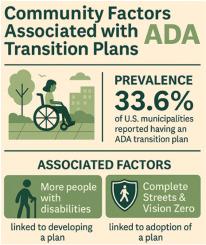
Abstract Image

社区因素与美国市政当局行人屏障拆除计划的流行相关
安全、方便的行人基础设施是支持残疾人行走和骑车的必要条件。然而,在改善可及性方面的进展有限,残疾人走路和坐轮椅的数量也是如此。此外,大多数社区缺乏一项消除行人障碍的计划,即《美国残疾人法案》(ADA)过渡计划。有限的研究调查了哪些社区因素与制定计划有关。方法利用2021年社区健康饮食和积极生活政策和环境支持调查的数据,本研究调查了具有全国代表性的地方政府样本中的三个目标:(1)估计全国ADA过渡计划的流行程度;(2)检验社会经济指标与制定此类计划的几率之间的关系;(3)探讨制定类似的行人安全重点计划与制定ADA过渡计划之间的关系。我们进行了描述性分析、双变量和多变量统计检验来检验与制定计划的关系。结果只有33.55%的城市报告有《美国残疾人法》过渡计划。在居民少于2500人的东北部社区和直辖市(非城市地区)患病率较低。残障居民比例较高的社区在计划制定过程中的几率显著更高,但与已采用的计划无关。以行人为导向的政策的存在,如“零愿景”和“完整街道”,与制定计划的几率呈正相关。贫困水平、家庭收入中位数和拥有学士学位或更高学位的居民比例与采用计划无关。结论:将《美国残疾人法》合规纳入更广泛的、积极的以行动为重点的规划框架,可以推动无障碍道路的发展,并支持社区中残疾人和非残疾人增加步行和轮转。较小的社区需要为《美国残疾人法》过渡计划的制定和实施提供额外的支持。
本文章由计算机程序翻译,如有差异,请以英文原文为准。
求助全文
约1分钟内获得全文 求助全文
来源期刊
CiteScore
6.10
自引率
11.10%
发文量
196
审稿时长
69 days
×
引用
GB/T 7714-2015
复制
MLA
复制
APA
复制
导出至
BibTeX EndNote RefMan NoteFirst NoteExpress
×
提示
您的信息不完整,为了账户安全,请先补充。
现在去补充
×
提示
您因"违规操作"
具体请查看互助需知
我知道了
×
提示
确定
请完成安全验证×
copy
已复制链接
快去分享给好友吧!
我知道了
右上角分享
点击右上角分享
0
联系我们:info@booksci.cn Book学术提供免费学术资源搜索服务,方便国内外学者检索中英文文献。致力于提供最便捷和优质的服务体验。 Copyright © 2023 布克学术 All rights reserved.
京ICP备2023020795号-1
ghs 京公网安备 11010802042870号
Book学术文献互助
Book学术文献互助群
群 号:604180095
Book学术官方微信
小红书



