
LIO-VisionAR: Intelligence-enabled augmented reality guidance for laser indirect ophthalmoscope-based retinal laser therapy
Intelligence-based medicine
Pub Date : 2026-03-01
Epub Date: 2026-01-28
DOI:10.1016/j.ibmed.2026.100353
引用次数: 0
Abstract
Objective
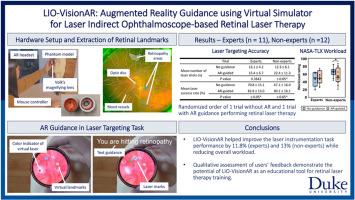
Laser indirect ophthalmoscope (LIO) retinal therapy is a complex procedure that demands precision. We present LIO-VisionAR, an intelligence-enabled augmented reality (AR) guidance system designed to support safer and more effective training for LIO-based retinal laser therapy.
Methods
A custom retina model with retinopathy areas was developed and integrated into a human phantom model. A virtual retina model and simulator were developed using the color fundus photo to compute the magnification and laser targeting guidance based on the user's AR head-mounted device movement. Randomized user trials compared conventional and AR-guided retinal laser tasks, while multimodal behavioral telemetry were recorded for quantitative performance analysis and proof-of-concept skill inference.
Results
A total of 11 experts and 12 non-experts were included in the study. With AR guidance, laser targeting accuracy increased from 70.8 % to 82.6 % for experts and from 65.7 % to 81.7 % for non-experts. AR guidance increased laser instrumentation time, reflecting a deliberate speed–accuracy trade-off. Analysis of AR-captured behavioral telemetry showed that gaze exploration and temporal control features were associated with performance, and unsupervised clustering revealed distinct behavioral strategies linked to progressively higher accuracy. A composite performance-based skill score exhibited a moderate positive association with laser accuracy (Spearman ρ = 0.45, p = 0.032). Over 80 % of experts agreed that our system is appropriate for teaching and could improve retinal laser therapy training and safety.
Conclusions
LIO-VisionAR improves procedural accuracy under simulated conditions and demonstrates a concrete pathway toward adaptive, intelligence-based AR guidance for ophthalmic microsurgical training.
LIO-VisionAR:用于激光间接检眼镜视网膜激光治疗的智能增强现实指导
目的激光间接检眼镜(LIO)视网膜治疗是一项复杂的手术,要求精度高。我们提出了一种智能增强现实(AR)引导系统,旨在支持更安全,更有效的基于lio的视网膜激光治疗培训。方法建立具有视网膜病变区域的定制视网膜模型,并将其整合到人体幻影模型中。利用彩色眼底照片建立了虚拟视网膜模型和模拟器,计算了基于用户AR头戴式设备运动的放大倍率和激光瞄准制导。随机用户试验比较了传统和ar制导视网膜激光任务,同时记录了多模态行为遥测,用于定量性能分析和概念验证技能推断。结果共纳入专家11人,非专家12人。使用AR制导,专家激光瞄准精度从70.8%增加到82.6%,非专家激光瞄准精度从65.7%增加到81.7%。AR制导增加了激光仪器时间,反映了有意的速度精度权衡。ar捕捉的行为遥测分析表明,凝视探索和时间控制特征与性能相关,无监督聚类揭示了不同的行为策略,这些策略与逐渐提高的准确性相关。基于性能的综合技能得分与激光精度呈正相关(Spearman ρ = 0.45, p = 0.032)。超过80%的专家认为我们的系统适合教学,可以提高视网膜激光治疗的培训和安全性。结论slio - visionar提高了模拟条件下的操作精度,为自适应智能AR指导眼科显微外科训练提供了具体途径。
本文章由计算机程序翻译,如有差异,请以英文原文为准。
求助全文
约1分钟内获得全文
求助全文

 求助内容:
求助内容: 应助结果提醒方式:

 京公网安备 11010802042870号


