
Correlating chemico-physical features of thymol-based deep eutectic solvents with astaxanthin extraction performances
IF 5.2
2区 化学
Q2 CHEMISTRY, PHYSICAL
Journal of Molecular Liquids
Pub Date : 2026-04-15
Epub Date: 2026-02-06
DOI:10.1016/j.molliq.2026.129357
引用次数: 0
Abstract
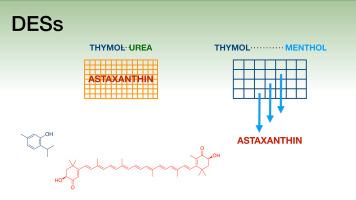
Hydrophobic/water-insoluble Deep Eutectic Solvents (DESs), such as the thymol-based ones, are widely used and studied for the extraction and pre-concentration of valuable compounds from various matrices. In this paper, a structure-activity approach was used to determine the factors that influence the efficacy of a series of thymol-based hydrophobic DESs applied for the extraction of astaxanthin from genetically-modified Picosynechococcus sp. PCC 11901, a recently discovered cyanobacterium. As expected, the polarity of the media plays a significant role, but surprisingly, the intimacy of the molecules forming the DESs has a relevant role in the process as well, showing this parameter to be crucial for their performances. This parameter is also linked to the viscosity, which is also playing a key role in the processes. Moreover, the comparison of the results with an ideal non-DES mixture showed a non-correlation of this liquid with the set of DESs used, underlining the importance of the liquid's identity determination in this field.
百里香基深共晶溶剂的化学物理特性与虾青素提取性能的关系
疏水/不溶性深共晶溶剂(DESs),如百里香基深共晶溶剂,在各种基质中有价化合物的提取和预富集方面得到了广泛的应用和研究。本文采用结构-活性法研究了一系列以百里香为基础的疏水脱氢酶(DESs)对新发现的转基因皮聚球菌(Picosynechococcus sp. PCC 11901)虾青素提取效果的影响因素。正如预期的那样,介质的极性起着重要的作用,但令人惊讶的是,形成DESs的分子的亲密度在这个过程中也起着相关的作用,表明这个参数对它们的性能至关重要。该参数还与粘度有关,粘度在过程中也起着关键作用。此外,将结果与理想的非des混合物进行比较,发现该液体与所使用的des集不相关,强调了该液体在该领域的身份确定的重要性。
本文章由计算机程序翻译,如有差异,请以英文原文为准。
求助全文
约1分钟内获得全文
求助全文
来源期刊
Journal of Molecular Liquids
化学-物理:原子、分子和化学物理
CiteScore
10.30
自引率
16.70%
发文量
2597
审稿时长
78 days
期刊介绍:
The journal includes papers in the following areas:
– Simple organic liquids and mixtures
– Ionic liquids
– Surfactant solutions (including micelles and vesicles) and liquid interfaces
– Colloidal solutions and nanoparticles
– Thermotropic and lyotropic liquid crystals
– Ferrofluids
– Water, aqueous solutions and other hydrogen-bonded liquids
– Lubricants, polymer solutions and melts
– Molten metals and salts
– Phase transitions and critical phenomena in liquids and confined fluids
– Self assembly in complex liquids.– Biomolecules in solution
The emphasis is on the molecular (or microscopic) understanding of particular liquids or liquid systems, especially concerning structure, dynamics and intermolecular forces. The experimental techniques used may include:
– Conventional spectroscopy (mid-IR and far-IR, Raman, NMR, etc.)
– Non-linear optics and time resolved spectroscopy (psec, fsec, asec, ISRS, etc.)
– Light scattering (Rayleigh, Brillouin, PCS, etc.)
– Dielectric relaxation
– X-ray and neutron scattering and diffraction.
Experimental studies, computer simulations (MD or MC) and analytical theory will be considered for publication; papers just reporting experimental results that do not contribute to the understanding of the fundamentals of molecular and ionic liquids will not be accepted. Only papers of a non-routine nature and advancing the field will be considered for publication.
 求助内容:
求助内容: 应助结果提醒方式:

 京公网安备 11010802042870号


