
Acetic acid-modified MIL-125(Ti) photocatalysts for efficient degradation of tetracycline in seawater
IF 3.3
3区 化学
Q2 CHEMISTRY, INORGANIC & NUCLEAR
Solid State Sciences
Pub Date : 2026-05-01
Epub Date: 2026-01-31
DOI:10.1016/j.solidstatesciences.2026.108234
引用次数: 0
Abstract
Photocatalytic degradation of antibiotics in high-salinity seawater remains challenging due to salt ion interference and limited visible-light utilization. In this study, we developed a defect-rich titanium-based metal–organic framework (MIL-125(HAC)) through acetic acid modulation via a solvothermal method. The optimized MIL-125(HAC)-3 photocatalyst exhibited remarkable tetracycline (TC) degradation efficiency in seawater, reaching 90.9% after 60 min of visible-light irradiation (compared with 90.0% in deionized water) and maintaining over 85% efficiency after five cycles. This demonstrates its robust resistance to salt ion interference. Additionally, the degradation rate constant of MIL-125(HAC)-3 in seawater (0.0283 min−1) was 25 times higher than that of commercial TiO2, highlighting its superior photocatalytic performance. The enhanced performance is attributed to the introduction of acetic acid, which induced a rich mesoporous defect structure, facilitating selective TC adsorption and significantly broadening the visible light response range. Free radical trapping experiments and electron paramagnetic resonance (EPR) spectroscopy further revealed that superoxide radicals (•O2−) and holes (h+) serve as the primary active species in the degradation process. This work offers a scalable and effective strategy for designing marine-tolerant photocatalysts to remediate antibiotic pollution.
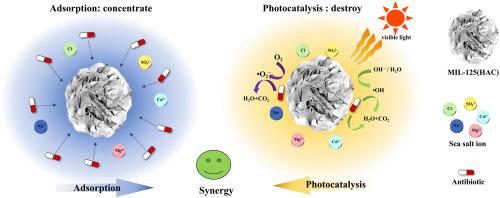
醋酸改性MIL-125(Ti)光催化剂在海水中高效降解四环素的研究
由于盐离子干扰和可见光利用有限,高盐度海水中抗生素的光催化降解仍然具有挑战性。在这项研究中,我们通过溶剂热法通过乙酸调制开发了一种富缺陷的钛基金属有机骨架(MIL-125(HAC))。优化后的MIL-125(HAC)-3光催化剂在海水中表现出显著的四环素(TC)降解效率,在可见光照射60 min后达到90.9%(在去离子水中为90.0%),5个循环后效率保持在85%以上。这证明了它对盐离子干扰的强大抵抗能力。此外,MIL-125(HAC)-3在海水中的降解速率常数(0.0283 min−1)是商用TiO2的25倍,显示出其优越的光催化性能。性能的增强归功于乙酸的引入,乙酸诱导了丰富的介孔缺陷结构,促进了TC的选择性吸附,并显着拓宽了可见光响应范围。自由基捕获实验和电子顺磁共振(EPR)谱进一步揭示了超氧自由基(•O2−)和空穴(h+)是降解过程中的主要活性物质。这项工作为设计海洋耐受光催化剂来修复抗生素污染提供了一种可扩展和有效的策略。
本文章由计算机程序翻译,如有差异,请以英文原文为准。
求助全文
约1分钟内获得全文
求助全文
来源期刊
Solid State Sciences
化学-无机化学与核化学
CiteScore
6.60
自引率
2.90%
发文量
214
审稿时长
27 days
期刊介绍:
Solid State Sciences is the journal for researchers from the broad solid state chemistry and physics community. It publishes key articles on all aspects of solid state synthesis, structure-property relationships, theory and functionalities, in relation with experiments.
Key topics for stand-alone papers and special issues:
-Novel ways of synthesis, inorganic functional materials, including porous and glassy materials, hybrid organic-inorganic compounds and nanomaterials
-Physical properties, emphasizing but not limited to the electrical, magnetical and optical features
-Materials related to information technology and energy and environmental sciences.
The journal publishes feature articles from experts in the field upon invitation.
Solid State Sciences - your gateway to energy-related materials.
 求助内容:
求助内容: 应助结果提醒方式:

 京公网安备 11010802042870号


