HYpofractionated, dose-redistributed RAdiotherapy (HYDRA) versus conventional radiotherapy for head and neck cancer: planned interim analysis and dosimetric comparison from the phase I HYDRA trial

IF 2.7 3区 医学 Q3 ONCOLOGY
Pascal A. Gunsch , Michiel Kroesen , Reno Debets , Stijn Keereweer , Esther van Meerten , Jaap Zindler , Erik van Werkhoven , Mischa Hoogeman , Gerda M. Verduijn , Remi A. Nout , Joris B.W. Elbers
{"title":"HYpofractionated, dose-redistributed RAdiotherapy (HYDRA) versus conventional radiotherapy for head and neck cancer: planned interim analysis and dosimetric comparison from the phase I HYDRA trial","authors":"Pascal A. Gunsch ,&nbsp;Michiel Kroesen ,&nbsp;Reno Debets ,&nbsp;Stijn Keereweer ,&nbsp;Esther van Meerten ,&nbsp;Jaap Zindler ,&nbsp;Erik van Werkhoven ,&nbsp;Mischa Hoogeman ,&nbsp;Gerda M. Verduijn ,&nbsp;Remi A. Nout ,&nbsp;Joris B.W. Elbers","doi":"10.1016/j.ctro.2026.101113","DOIUrl":null,"url":null,"abstract":"<div><h3>Purpose</h3><div>(Chemo)radiotherapy for squamous cell carcinoma of the oropharynx, hypopharynx, and larynx results in significant treatment burden and may cause radiation-induced lymphopenia (RIL), which is associated with worse survival. We aim to reduce treatment burden and RIL using HYpofractionation and Dose-redistribution in patients treated with proton or photon RAdiotherapy (HYDRA, NCT05364411).</div></div><div><h3>Methods</h3><div>Patients receiving curative (chemo)radiotherapy for cT1-4 N0-3bM0 oropharyngeal and hypopharyngeal carcinomas are eligible. Referral for proton therapy is determined by model-based selection (MBS) according to Dutch protocols, resulting in a HYDRA-proton and HYDRA-photon cohort. HYDRA in 20 fractions constitutes 40 Gy to the elective volume, 55 Gy to gross tumour volume (GTV) + 5 mm and 59 Gy to GTV − 3 mm. Safety interim analyses are conducted in each cohort when ten patients complete 6 months follow-up. The interim results determine trial continuation and expansion to inclusion of laryngeal carcinomas according to predefined dose limiting toxicities (DLT). Per included HYDRA-patient, we perform an intra-patient plan comparison of the HYDRA plan versus the conventional treatment plan that was used for MBS.</div></div><div><h3>Results</h3><div>The HYDRA-photon interim analysis (reached in March 2024, <em>n</em> = 10) showed one DLT (osteoradionecrosis), with no other late grade ≥ 3 toxicity after a median follow-up of 10.6 months. Among all enrolled HYDRA-patients (photons: <em>n</em> = 14; protons: <em>n</em> = 5), intra-patient plan comparison showed that HYDRA delivered a focal boost of Dmean 59.6 Gy (range 59.0–60.1 Gy) to the GTV, while on average, organs at risk received a reduced dose (HYDRA-photons: 0.4–4.5 Gy EQD2; HYDRA-protons: 2.1–5.0 GyE EQD2).</div></div><div><h3>Conclusions</h3><div>The predefined interim analysis of HYDRA-photons showed one DLT. Per protocol, inclusion of laryngeal carcinomas in the photon cohort is now possible. The 20 fraction HYDRA schedule delivers a focal boost to the tumour with reduced dose to all organs at risk.</div></div>","PeriodicalId":10342,"journal":{"name":"Clinical and Translational Radiation Oncology","volume":"58 ","pages":"Article 101113"},"PeriodicalIF":2.7000,"publicationDate":"2026-05-01","publicationTypes":"Journal Article","fieldsOfStudy":null,"isOpenAccess":false,"openAccessPdf":"","citationCount":"0","resultStr":null,"platform":"Semanticscholar","paperid":null,"PeriodicalName":"Clinical and Translational Radiation Oncology","FirstCategoryId":"3","ListUrlMain":"https://www.sciencedirect.com/science/article/pii/S240563082600008X","RegionNum":3,"RegionCategory":"医学","ArticlePicture":[],"TitleCN":null,"AbstractTextCN":null,"PMCID":null,"EPubDate":"2026/1/25 0:00:00","PubModel":"Epub","JCR":"Q3","JCRName":"ONCOLOGY","Score":null,"Total":0}
引用次数: 0

Abstract

Purpose

(Chemo)radiotherapy for squamous cell carcinoma of the oropharynx, hypopharynx, and larynx results in significant treatment burden and may cause radiation-induced lymphopenia (RIL), which is associated with worse survival. We aim to reduce treatment burden and RIL using HYpofractionation and Dose-redistribution in patients treated with proton or photon RAdiotherapy (HYDRA, NCT05364411).

Methods

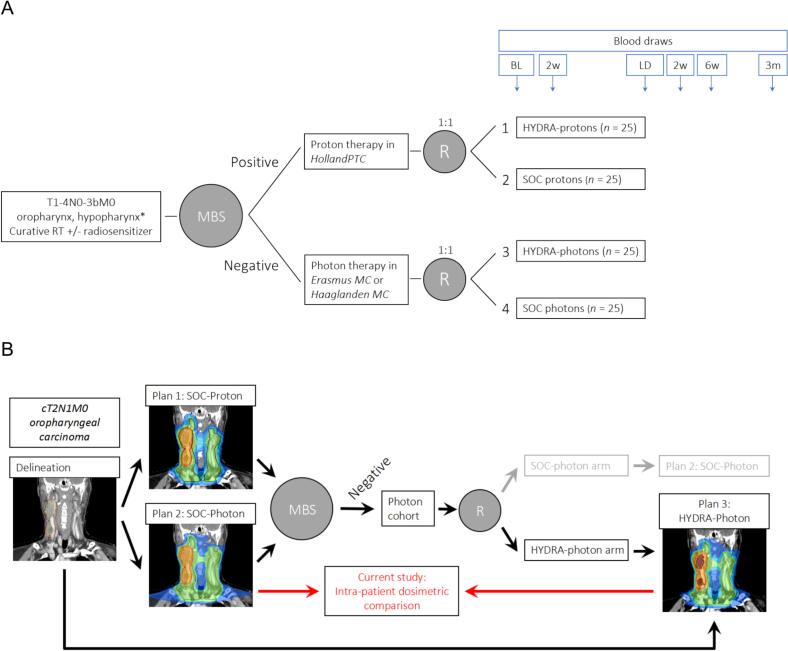
Patients receiving curative (chemo)radiotherapy for cT1-4 N0-3bM0 oropharyngeal and hypopharyngeal carcinomas are eligible. Referral for proton therapy is determined by model-based selection (MBS) according to Dutch protocols, resulting in a HYDRA-proton and HYDRA-photon cohort. HYDRA in 20 fractions constitutes 40 Gy to the elective volume, 55 Gy to gross tumour volume (GTV) + 5 mm and 59 Gy to GTV − 3 mm. Safety interim analyses are conducted in each cohort when ten patients complete 6 months follow-up. The interim results determine trial continuation and expansion to inclusion of laryngeal carcinomas according to predefined dose limiting toxicities (DLT). Per included HYDRA-patient, we perform an intra-patient plan comparison of the HYDRA plan versus the conventional treatment plan that was used for MBS.

Results

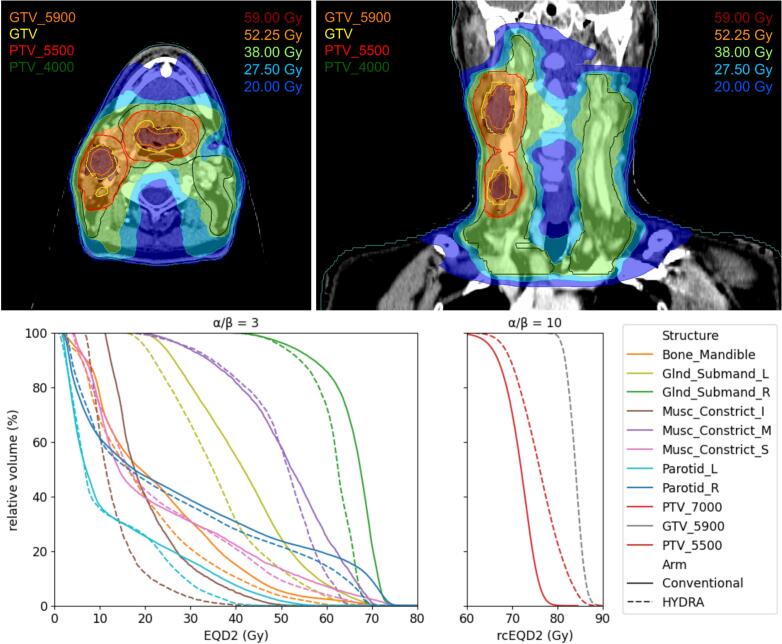
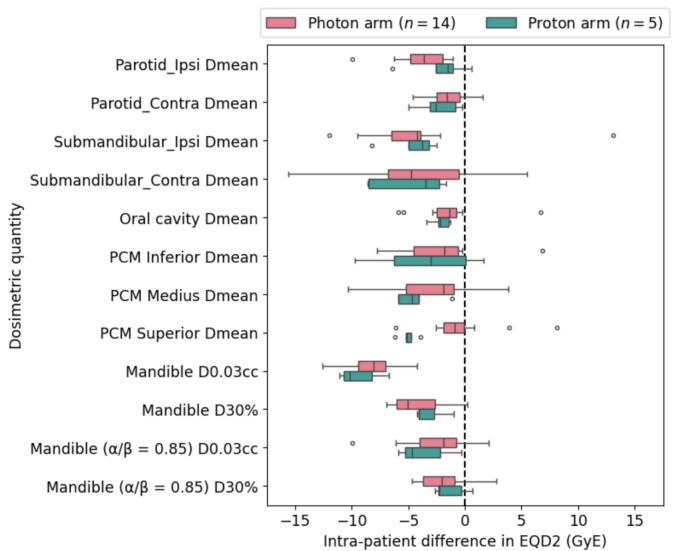
The HYDRA-photon interim analysis (reached in March 2024, n = 10) showed one DLT (osteoradionecrosis), with no other late grade ≥ 3 toxicity after a median follow-up of 10.6 months. Among all enrolled HYDRA-patients (photons: n = 14; protons: n = 5), intra-patient plan comparison showed that HYDRA delivered a focal boost of Dmean 59.6 Gy (range 59.0–60.1 Gy) to the GTV, while on average, organs at risk received a reduced dose (HYDRA-photons: 0.4–4.5 Gy EQD2; HYDRA-protons: 2.1–5.0 GyE EQD2).

Conclusions

The predefined interim analysis of HYDRA-photons showed one DLT. Per protocol, inclusion of laryngeal carcinomas in the photon cohort is now possible. The 20 fraction HYDRA schedule delivers a focal boost to the tumour with reduced dose to all organs at risk.
Abstract Image

Abstract Image

Abstract Image

低分割、剂量再分配放疗(HYDRA)与常规放疗治疗头颈癌:计划的中期分析和I期HYDRA试验的剂量学比较
目的:口咽部、下咽和喉部鳞状细胞癌的(化疗)放疗带来了显著的治疗负担,并可能引起放射性淋巴细胞减少症(RIL),其生存率较差。我们的目标是在质子或光子放疗患者中使用低分割和剂量重新分配来减轻治疗负担和RIL (HYDRA, NCT05364411)。方法:对cT1-4 N0-3bM0口咽癌和下咽癌患者进行治疗性(化疗)放疗。根据荷兰协议,质子治疗的转诊由基于模型的选择(MBS)决定,从而产生hydra质子和hydra光子队列。20个部分的HYDRA对可选体积构成40 Gy,对总肿瘤体积(GTV) + 5 mm构成55 Gy,对GTV - 3 mm构成59 Gy。当10名患者完成6个月的随访时,对每个队列进行安全性中期分析。中期结果决定了试验的继续和扩展,根据预先确定的剂量限制毒性(DLT)纳入喉癌。对于纳入的HYDRA患者,我们对HYDRA计划与用于MBS的传统治疗计划进行了患者内部计划比较。结果:在中位随访10.6个月后,HYDRA-photon中期分析(2024年3月,n = 10)显示1例DLT(骨放射性坏死),无其他晚期≥3级毒性。在所有入组的HYDRA患者(光子:n = 14,质子:n = 5)中,患者内部计划比较显示HYDRA对GTV的局灶增强平均为59.6 Gy(范围59.0-60.1 Gy),而危险器官接受的平均剂量减少(HYDRA光子:0.4-4.5 Gy EQD2; HYDRA质子:2.1-5.0 GyE EQD2)。结论:预先确定的hydra光子中期分析显示一个DLT。根据协议,将喉癌纳入光子队列现在是可能的。20分的HYDRA计划对肿瘤进行局部增强,对所有危险器官的剂量减少。
本文章由计算机程序翻译,如有差异,请以英文原文为准。
求助全文
约1分钟内获得全文 求助全文
来源期刊
Clinical and Translational Radiation Oncology
Clinical and Translational Radiation Oncology Medicine-Radiology, Nuclear Medicine and Imaging
CiteScore
5.30
自引率
3.20%
发文量
114
审稿时长
40 days

×
引用
GB/T 7714-2015
复制
MLA
复制
APA
复制
导出至
BibTeX EndNote RefMan NoteFirst NoteExpress
×
提示
您的信息不完整,为了账户安全,请先补充。
现在去补充
×
提示
您因"违规操作"
具体请查看互助需知
我知道了
×
提示
确定
请完成安全验证×
copy
已复制链接
快去分享给好友吧!
我知道了
右上角分享
点击右上角分享
0
联系我们:info@booksci.cn Book学术提供免费学术资源搜索服务,方便国内外学者检索中英文文献。致力于提供最便捷和优质的服务体验。 Copyright © 2023 布克学术 All rights reserved.
京ICP备2023020795号-1
ghs 京公网安备 11010802042870号
Book学术文献互助
Book学术文献互助群
群 号:604180095
Book学术官方微信
小红书