
Clinically aligned whole-body MRI segmentation of skeletal metastases via Supervised Anatomical Pretraining
IF 3.5
2区 医学
Q2 Medicine
引用次数: 0
Abstract
In oncology practice, response assessment of metastatic disease requires reliable and reproducible quantification of measurable metastatic burden. Manual identification, segmentation, and volumetry of all lesions is labor-intensive and variable, limiting routine clinical adoption. An automated approach is therefore needed. Segmenting metastatic bone disease (MBD) on whole-body MRI (WB-MRI) is challenging because of the heterogeneous appearance and anatomical distribution of lesions, ambiguous boundaries, and the low volumetric prevalence of metastatic deposits within the body. Training robust machine learning models for this task requires large, well-annotated datasets that capture lesion variability. However, assembling such datasets demands substantial expert time and is prone to annotation error. Although self-supervised learning (SSL) can take advantage of large unlabeled datasets, the learned representations tend to remain generic and may miss the subtle anatomical and pathological features essential for accurate lesion detection.
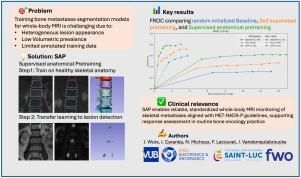
In this work, we propose a Supervised Anatomical Pretraining (SAP) method that learns from a limited dataset of anatomical labels. First, an MRI-based skeletal segmentation model is developed and trained on WB-MRI scans from healthy individuals for high-quality skeletal delineation. Then, we compare its downstream efficacy in segmenting MBD on a cohort of 40 patients with metastatic prostate cancer, against a randomly initialized baseline and a state-of-the-art self-supervised method.
SAP significantly outperforms both the Baseline and SSL-pretrained models achieving a normalized surface Dice of 0.78 and a Dice coefficient of 0.66. The method achieved a lesion detection score of 0.45, improving on 0.26 (Baseline) and 0.31 (SSL). When considering only clinically relevant lesions larger than 1 mL, SAP achieves a mean lesion level sensitivity of 0.89 at 0.46 false positives per exam, supporting reliable follow-up and treatment-response assessment.
Learning bone morphology from anatomy yields an effective and domain-relevant inductive bias that can be leveraged for the downstream segmentation task of bone lesions. These results highlight SAP’s clinical utility for standardized, high-sensitivity WB-MRI monitoring of skeletal metastases in routine bone oncology practice. All code and models are made publicly available.
通过监督解剖预训练的骨骼转移的临床对齐全身MRI分割
在肿瘤学实践中,转移性疾病的反应评估需要可靠和可重复的可测量转移性负担的量化。人工识别、分割和测量所有病变的体积是劳动密集型和可变的,限制了常规临床应用。因此需要一种自动化的方法。在全身MRI (WB-MRI)上分割转移性骨病(MBD)是具有挑战性的,因为病变的异质外观和解剖分布,边界模糊,以及体内转移性沉积物的低体积患病率。为这项任务训练健壮的机器学习模型需要大量的、注释良好的数据集,以捕获病变的可变性。然而,组装这样的数据集需要大量的专家时间,并且容易出现注释错误。尽管自监督学习(SSL)可以利用大量未标记的数据集,但学习到的表示往往保持一般性,可能会错过准确检测病变所必需的微妙解剖和病理特征。在这项工作中,我们提出了一种监督解剖预训练(SAP)方法,该方法从有限的解剖标签数据集中学习。首先,开发了基于mri的骨骼分割模型,并对健康个体的WB-MRI扫描进行了训练,以获得高质量的骨骼描绘。然后,我们比较了其对40例转移性前列腺癌患者进行MBD分段的下游疗效,对照随机初始化基线和最先进的自我监督方法。SAP显著优于Baseline和ssl预训练模型,实现了0.78的归一化表面Dice和0.66的Dice系数。该方法的病灶检测F2评分为0.45,较基线(0.26)和SSL(0.31)有所提高。当仅考虑大于1ml的临床相关病变时,SAP的平均病变水平敏感性为0.89,每次检查0.46个假阳性,支持可靠的随访和治疗反应评估。从解剖学中学习骨形态可以产生有效的和领域相关的归纳偏差,可以用于骨病变的下游分割任务。这些结果突出了SAP在常规骨肿瘤学实践中对骨骼转移进行标准化、高灵敏度WB-MRI监测的临床应用。所有的代码和模型都是公开的。
本文章由计算机程序翻译,如有差异,请以英文原文为准。
求助全文
约1分钟内获得全文
求助全文
来源期刊

Journal of Bone Oncology
ONCOLOGY-
CiteScore
7.20
自引率
2.90%
发文量
50
审稿时长
34 days
期刊介绍:
The Journal of Bone Oncology is a peer-reviewed international journal aimed at presenting basic, translational and clinical high-quality research related to bone and cancer.
As the first journal dedicated to cancer induced bone diseases, JBO welcomes original research articles, review articles, editorials and opinion pieces. Case reports will only be considered in exceptional circumstances and only when accompanied by a comprehensive review of the subject.
The areas covered by the journal include:
Bone metastases (pathophysiology, epidemiology, diagnostics, clinical features, prevention, treatment)
Preclinical models of metastasis
Bone microenvironment in cancer (stem cell, bone cell and cancer interactions)
Bone targeted therapy (pharmacology, therapeutic targets, drug development, clinical trials, side-effects, outcome research, health economics)
Cancer treatment induced bone loss (epidemiology, pathophysiology, prevention and management)
Bone imaging (clinical and animal, skeletal interventional radiology)
Bone biomarkers (clinical and translational applications)
Radiotherapy and radio-isotopes
Skeletal complications
Bone pain (mechanisms and management)
Orthopaedic cancer surgery
Primary bone tumours
Clinical guidelines
Multidisciplinary care
Keywords: bisphosphonate, bone, breast cancer, cancer, CTIBL, denosumab, metastasis, myeloma, osteoblast, osteoclast, osteooncology, osteo-oncology, prostate cancer, skeleton, tumour.
 求助内容:
求助内容: 应助结果提醒方式:

 京公网安备 11010802042870号


