
Feasibility and oncologic outcome of en resection with intentional tumor transgression in primary spinal sarcoma: The Korean Society of Spinal Tumors multicenter study (KSST 2024–02)
IF 3.5
2区 医学
Q2 Medicine
引用次数: 0
Abstract
Introduction
Primary spinal sarcoma is rare and technically challenging, particularly when attempting en bloc resection with negative margins. Intentional tumor transgression may be used when Enneking-appropriate en bloc resection is not feasible, but its oncologic implications remain unclear. This study evaluated the feasibility and outcomes of en bloc resection with intentional tumor transgression compared with other resection strategies.
Methods
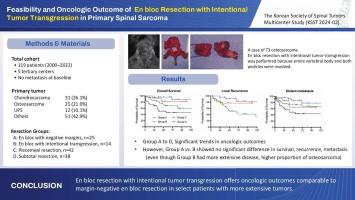
This multicenter retrospective study included patients who underwent surgery for primary spinal sarcoma across five tertiary hospitals from 2000 to 2022. Patients were grouped by resection method: (A) en bloc resection with negative margins, (B) en bloc resection with intentional tumor transgression, (C) piecemeal resection, and (D) subtotal resection. Tumor extent was assessed using a modified Weinstein-Boriani-Biagini classification. The primary outcome was overall survival; secondary outcomes included local recurrence, distant metastasis, and perioperative complications.
Results
The study included 119 patients (mean age 46.0 ± 19.8 years). Oncological outcomes (overall survival, local recurrence, and distant metastasis) demonstrated significant trends in survival analysis across groups A to D. Although Group B had more extensive disease (>3 quadrants, canal encroachment, multi-level involvement), its overall survival, local recurrence, and distant metastasis did not differ significantly from Group A (hazard ratio [HR] 0.54, p = 0.467; HR 0.46, p = 0.307; HR 0.46, p = 0.237, respectively). Complication rates were comparable between groups A and B.
Conclusion
En bloc resection with intentional tumor transgression offers oncologic outcomes comparable to margin-negative en bloc resection in selected patients with more extensive tumors. This technique may be a viable alternative when Enneking-appropriate en bloc resection is not feasible.
韩国脊柱肿瘤学会多中心研究(KSST 2024-02):原发性脊柱肉瘤全切除术合并故意肿瘤侵入的可行性和肿瘤学结果
原发性脊柱肉瘤是一种罕见且技术上具有挑战性的肉瘤,特别是当试图以阴性切缘进行整体切除时。当enneing -合适的整体切除不可行时,可以使用故意肿瘤越界,但其肿瘤学意义尚不清楚。本研究评估了有意肿瘤越界的整体切除与其他切除策略的可行性和结果。方法本多中心回顾性研究纳入了2000年至2022年5家三级医院的原发性脊柱肉瘤手术患者。患者按切除方法分组:(A)阴性切缘整块切除,(B)有意肿瘤越界整块切除,(C)分段切除,(D)次全切除。采用改良的Weinstein-Boriani-Biagini分类评估肿瘤范围。主要终点是总生存期;次要结果包括局部复发、远处转移和围手术期并发症。结果纳入119例患者,平均年龄46.0±19.8岁。肿瘤预后(总生存期、局部复发和远处转移)在A组至d组的生存分析中显示出显著的趋势。尽管B组的疾病范围更广(3个象限、管侵犯、多层级累及),但其总生存期、局部复发和远处转移与A组没有显著差异(风险比[HR] 0.54, p = 0.467; HR 0.46, p = 0.307; HR 0.46, p = 0.237)。A组和b组的并发症发生率相当。结论在肿瘤范围更广的患者中,有意肿瘤越界的整体切除与边缘阴性的整体切除的肿瘤预后相当。当enneking -合适的整块切除不可行时,该技术可能是一种可行的替代方法。
本文章由计算机程序翻译,如有差异,请以英文原文为准。
求助全文
约1分钟内获得全文
求助全文
来源期刊

Journal of Bone Oncology
ONCOLOGY-
CiteScore
7.20
自引率
2.90%
发文量
50
审稿时长
34 days
期刊介绍:
The Journal of Bone Oncology is a peer-reviewed international journal aimed at presenting basic, translational and clinical high-quality research related to bone and cancer.
As the first journal dedicated to cancer induced bone diseases, JBO welcomes original research articles, review articles, editorials and opinion pieces. Case reports will only be considered in exceptional circumstances and only when accompanied by a comprehensive review of the subject.
The areas covered by the journal include:
Bone metastases (pathophysiology, epidemiology, diagnostics, clinical features, prevention, treatment)
Preclinical models of metastasis
Bone microenvironment in cancer (stem cell, bone cell and cancer interactions)
Bone targeted therapy (pharmacology, therapeutic targets, drug development, clinical trials, side-effects, outcome research, health economics)
Cancer treatment induced bone loss (epidemiology, pathophysiology, prevention and management)
Bone imaging (clinical and animal, skeletal interventional radiology)
Bone biomarkers (clinical and translational applications)
Radiotherapy and radio-isotopes
Skeletal complications
Bone pain (mechanisms and management)
Orthopaedic cancer surgery
Primary bone tumours
Clinical guidelines
Multidisciplinary care
Keywords: bisphosphonate, bone, breast cancer, cancer, CTIBL, denosumab, metastasis, myeloma, osteoblast, osteoclast, osteooncology, osteo-oncology, prostate cancer, skeleton, tumour.
 求助内容:
求助内容: 应助结果提醒方式:

 京公网安备 11010802042870号


