
Transcutaneous electrical nerve stimulation improves walking in fatigued persons with multiple sclerosis: A randomized controlled trial
IF 4.6
3区 医学
Q1 REHABILITATION
Annals of Physical and Rehabilitation Medicine
Pub Date : 2026-04-01
Epub Date: 2026-02-11
DOI:10.1016/j.rehab.2025.102081
引用次数: 0
Abstract
Background
Walking difficulties and fatigue severely limit daily life in persons with multiple sclerosis (pwMS). Sensory stimulation, such as transcutaneous electrical nerve stimulation (TENS), might offer a non-pharmacological strategy to enhance motor function through sensorimotor interactions in the central nervous system.
Objective
This randomized, double-blinded, sham-controlled, parallel-group superiority trial investigated the effects of TENS applied to the knee extensors, with and without concurrent exercise, on walking and fatigue in pwMS.
Methods
PwMS (n = 80) with fatigue (FSS>4 or MFIS>38) and walking difficulties (MSWS-12>30) were randomized to one of four groups: TENS only (TENS; n = 21), TENS+exercises (COMBINATION; n = 20), sham stimulation (SHAM; n = 20) or sham+exercises (EXERCISE; n = 19) using a computer-generated stratified randomization. Each group performed twelve 10-min sessions over 4 weeks. Participants and outcome assessors were blinded to the stimulation type. Primary outcomes were walking performance (6-minute walk test, 6-MWT), fatigue (FSS, MFIS), and self-reported walking limitations (MSWS-12). Secondary outcomes were knee extensor strength and force steadiness and the 30-second chair-stand test (30-CST). Outcomes were assessed at baseline, immediately post-intervention, and at 2-week follow-up.
Results
Intention-to-treat linear mixed-effect models showed a significant time*group interaction for the 6-MWT (p < .05). Relative to SHAM, within-group comparisons indicated significant improvements in the TENS group only (+35 m [95% CI: 23.1–46.5] post-intervention; +35 m [95% CI: 22.4–48.4] at follow-up). Clinically meaningful improvements (>21.6 m) in walking distance were achieved by 74% of the TENS group compared to 44%, 40% and 28% in the COMBINATION, SHAM and EXERCISE group. FSS, MFIS, MSWS-12 and secondary outcomes improved across all groups, with no between-group differences. No important harms were notified.
Conclusions
TENS during rest, but not during exercise, improved walking performance in pwMS more than SHAM, but not subjective outcomes such as fatigue or perceived walking limitations. Future studies should investigate underlying neurophysiological mechanisms to optimize therapeutic outcomes.
Trial registration
ClinicalTrials.gov (NCT05321927).
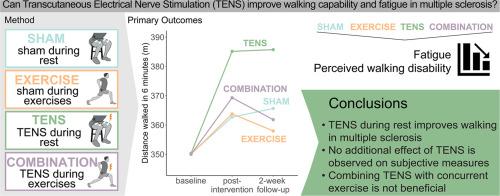
经皮神经电刺激改善多发性硬化症疲乏患者的行走:一项随机对照试验
行走困难和疲劳严重限制了多发性硬化(pwMS)患者的日常生活。感觉刺激,如经皮神经电刺激(TENS),可能提供一种非药物策略,通过中枢神经系统的感觉-运动相互作用来增强运动功能。目的:本研究是一项随机、双盲、假对照、平行组的优势试验,研究在有和没有同时运动的情况下,膝关节伸肌应用TENS对pwMS患者行走和疲劳的影响。方法采用计算机分层随机化方法,将80例伴有疲劳(FSS>;4或MFIS>;38)和行走困难(MSWS-12>30)的spwms患者随机分为单纯TENS组(TENS; n = 21)、TENS+运动组(COMBINATION; n = 20)、假手术刺激组(sham; n = 20)或假手术+运动组(EXERCISE; n = 19)。每组在4周内进行12次10分钟的训练。参与者和结果评估者对刺激类型不知情。主要结果是步行表现(6分钟步行测试,6-MWT)、疲劳(FSS, MFIS)和自我报告的步行限制(MSWS-12)。次要结果是膝关节伸肌强度和力量稳定性以及30秒椅-架测试(30-CST)。在基线、干预后立即和2周随访时评估结果。结果意向-治疗线性混合效应模型显示6-MWT存在显著的时间*组相互作用(p < 0.05)。相对于SHAM,组内比较显示仅TENS组有显著改善(干预后+35 m [95% CI: 23.1-46.5];随访时+35 m [95% CI: 22.4-48.4])。有临床意义的步行距离改善(>;21.6米)在TENS组中有74%,而在联合、SHAM和运动组中分别为44%、40%和28%。FSS、MFIS、MSWS-12和次要结局在所有组中均有改善,组间无差异。没有重大危害报告。结论在休息时,而不是在运动时,stens能改善pwMS患者的行走表现,但对疲劳或感知行走限制等主观结果没有改善。未来的研究应探讨潜在的神经生理机制,以优化治疗效果。试验注册:clinicaltrials .gov (NCT05321927)。
本文章由计算机程序翻译,如有差异,请以英文原文为准。
求助全文
约1分钟内获得全文
求助全文
来源期刊
Annals of Physical and Rehabilitation Medicine
Medicine-Rehabilitation
CiteScore
7.80
自引率
4.30%
发文量
136
审稿时长
34 days
期刊介绍:
Annals of Physical and Rehabilitation Medicine covers all areas of Rehabilitation and Physical Medicine; such as: methods of evaluation of motor, sensory, cognitive and visceral impairments; acute and chronic musculoskeletal disorders and pain; disabilities in adult and children ; processes of rehabilitation in orthopaedic, rhumatological, neurological, cardiovascular, pulmonary and urological diseases.
 求助内容:
求助内容: 应助结果提醒方式:

 京公网安备 11010802042870号


