
Thermo-mechanical vibration analysis of bi-directional functionally graded plates in bi-directional temperature fields
IF 4.9
2区 工程技术
Q1 ACOUSTICS
Journal of Sound and Vibration
Pub Date : 2026-05-12
Epub Date: 2026-02-03
DOI:10.1016/j.jsv.2026.119684
引用次数: 0
Abstract
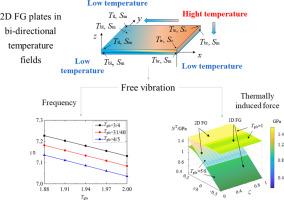
Characterized by continuous material gradient in two spatial directions, bi-directional functionally graded materials (2D FGMs) are born to adapt to the bi-directional temperature fields (2D TF) near the stagnation point of hypersonic vehicle wing leading edges. Their unique configuration mitigates peak thermal stresses and homogenizes stress distribution, which exhibits promising potential in hypersonic vehicles. Existing studies predominantly focused on uniform/unidirectional TFs or axisymmetric geometries, with natural frequencies derived numerically. This study investigated the dynamic characteristics of 2D FGM square plates with temperature-dependent material properties subjected to 2D TFs that approximating service conditions for the first time. First, a 2D TF model conforming to the heat conduction equation was established. Second, governing equations were derived based on the power-law function, four-variable shear deformation theory, and Hamilton’s principle. Subsequently, an analytical framework integrating the Levy method, the perturbation approach, and the state-space method was developed and validated. Finally, the compound parametric effects of TFs, power-law indexes, and material gradients were investigated. It was found that, frequencies and thermally induced forces are more sensitive to the temperature gradient along the thickness direction; The 2D material gradient coordinated with the 2D TF and effectively suppresses thermally induced forces across most regions.
双向温度场下双向功能梯度板的热-机械振动分析
为了适应高超声速飞行器机翼前缘驻点附近的双向温度场,在两个空间方向上具有连续的材料梯度特征的双向功能梯度材料(2D fgm)应运而生。其独特的结构减轻了峰值热应力和均匀应力分布,在高超声速飞行器中显示出很好的潜力。现有的研究主要集中在均匀/单向tf或轴对称几何上,其固有频率是数值推导的。本文首次研究了具有温度相关材料性能的二维FGM方形板在接近使用条件的二维tf作用下的动态特性。首先,建立符合热传导方程的二维TF模型。其次,基于幂律函数、四变量剪切变形理论和Hamilton原理推导了控制方程;随后,开发并验证了一个综合Levy方法、微扰方法和状态空间方法的分析框架。最后,研究了TFs、幂律指数和材料梯度的复合参数效应。结果表明,频率和热激力对沿厚度方向的温度梯度更为敏感;二维材料梯度与二维TF协调,有效地抑制了大部分区域的热诱导力。
本文章由计算机程序翻译,如有差异,请以英文原文为准。
求助全文
约1分钟内获得全文
求助全文
来源期刊
Journal of Sound and Vibration
工程技术-工程:机械
CiteScore
9.10
自引率
10.60%
发文量
551
审稿时长
69 days
期刊介绍:
The Journal of Sound and Vibration (JSV) is an independent journal devoted to the prompt publication of original papers, both theoretical and experimental, that provide new information on any aspect of sound or vibration. There is an emphasis on fundamental work that has potential for practical application.
JSV was founded and operates on the premise that the subject of sound and vibration requires a journal that publishes papers of a high technical standard across the various subdisciplines, thus facilitating awareness of techniques and discoveries in one area that may be applicable in others.
 求助内容:
求助内容: 应助结果提醒方式:

 京公网安备 11010802042870号


