Prognostic value of RecurIndex in differentiating HER2-low from HER2-negative early-stage breast cancer: a comprehensive clinicopathologic and molecular analysis in Chinese patients.
{"title":"Prognostic value of RecurIndex in differentiating HER2-low from HER2-negative early-stage breast cancer: a comprehensive clinicopathologic and molecular analysis in Chinese patients.","authors":"Shuo Zhang, Tianli Hui, Wei Gao, Jiajie Shi, Meng Cheng, Mengxiao Wang, Dongsheng Chen, Xing Zhang, Yuan Tan, Cuizhi Geng","doi":"10.21037/tbcr-25-54","DOIUrl":null,"url":null,"abstract":"<p><strong>Background: </strong>Breast cancer (BC) has become the most prevalent malignancy worldwide in recent years. Human epidermal growth factor receptor 2 (HER2) low-expressing tumors account for approximately 60% of BCs in clinical practice, and HER2 low-expression is defined as immunohistochemistry (IHC) 1+ or 2+, along with negative fluorescence in situ hybridization (FISH). Although the efficacy of antibody-drug combinations (ADCs) for the treatment of metastatic HER2 low-expressing BC has been demonstrated, there is still a lack of data on the clinicopathologic characteristics, risk of recurrence, and adjuvant treatment outcomes of early-stage HER2-overexpressing BC compared with non-HER2-overexpressing BC. The objective of this study is to explore whether the clinically validated RecurIndex assay could provide additional prognostic stratification between HER2-low and HER2-zero early-stage BCs in a real-world, single-center cohort.</p><p><strong>Methods: </strong>A retrospective analysis of data from 120 patients diagnosed with pT1-2N1M0 BC who had undergone RecurIndex testing. In order to enhance our comprehension of HER2-negative and HER2-positive tumors, we examined the clinicopathological characteristics, survival outcomes, and the RecurIndex risk model index for BCs categorized by HER2 status.</p><p><strong>Results: </strong>In our study, there were significantly fewer hormone receptor-positive (HR<sup>+</sup>) patients in the HER2-zero group than in the HER2-low group. Other than that, other clinical characteristics were similar. Local recurrence (LR) and distal recurrence (DR) scores were statistically increased in the HER2-zero group (LR-score: HER2-zero <i>vs.</i> HER2-low group: median 41.3 <i>vs.</i> 39.2, P=0.03; DR-score: median 46.9 <i>vs.</i> 44.8, P=0.003). In the HR<sup>+</sup> subgroup, the 9-year recurrence-free survival (RFS) was significantly higher in HER2-low BC than in HER2-zero BC [77.8% <i>vs.</i> 53.5%; hazard ratio =0.3026; 95% confidence interval (CI): 0.1039-0.8817; P=0.03]. HR<sup>+</sup> DR low-risk BC patients without adjuvant chemotherapy had better 9-year RFS (100% <i>vs.</i> 99.7%, P=0.60) and overall survival (OS) (100% <i>vs.</i> 99.7%, P=0.60) than those who received chemotherapy.</p><p><strong>Conclusions: </strong>Our results demonstrated that HER2-zero group have a higher recurrence risk and poor prognosis than HER2-low group. HER2-low HR<sup>+</sup> RecurIndex-DR low risk patients may not benefit from adjuvant chemotherapy. RecurIndex may help explore prognostic stratification and may guide potential chemotherapy de-escalation in HER2-low early BC, laying groundwork for future ADC use.</p>","PeriodicalId":101427,"journal":{"name":"Translational breast cancer research : a journal focusing on translational research in breast cancer","volume":"7 ","pages":"5"},"PeriodicalIF":1.4000,"publicationDate":"2026-01-27","publicationTypes":"Journal Article","fieldsOfStudy":null,"isOpenAccess":false,"openAccessPdf":"https://www.ncbi.nlm.nih.gov/pmc/articles/PMC12885771/pdf/","citationCount":"0","resultStr":null,"platform":"Semanticscholar","paperid":null,"PeriodicalName":"Translational breast cancer research : a journal focusing on translational research in breast cancer","FirstCategoryId":"1085","ListUrlMain":"https://doi.org/10.21037/tbcr-25-54","RegionNum":0,"RegionCategory":null,"ArticlePicture":[],"TitleCN":null,"AbstractTextCN":null,"PMCID":null,"EPubDate":"2026/1/1 0:00:00","PubModel":"eCollection","JCR":"","JCRName":"","Score":null,"Total":0}
引用次数: 0
Abstract
Background: Breast cancer (BC) has become the most prevalent malignancy worldwide in recent years. Human epidermal growth factor receptor 2 (HER2) low-expressing tumors account for approximately 60% of BCs in clinical practice, and HER2 low-expression is defined as immunohistochemistry (IHC) 1+ or 2+, along with negative fluorescence in situ hybridization (FISH). Although the efficacy of antibody-drug combinations (ADCs) for the treatment of metastatic HER2 low-expressing BC has been demonstrated, there is still a lack of data on the clinicopathologic characteristics, risk of recurrence, and adjuvant treatment outcomes of early-stage HER2-overexpressing BC compared with non-HER2-overexpressing BC. The objective of this study is to explore whether the clinically validated RecurIndex assay could provide additional prognostic stratification between HER2-low and HER2-zero early-stage BCs in a real-world, single-center cohort.
Methods: A retrospective analysis of data from 120 patients diagnosed with pT1-2N1M0 BC who had undergone RecurIndex testing. In order to enhance our comprehension of HER2-negative and HER2-positive tumors, we examined the clinicopathological characteristics, survival outcomes, and the RecurIndex risk model index for BCs categorized by HER2 status.
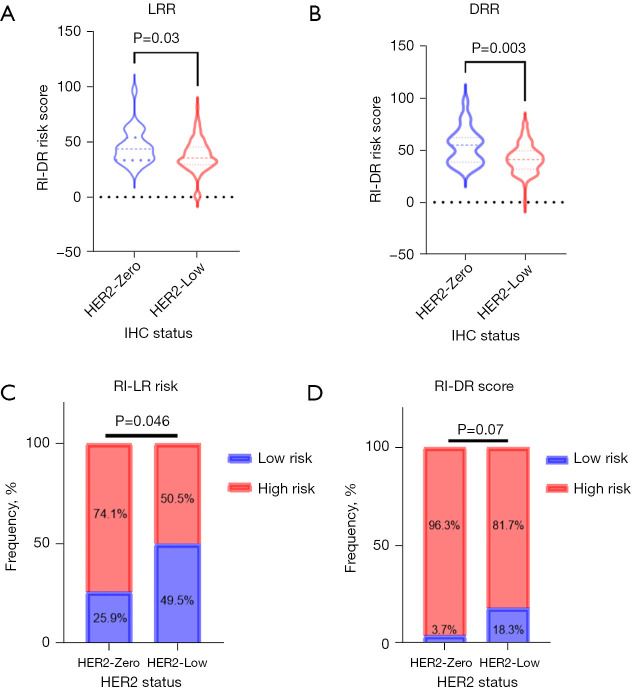
Results: In our study, there were significantly fewer hormone receptor-positive (HR+) patients in the HER2-zero group than in the HER2-low group. Other than that, other clinical characteristics were similar. Local recurrence (LR) and distal recurrence (DR) scores were statistically increased in the HER2-zero group (LR-score: HER2-zero vs. HER2-low group: median 41.3 vs. 39.2, P=0.03; DR-score: median 46.9 vs. 44.8, P=0.003). In the HR+ subgroup, the 9-year recurrence-free survival (RFS) was significantly higher in HER2-low BC than in HER2-zero BC [77.8% vs. 53.5%; hazard ratio =0.3026; 95% confidence interval (CI): 0.1039-0.8817; P=0.03]. HR+ DR low-risk BC patients without adjuvant chemotherapy had better 9-year RFS (100% vs. 99.7%, P=0.60) and overall survival (OS) (100% vs. 99.7%, P=0.60) than those who received chemotherapy.
Conclusions: Our results demonstrated that HER2-zero group have a higher recurrence risk and poor prognosis than HER2-low group. HER2-low HR+ RecurIndex-DR low risk patients may not benefit from adjuvant chemotherapy. RecurIndex may help explore prognostic stratification and may guide potential chemotherapy de-escalation in HER2-low early BC, laying groundwork for future ADC use.




 求助内容:
求助内容: 应助结果提醒方式:

 京公网安备 11010802042870号


