Daniël C M Huijten, Veja Widdershoven, Selena Paardekooper, Christian J P A Hoebe, Rianne P Reijs
{"title":"Cross-border vaccination behaviour of residents living in a European Union border region: a cross-sectional survey study.","authors":"Daniël C M Huijten, Veja Widdershoven, Selena Paardekooper, Christian J P A Hoebe, Rianne P Reijs","doi":"10.1186/s44263-026-00249-y","DOIUrl":null,"url":null,"abstract":"<p><strong>Background: </strong>Border regions comprise over 30% of the European Union's territory and are home to more than 125 million people. Despite open market policies, access to public health services and transparency of public health records are still limited by national borders. As people in border regions can display cross-border vaccination behaviour, which is defined as residents of one country receiving vaccinations in a neighbouring country, they can create misinterpretations of vaccination coverage rates. This study assessed the frequency of cross-border vaccination behaviour and described how cross-border vaccination behaviour is associated with other transnational factors.</p><p><strong>Methods: </strong>This cross-sectional survey study assessed vaccinations received by participants and their children. A total of 15,002 invitations were posted to residents of South-Limburg, a Dutch border region. The web-based questionnaire was available in Dutch, English, German, and French. Three vaccination groups (National Immunisation Program vaccinations for participants' children, pandemic vaccinations, and regular adult vaccinations) were analysed using multivariable logistic regressions.</p><p><strong>Results: </strong>Among the 2800 participants (response rate = 18.7%), the majority were vaccinated exclusively in their country of residence, with rates ranging from 95.6% for pandemic vaccinations to 96.7% for regular adult vaccinations. Across all vaccination groups, participants born (adjusted Odds Ratio (aOR) range: 3.40-131.87) or raised (aOR range: 3.18-91.33) in another country demonstrated significantly higher levels of cross-border vaccination behaviour. Cross-border vaccination behaviour was also more common among those reporting casual (aOR range: 3.14-14.62) or structural (aOR range: 6.98-18.77) cross-border mobility. The most frequently self-reported reasons for cross-border vaccination were receiving paediatric care in the neighbouring country for National Immunisation Program vaccinations (N = 13/25), availability of the vaccination itself for pandemic vaccinations (N = 72/125), and being born in a neighbouring country for regular adult vaccinations (N = 45/52).</p><p><strong>Conclusions: </strong>Cross-border vaccination behaviour appeared to have a limited effect on the overall vaccination coverage; however, it was found to be significantly associated with transnational factors. These findings highlight the importance of monitoring cross-border public health access to improve vaccination coverage data and inform public health policies in border regions.</p>","PeriodicalId":519903,"journal":{"name":"BMC global and public health","volume":"4 1","pages":"19"},"PeriodicalIF":0.0000,"publicationDate":"2026-02-11","publicationTypes":"Journal Article","fieldsOfStudy":null,"isOpenAccess":false,"openAccessPdf":"https://www.ncbi.nlm.nih.gov/pmc/articles/PMC12895819/pdf/","citationCount":"0","resultStr":null,"platform":"Semanticscholar","paperid":null,"PeriodicalName":"BMC global and public health","FirstCategoryId":"1085","ListUrlMain":"https://doi.org/10.1186/s44263-026-00249-y","RegionNum":0,"RegionCategory":null,"ArticlePicture":[],"TitleCN":null,"AbstractTextCN":null,"PMCID":null,"EPubDate":"","PubModel":"","JCR":"","JCRName":"","Score":null,"Total":0}
引用次数: 0
Abstract
Background: Border regions comprise over 30% of the European Union's territory and are home to more than 125 million people. Despite open market policies, access to public health services and transparency of public health records are still limited by national borders. As people in border regions can display cross-border vaccination behaviour, which is defined as residents of one country receiving vaccinations in a neighbouring country, they can create misinterpretations of vaccination coverage rates. This study assessed the frequency of cross-border vaccination behaviour and described how cross-border vaccination behaviour is associated with other transnational factors.
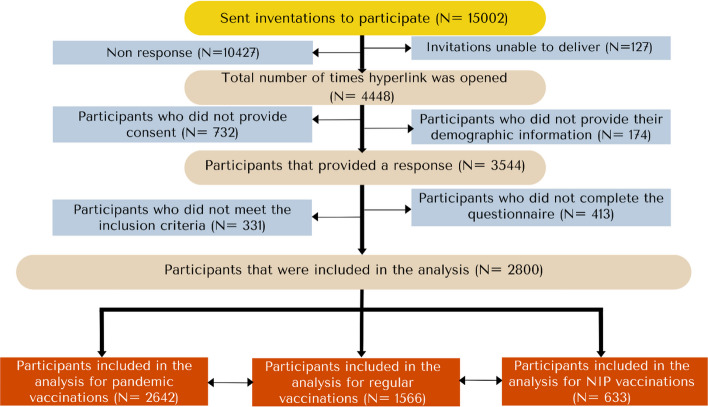
Methods: This cross-sectional survey study assessed vaccinations received by participants and their children. A total of 15,002 invitations were posted to residents of South-Limburg, a Dutch border region. The web-based questionnaire was available in Dutch, English, German, and French. Three vaccination groups (National Immunisation Program vaccinations for participants' children, pandemic vaccinations, and regular adult vaccinations) were analysed using multivariable logistic regressions.
Results: Among the 2800 participants (response rate = 18.7%), the majority were vaccinated exclusively in their country of residence, with rates ranging from 95.6% for pandemic vaccinations to 96.7% for regular adult vaccinations. Across all vaccination groups, participants born (adjusted Odds Ratio (aOR) range: 3.40-131.87) or raised (aOR range: 3.18-91.33) in another country demonstrated significantly higher levels of cross-border vaccination behaviour. Cross-border vaccination behaviour was also more common among those reporting casual (aOR range: 3.14-14.62) or structural (aOR range: 6.98-18.77) cross-border mobility. The most frequently self-reported reasons for cross-border vaccination were receiving paediatric care in the neighbouring country for National Immunisation Program vaccinations (N = 13/25), availability of the vaccination itself for pandemic vaccinations (N = 72/125), and being born in a neighbouring country for regular adult vaccinations (N = 45/52).
Conclusions: Cross-border vaccination behaviour appeared to have a limited effect on the overall vaccination coverage; however, it was found to be significantly associated with transnational factors. These findings highlight the importance of monitoring cross-border public health access to improve vaccination coverage data and inform public health policies in border regions.



 求助内容:
求助内容: 应助结果提醒方式:

 京公网安备 11010802042870号


