{"title":"Eligibility for adjuvant CDK4/6 inhibitors in HR+/HER2- early breast cancer: insights from a large cohort in central south China.","authors":"Jianmin Wu, Ziru Zhao, Mengxi Li, Jing Cao, Kejing Zhang","doi":"10.21037/tbcr-25-27","DOIUrl":null,"url":null,"abstract":"<p><strong>Background: </strong>The MonarchE and NATALEE trials have established adjuvant CDK4/6 inhibitors (abemaciclib and ribociclib) as pivotal therapies for high-risk hormone receptor-positive (HR+) early breast cancer (EBC). However, real-world data regarding the populations eligible for these trials remains limited, especially in Asian cohorts, highlighting the need for data that bridges the gap between trial findings and clinical practice in diverse settings. We conducted this real-world study in a central Chinese population to identify patient characteristics potentially associated with clinical benefits from CDK4/6 inhibitors such as abemaciclib and ribociclib.</p><p><strong>Methods: </strong>This retrospective study analyzed 1,947 patients with stage I-III HR+ invasive breast cancer (BC) treated at Xiangya Hospital, China, from 2015 to 2021. The clinicopathological profiles of patients meeting the eligibility criteria of the MonarchE and NATALEE trials were compared. Eligibility was defined according to trial-specific inclusion criteria: MonarchE required ≥4 positive lymph nodes (LNs) or 1-3 LNs with tumor size ≥5 cm or grade 3 histology (Cohort 1), or 1-3 LNs with Ki-67 ≥20% (Cohort 2). NATALEE included stage IIB-III and high-risk stage IIA (T2N0 with grade 3 or Ki-67 ≥20%).</p><p><strong>Results: </strong>Among the cohort, 26.7% (n=519) met MonarchE criteria, with a higher proportion of grade 3 tumors (25.2%) and T3 disease (17.9%). The cohort was composed of 70.7% of Cohort 1 and 29.3% of Cohort 2. In Cohort 1, 36.5% of patients exhibited 1-3 node-positive disease with high-risk biological features. In contrast, 58.0% (n=1,130) were eligible for NATALEE, including 295 stage III, 417 stage IIB, and 312 node-negative (N0) patients with high-risk biological characteristics (26.0% grade 3; 85.3% Ki-67 ≥20%). NATALEE-eligible patients were older (median age 50 <i>vs.</i> 49 years) and showed greater heterogeneity in Ki-67 expression (44.9% had Ki-67 <20%). Notably, 45.8% of NATALEE-eligible patients overlapped with MonarchE criteria, and 27.6% of the NATALEE cohort consisted of N0 patients with aggressive biological features.</p><p><strong>Conclusions: </strong>These findings challenge the traditional nodal-centric risk stratification model and highlight important disparities in the patient populations defined by trial eligibility criteria. The data suggest that nearly 60% of HR+ EBC patients may qualify for adjuvant ribociclib therapy under NATALEE criteria, indicating a broader therapeutic eligibility than previously recognized and emphasizing the need for a more inclusive, biology-driven approach to treatment selection in HR+ EBC.</p>","PeriodicalId":101427,"journal":{"name":"Translational breast cancer research : a journal focusing on translational research in breast cancer","volume":"7 ","pages":"1"},"PeriodicalIF":1.4000,"publicationDate":"2026-01-09","publicationTypes":"Journal Article","fieldsOfStudy":null,"isOpenAccess":false,"openAccessPdf":"https://www.ncbi.nlm.nih.gov/pmc/articles/PMC12885768/pdf/","citationCount":"0","resultStr":null,"platform":"Semanticscholar","paperid":null,"PeriodicalName":"Translational breast cancer research : a journal focusing on translational research in breast cancer","FirstCategoryId":"1085","ListUrlMain":"https://doi.org/10.21037/tbcr-25-27","RegionNum":0,"RegionCategory":null,"ArticlePicture":[],"TitleCN":null,"AbstractTextCN":null,"PMCID":null,"EPubDate":"2026/1/1 0:00:00","PubModel":"eCollection","JCR":"","JCRName":"","Score":null,"Total":0}
引用次数: 0
Abstract
Background: The MonarchE and NATALEE trials have established adjuvant CDK4/6 inhibitors (abemaciclib and ribociclib) as pivotal therapies for high-risk hormone receptor-positive (HR+) early breast cancer (EBC). However, real-world data regarding the populations eligible for these trials remains limited, especially in Asian cohorts, highlighting the need for data that bridges the gap between trial findings and clinical practice in diverse settings. We conducted this real-world study in a central Chinese population to identify patient characteristics potentially associated with clinical benefits from CDK4/6 inhibitors such as abemaciclib and ribociclib.
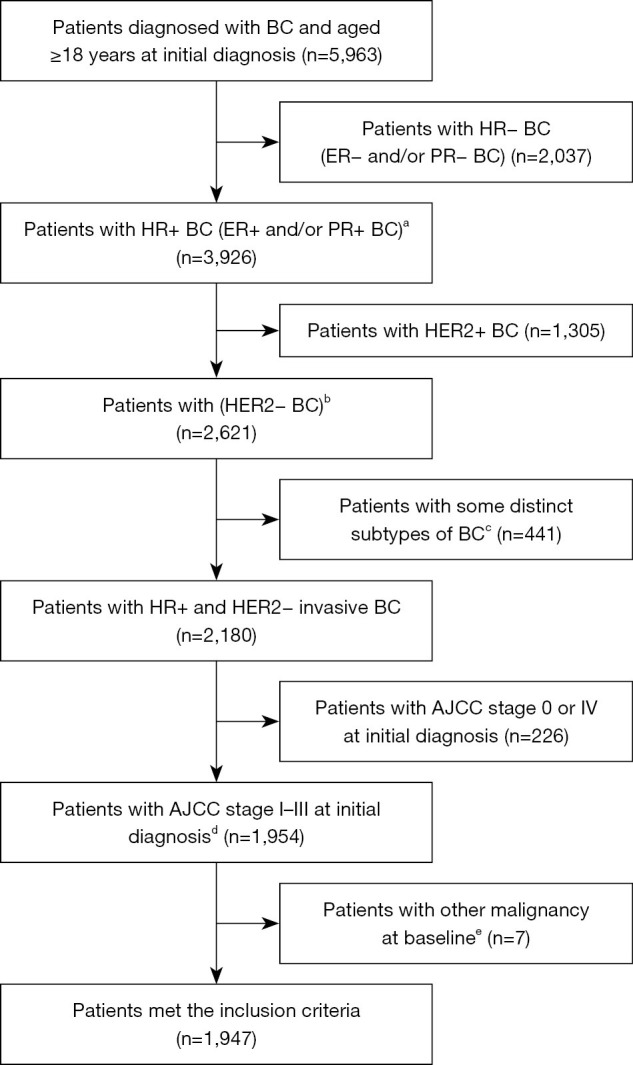
Methods: This retrospective study analyzed 1,947 patients with stage I-III HR+ invasive breast cancer (BC) treated at Xiangya Hospital, China, from 2015 to 2021. The clinicopathological profiles of patients meeting the eligibility criteria of the MonarchE and NATALEE trials were compared. Eligibility was defined according to trial-specific inclusion criteria: MonarchE required ≥4 positive lymph nodes (LNs) or 1-3 LNs with tumor size ≥5 cm or grade 3 histology (Cohort 1), or 1-3 LNs with Ki-67 ≥20% (Cohort 2). NATALEE included stage IIB-III and high-risk stage IIA (T2N0 with grade 3 or Ki-67 ≥20%).
Results: Among the cohort, 26.7% (n=519) met MonarchE criteria, with a higher proportion of grade 3 tumors (25.2%) and T3 disease (17.9%). The cohort was composed of 70.7% of Cohort 1 and 29.3% of Cohort 2. In Cohort 1, 36.5% of patients exhibited 1-3 node-positive disease with high-risk biological features. In contrast, 58.0% (n=1,130) were eligible for NATALEE, including 295 stage III, 417 stage IIB, and 312 node-negative (N0) patients with high-risk biological characteristics (26.0% grade 3; 85.3% Ki-67 ≥20%). NATALEE-eligible patients were older (median age 50 vs. 49 years) and showed greater heterogeneity in Ki-67 expression (44.9% had Ki-67 <20%). Notably, 45.8% of NATALEE-eligible patients overlapped with MonarchE criteria, and 27.6% of the NATALEE cohort consisted of N0 patients with aggressive biological features.
Conclusions: These findings challenge the traditional nodal-centric risk stratification model and highlight important disparities in the patient populations defined by trial eligibility criteria. The data suggest that nearly 60% of HR+ EBC patients may qualify for adjuvant ribociclib therapy under NATALEE criteria, indicating a broader therapeutic eligibility than previously recognized and emphasizing the need for a more inclusive, biology-driven approach to treatment selection in HR+ EBC.



 求助内容:
求助内容: 应助结果提醒方式:

 京公网安备 11010802042870号


