
Functional dynamics of fish assemblages in a tropical estuary during different phases of El Niño‒Southern Oscillation
IF 3.2
3区 环境科学与生态学
Q2 ENVIRONMENTAL SCIENCES
Marine environmental research
Pub Date : 2026-04-01
Epub Date: 2026-01-24
DOI:10.1016/j.marenvres.2026.107855
引用次数: 0
Abstract
Climate change has increased the frequency and intensity of El Niño‒Southern Oscillation (ENSO) events, which are climate phenomena involving fluctuations in surface temperatures, wind speed, and rainfall patterns across the globe. These changes affect estuarine fish communities by modifying hydrological cycles and environmental conditions such as salinity and freshwater flow, thereby influencing community composition and functional diversity. Analyzing functional diversity is therefore essential to understanding ecosystem resilience to climate change and anticipating the growing impacts of ENSO. Since ENSO effects vary by phase and geographic location, this study examined how different ENSO phases influenced the functional dynamics of the fish community in the Mamanguape River estuary in northeastern Brazil, using data collected from 2011 to 2016. In terms of environmental conditions, there was a peak in precipitation during the first year of La Niña, followed by the subsequent dry years, with the neutral and El Niño periods being more similar. However, the La Niña phenomenon of 2011 was atypical, with below-average rainfall, and occurred in the middle of a prolonged period of drought that began in the late 1990s, which may have influenced the functional response of the fish community. Unexpectedly, functional redundancy values remained low throughout all ENSO phases, highlighting possible functional vulnerability. The functional diversity of this ecosystem may be maintained because of species complementarity and compensatory effects. These results highlight the importance of analyzing the influence of ENSO in estuaries with different climatic characteristics.
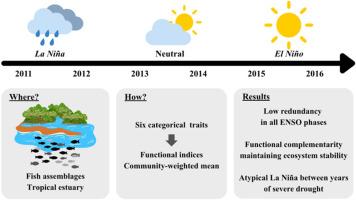
El Niño-Southern涛动不同阶段热带河口鱼类群落的功能动力学。
气候变化增加了厄尔尼诺Niño-Southern涛动(ENSO)事件的频率和强度,这是一种涉及全球地表温度、风速和降雨模式波动的气候现象。这些变化通过改变水文循环和环境条件(如盐度和淡水流量)影响河口鱼类群落,从而影响群落组成和功能多样性。因此,分析功能多样性对于理解生态系统对气候变化的适应能力和预测ENSO日益增长的影响至关重要。由于ENSO效应因阶段和地理位置而异,本研究使用2011年至2016年收集的数据,研究了ENSO不同阶段如何影响巴西东北部Mamanguape河河口鱼类群落的功能动态。从环境条件上看,La Niña元年降水出现高峰,随后为干旱年,中性期与El Niño期较为相似。然而,2011年的La Niña现象是非典型的,降雨量低于平均水平,并且发生在20世纪90年代末开始的长期干旱期间,这可能影响了鱼类群落的功能响应。出乎意料的是,在所有ENSO阶段,功能冗余值仍然很低,突出了可能存在的功能漏洞。由于物种的互补性和补偿效应,该生态系统的功能多样性得以保持。这些结果突出了分析ENSO对不同气候特征河口的影响的重要性。
本文章由计算机程序翻译,如有差异,请以英文原文为准。
求助全文
约1分钟内获得全文
求助全文
来源期刊
Marine environmental research
环境科学-毒理学
CiteScore
5.90
自引率
3.00%
发文量
217
审稿时长
46 days
期刊介绍:
Marine Environmental Research publishes original research papers on chemical, physical, and biological interactions in the oceans and coastal waters. The journal serves as a forum for new information on biology, chemistry, and toxicology and syntheses that advance understanding of marine environmental processes.
Submission of multidisciplinary studies is encouraged. Studies that utilize experimental approaches to clarify the roles of anthropogenic and natural causes of changes in marine ecosystems are especially welcome, as are those studies that represent new developments of a theoretical or conceptual aspect of marine science. All papers published in this journal are reviewed by qualified peers prior to acceptance and publication. Examples of topics considered to be appropriate for the journal include, but are not limited to, the following:
– The extent, persistence, and consequences of change and the recovery from such change in natural marine systems
– The biochemical, physiological, and ecological consequences of contaminants to marine organisms and ecosystems
– The biogeochemistry of naturally occurring and anthropogenic substances
– Models that describe and predict the above processes
– Monitoring studies, to the extent that their results provide new information on functional processes
– Methodological papers describing improved quantitative techniques for the marine sciences.
 求助内容:
求助内容: 应助结果提醒方式:

 京公网安备 11010802042870号


