
Determining Physical Function Measures for Estimating VO2Peak in Patients Receiving Hemodialysis

IF 3.4 Q1 UROLOGY & NEPHROLOGY
Kidney Medicine Pub Date : 2026-03-01 Epub Date: 2026-01-05 DOI:10.1016/j.xkme.2026.101244
Nolan W. Groninger , Monique Campos , Eliott Arroyo , Gayatri Narayanan , Heather N. Burney , Xiaochun Li , Drake E. Dillman , Keith G. Avin , S. Jawad Sher , Sharon L. Karp , Sharon M. Moe , Kenneth Lim
{"title":"Determining Physical Function Measures for Estimating VO2Peak in Patients Receiving Hemodialysis","authors":"Nolan W. Groninger ,&nbsp;Monique Campos ,&nbsp;Eliott Arroyo ,&nbsp;Gayatri Narayanan ,&nbsp;Heather N. Burney ,&nbsp;Xiaochun Li ,&nbsp;Drake E. Dillman ,&nbsp;Keith G. Avin ,&nbsp;S. Jawad Sher ,&nbsp;Sharon L. Karp ,&nbsp;Sharon M. Moe ,&nbsp;Kenneth Lim","doi":"10.1016/j.xkme.2026.101244","DOIUrl":null,"url":null,"abstract":"<div><h3>Rationale &amp; Objective</h3><div>Cardiopulmonary exercise testing is the gold standard for evaluating cardiovascular functional capacity, as assessed by oxygen uptake at peak exercise (VO<sub>2</sub>Peak). Traditional physical function tests have been proposed as predictive of VO<sub>2</sub>Peak, although their associations remain inconclusive in individuals with kidney failure. This study aimed to assess whether comprehensive physical function metrics are associated with VO<sub>2</sub>Peak in patients receiving hemodialysis.</div></div><div><h3>Study Design</h3><div>Cross-sectional analysis from the “Effects of Long Interdialytic Intervals on Cardiovascular Functional Capacity (ECON)” study.</div></div><div><h3>Setting &amp; Participants</h3><div>Thirty patients with kidney failure receiving maintenance thrice-weekly hemodialysis.</div></div><div><h3>Predictors</h3><div>Physical function tests.</div></div><div><h3>Outcomes</h3><div>VO<sub>2</sub>Peak (mL·min<sup>−1</sup>·kg<sup>−1</sup>) measured by cardiopulmonary exercise testing, with participants dichotomized into Low (n=14) and High (n=16) VO<sub>2</sub>Peak groups.</div></div><div><h3>Analytical Approach</h3><div>Group comparisons for demographics and physical function measures were performed. Multivariable linear regression was used to assess associations.</div></div><div><h3>Results</h3><div>The Low and High groups were well matched by age, sex, and race (all <em>P</em> ≥ 0.05). However, body mass index (32.7 ± 6.7 kg/m<sup>2</sup> vs 26.9 ± 6.5 kg/m<sup>2</sup>; <em>P</em> = 0.02) and fat mass composition (41.8 ± 7.3% vs 28.9 ± 12.0%; <em>P</em> = 0.002) were significantly higher in the Low group. The Short Form-36-Physical Function Scale total score, standing static balance test score, number of sit-to-stands in 30 seconds (30sec-STS), total Short Physical Performance Battery score, Patient-Reported Outcomes Measurement Information System physical function computerized adaptive testing, Patient-Reported Outcomes Measurement Information System physical mobility computerized adaptive testing, handgrip strength, and 6-minute walk test were all significantly associated with VO<sub>2</sub>Peak (all <em>P</em> &lt; 0.05). However, after adjusting for age, sex, and fat mass composition, only 30sec-STS was significantly associated with VO<sub>2</sub>Peak (<em>P</em> = 0.04).</div></div><div><h3>Limitations</h3><div>The study’s small sample size and cross-sectional design limit statistical power and causal inference.</div></div><div><h3>Conclusions</h3><div>Metrics of basic physical function demonstrate limited association with VO<sub>2</sub>Peak in patients on hemodialysis, except for the 30sec-STS test.</div></div><div><h3>Plain-Language Summary</h3><div>People with kidney failure often have serious heart and muscle problems that limit their ability to exercise. This study tested how simple physical function tests relate to cardiovascular fitness, measured by oxygen use during exercise (oxygen uptake at peak exercise), in 30 individuals receiving hemodialysis for kidney failure treatment. Participants completed tests such as standing balance, sit-to-stand, walking distance, and handgrip strength. After accounting for age, sex, and body fat, only the 30-second sit-to-stand test remained significantly associated with oxygen uptake at peak exercise. These results suggest that this quick test may provide a useful indication of physical fitness in dialysis patients. Larger studies are needed to confirm these findings and to inform practical assessments of physical health in this population.</div></div>","PeriodicalId":17885,"journal":{"name":"Kidney Medicine","volume":"8 3","pages":"Article 101244"},"PeriodicalIF":3.4000,"publicationDate":"2026-03-01","publicationTypes":"Journal Article","fieldsOfStudy":null,"isOpenAccess":false,"openAccessPdf":"","citationCount":"0","resultStr":null,"platform":"Semanticscholar","paperid":null,"PeriodicalName":"Kidney Medicine","FirstCategoryId":"1085","ListUrlMain":"https://www.sciencedirect.com/science/article/pii/S2590059526000051","RegionNum":0,"RegionCategory":null,"ArticlePicture":[],"TitleCN":null,"AbstractTextCN":null,"PMCID":null,"EPubDate":"2026/1/5 0:00:00","PubModel":"Epub","JCR":"Q1","JCRName":"UROLOGY & NEPHROLOGY","Score":null,"Total":0}
引用次数: 0

Abstract

Rationale & Objective

Cardiopulmonary exercise testing is the gold standard for evaluating cardiovascular functional capacity, as assessed by oxygen uptake at peak exercise (VO2Peak). Traditional physical function tests have been proposed as predictive of VO2Peak, although their associations remain inconclusive in individuals with kidney failure. This study aimed to assess whether comprehensive physical function metrics are associated with VO2Peak in patients receiving hemodialysis.

Study Design

Cross-sectional analysis from the “Effects of Long Interdialytic Intervals on Cardiovascular Functional Capacity (ECON)” study.

Setting & Participants

Thirty patients with kidney failure receiving maintenance thrice-weekly hemodialysis.

Predictors

Physical function tests.

Outcomes

VO2Peak (mL·min−1·kg−1) measured by cardiopulmonary exercise testing, with participants dichotomized into Low (n=14) and High (n=16) VO2Peak groups.

Analytical Approach

Group comparisons for demographics and physical function measures were performed. Multivariable linear regression was used to assess associations.

Results

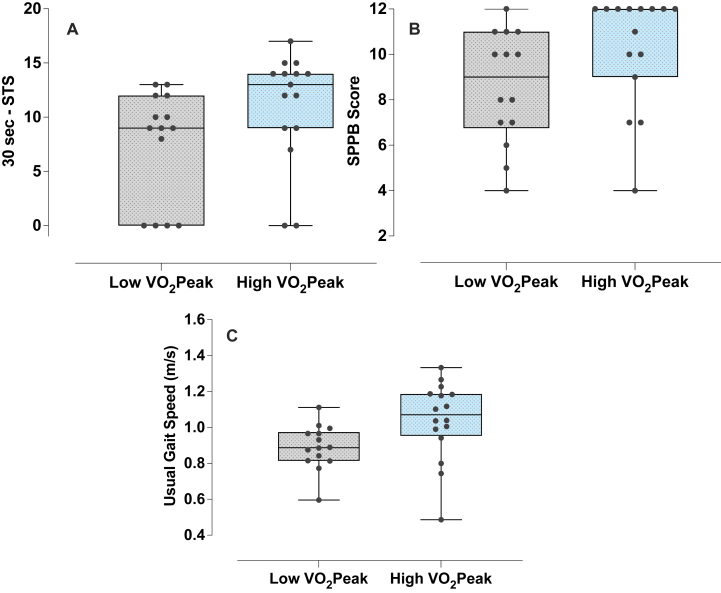
The Low and High groups were well matched by age, sex, and race (all P ≥ 0.05). However, body mass index (32.7 ± 6.7 kg/m2 vs 26.9 ± 6.5 kg/m2; P = 0.02) and fat mass composition (41.8 ± 7.3% vs 28.9 ± 12.0%; P = 0.002) were significantly higher in the Low group. The Short Form-36-Physical Function Scale total score, standing static balance test score, number of sit-to-stands in 30 seconds (30sec-STS), total Short Physical Performance Battery score, Patient-Reported Outcomes Measurement Information System physical function computerized adaptive testing, Patient-Reported Outcomes Measurement Information System physical mobility computerized adaptive testing, handgrip strength, and 6-minute walk test were all significantly associated with VO2Peak (all P < 0.05). However, after adjusting for age, sex, and fat mass composition, only 30sec-STS was significantly associated with VO2Peak (P = 0.04).

Limitations

The study’s small sample size and cross-sectional design limit statistical power and causal inference.

Conclusions

Metrics of basic physical function demonstrate limited association with VO2Peak in patients on hemodialysis, except for the 30sec-STS test.

Plain-Language Summary

People with kidney failure often have serious heart and muscle problems that limit their ability to exercise. This study tested how simple physical function tests relate to cardiovascular fitness, measured by oxygen use during exercise (oxygen uptake at peak exercise), in 30 individuals receiving hemodialysis for kidney failure treatment. Participants completed tests such as standing balance, sit-to-stand, walking distance, and handgrip strength. After accounting for age, sex, and body fat, only the 30-second sit-to-stand test remained significantly associated with oxygen uptake at peak exercise. These results suggest that this quick test may provide a useful indication of physical fitness in dialysis patients. Larger studies are needed to confirm these findings and to inform practical assessments of physical health in this population.

Abstract Image

Abstract Image

测定血液透析患者身体功能指标估算VO2Peak。
原理与目的:心肺运动试验是评价心血管功能的金标准,通过峰值运动时的摄氧量(VO2Peak)来评估。传统的身体功能测试已被提出作为VO2Peak的预测指标,尽管它们在肾衰竭患者中的相关性仍不确定。本研究旨在评估接受血液透析患者的综合身体功能指标是否与VO2Peak相关。研究设计:“长透析间隔时间对心血管功能(ECON)的影响”研究的横断面分析。环境与参与者:30例肾衰竭患者接受维持性血液透析,每周3次。预测指标:身体机能测试。结果:通过心肺运动试验测量VO2Peak (mL·min-1·kg-1),参与者分为低(n=14)和高(n=16) VO2Peak组。分析方法:进行人口统计学和身体功能测量的组间比较。多变量线性回归用于评估相关性。结果:低组和高组在年龄、性别、种族上匹配良好(P均≥0.05)。然而,体重指数(32.7±6.7 kg/m2 vs 26.9±6.5 kg/m2, P = 0.02)和脂肪质量组成(41.8±7.3% vs 28.9±12.0%,P = 0.002)在低组显著更高。短表36-身体功能量表总分、站立静态平衡测试分数、30秒内坐转站次数、短表身体功能电池总分、患者报告结果测量信息系统身体功能计算机化适应测试、患者报告结果测量信息系统身体活动能力计算机化适应测试、握力、6分钟步行试验与VO2Peak均有显著相关(P < 0.05)。然而,在调整了年龄、性别和脂肪质量组成后,只有30sec-STS与VO2Peak显著相关(P = 0.04)。局限性:研究的小样本量和横断面设计限制了统计能力和因果推断。结论:除30sec-STS测试外,血液透析患者的基本身体功能指标与VO2Peak的相关性有限。
本文章由计算机程序翻译,如有差异,请以英文原文为准。
求助全文
约1分钟内获得全文 求助全文
来源期刊
Kidney Medicine
Kidney Medicine Medicine-Internal Medicine
CiteScore
4.80
自引率
5.10%
发文量
176
审稿时长
12 weeks
×
引用
GB/T 7714-2015
复制
MLA
复制
APA
复制
导出至
BibTeX EndNote RefMan NoteFirst NoteExpress
×
提示
您的信息不完整,为了账户安全,请先补充。
现在去补充
×
提示
您因"违规操作"
具体请查看互助需知
我知道了
×
提示
确定
请完成安全验证×
copy
已复制链接
快去分享给好友吧!
我知道了
右上角分享
点击右上角分享
0
联系我们:info@booksci.cn Book学术提供免费学术资源搜索服务,方便国内外学者检索中英文文献。致力于提供最便捷和优质的服务体验。 Copyright © 2023 布克学术 All rights reserved.
京ICP备2023020795号-1
ghs 京公网安备 11010802042870号
Book学术文献互助
Book学术文献互助群
群 号:604180095
Book学术官方微信
小红书



