
Gancao decoction ameliorated senecionine-induced Hepatic Sinusoidal Obstruction Syndrome in mice by inhibiting NET formation and senecionine bioactivation in liver
IF 5.4
2区 医学
Q1 CHEMISTRY, MEDICINAL
Journal of ethnopharmacology
Pub Date : 2026-05-10
Epub Date: 2026-02-09
DOI:10.1016/j.jep.2026.121356
引用次数: 0
Abstract
Ethnopharmacological relevance
In China, pyrrolizidine alkaloid (PA)-induced hepatic sinusoidal obstruction syndrome (HSOS) accounts for approximately 50.0-88.6% of all HSOS cases, primarily resulting from inadvertent ingestion of Gynura japonica (Thunb.) Juel. (Tǔ sān qī). Glycyrrhiza uralensis Fisch. (Gān cǎo), a classical hepatoprotective herb in Traditional Chinese Medicine (TCM), has recently demonstrated significant protective effects against PA-induced HSOS in murine models. However, its underlying mechanisms remain poorly understood.
Aim of study
This study aimed to assess the therapeutic efficacy of Gancao decoction (GCD) and elucidate its underlying mechanisms in PA-induced HSOS.
Materials and methods
HSOS was induced in mice by senecionine (SEN), followed by treatment with GCD or enoxaparin (ENO, positive control). Histopathological and therapeutic efficacy was assessed by histopathological examination and serum biochemical analyses. Neutrophil depletion was employed to investigate the contribution of neutrophil extracellular traps (NETs) to the protective effects of GCD. Transcriptomic analysis was performed to identify potential targets of GCD. Mechanistic studies were investigated using quantitative real-time PCR (qPCR), Western blotting (WB), and immunofluorescence (IF). In addition, the inhibitory effect of GCD on SEN bioactivation was evaluated using human liver microsomes (HLMs).
Results
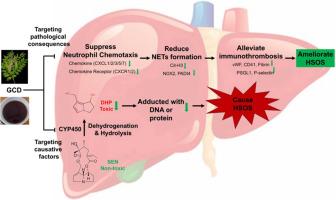
GCD improved serum biochemistry and hepatic histopathology in SEN-induced HSOS mice. Mechanistically, GCD suppressed intrahepatic neutrophil chemotaxis, thereby reducing NET formation and alleviating immunothrombosis. Furthermore, GCD inhibited the hepatic formation of dehydropyrrolizidine (DHP), the reactive metabolite responsible for SEN-induced HSOS.
Conclusion
GCD attenuated SEN-induced HSOS through dual mechanisms: (1) suppression of chemokine-driven neutrophil chemotaxis, leading to reduced NET formation and immunothrombosis; (2) inhibiting of SEN bioactivation. These findings provide mechanistic support for the ethnopharmacological use of Gancao in PA-HSOS and highlight its potential for clinical translation.
甘草汤通过抑制净网的形成和绿皮碱在肝脏的生物活性,改善绿皮碱诱导的小鼠肝窦梗阻综合征。
民族药理学相关性:在中国,吡咯利西啶生物碱(PA)引起的肝窦梗阻综合征(HSOS)约占所有HSOS病例的50.0% -88.6%,主要是由于误食黄花菊(Thunb)引起的。Juel。(t ā sān q ā)。乌拉尔甘草(Gān cǎo)是一种经典的中药保肝草药,最近在小鼠模型中显示出对pa诱导的HSOS有显著的保护作用。然而,其潜在机制仍然知之甚少。研究目的:观察甘草汤对pa诱导的HSOS的治疗作用,探讨其作用机制。材料和方法:用senecionine (SEN)诱导小鼠HSOS,然后用GCD或依诺肝素(ENO,阳性对照)治疗。通过组织病理学检查和血清生化分析评估组织病理学和治疗效果。中性粒细胞耗竭研究了中性粒细胞胞外陷阱(NETs)对GCD保护作用的贡献。转录组学分析用于鉴定GCD的潜在靶点。采用实时荧光定量PCR (qPCR)、Western blotting (WB)和免疫荧光(IF)进行机制研究。此外,利用人肝微粒体(HLMs)评价了GCD对SEN生物活化的抑制作用。结果:GCD改善了sen诱导的HSOS小鼠的血清生化和肝脏组织病理学。从机制上讲,GCD抑制肝内中性粒细胞趋化性,从而减少NET的形成,减轻免疫血栓形成。此外,GCD还能抑制肝生成脱氢吡咯利西定(DHP), DHP是sen诱导的HSOS的活性代谢物。结论:GCD通过双重机制减轻sen诱导的HSOS:(1)抑制趋化因子驱动的中性粒细胞趋化性,导致NET形成和免疫血栓形成减少;(2)抑制SEN生物活化。这些发现为甘草在PA-HSOS中的民族药理学应用提供了机制支持,并突出了其临床转化的潜力。
本文章由计算机程序翻译,如有差异,请以英文原文为准。
求助全文
约1分钟内获得全文
求助全文
来源期刊
Journal of ethnopharmacology
医学-全科医学与补充医学
CiteScore
10.30
自引率
5.60%
发文量
967
审稿时长
77 days
期刊介绍:
The Journal of Ethnopharmacology is dedicated to the exchange of information and understandings about people''s use of plants, fungi, animals, microorganisms and minerals and their biological and pharmacological effects based on the principles established through international conventions. Early people confronted with illness and disease, discovered a wealth of useful therapeutic agents in the plant and animal kingdoms. The empirical knowledge of these medicinal substances and their toxic potential was passed on by oral tradition and sometimes recorded in herbals and other texts on materia medica. Many valuable drugs of today (e.g., atropine, ephedrine, tubocurarine, digoxin, reserpine) came into use through the study of indigenous remedies. Chemists continue to use plant-derived drugs (e.g., morphine, taxol, physostigmine, quinidine, emetine) as prototypes in their attempts to develop more effective and less toxic medicinals.
 求助内容:
求助内容: 应助结果提醒方式:

 京公网安备 11010802042870号


