
Discovery of elfamycin-class inhibitors combating carbapenem-resistant Acinetobacter baumannii from the Antarctic-derived Streptomyces sp. A3-7
IF 4.7
2区 医学
Q1 BIOCHEMISTRY & MOLECULAR BIOLOGY
引用次数: 0
Abstract
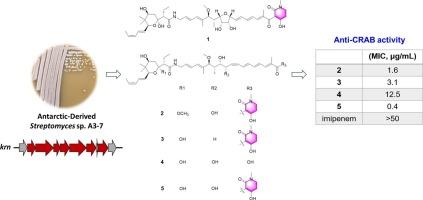
Carbapenem-resistant Acinetobacter baumannii (CRAB) poses a critical global health threat. An activity-guided screen of eight Antarctic Streptomyces strains identified the active isolate Streptomyces sp. A3-7, from which four new elfamycin-class polyketides (1–4) and one known analogue (5) were obtained. The structures of these compounds were elucidated through extensive MS and NMR spectroscopic analysis, and their biosynthesis is directed by the krn gene cluster. Anti-CRAB evaluation revealed that 5 was the most potent, with an MIC of 0.4 μg/mL, whereas 1 was inactive up to 50 μg/mL, indicating that the tetrahydrofuran ring in the kirromycin-type scaffold (1) significantly reduces anti-A. baumannii activity, whereas the linear “open” ethylene glycol scaffold of the kirrothricin-type analogues (2–5) provides a more effective antibacterial framework. A gradual decrease in potency was observed for 2–4 (MICs 1.6–12.5 μg/mL), suggesting the pyridone ring is a key functional group for activity within the kirrothricin series. Notably, all compounds demonstrated low cytotoxicity toward normal hepatocytes AC2F (CC50 > 20 μM). This promising safety profile, combined with their potent activity, highlights the potential of kirrothricin-type compounds as promising drug candidates for combating CRAB.
发现elfamycin类抑制剂对抗来自南极Streptomyces sp. A3-7的耐碳青霉烯鲍曼不动杆菌。
耐碳青霉烯鲍曼不动杆菌(CRAB)对全球健康构成严重威胁。对8株南极链霉菌进行活性筛选,鉴定出活性菌株Streptomyces sp. A3-7,从中分离得到4个新的elfamycin类聚酮(1-4)和1个已知类似物(5)。这些化合物的结构通过广泛的质谱和核磁共振谱分析被阐明,它们的生物合成是由krn基因簇指导的。抗螃蟹评价结果显示,5的抗螃蟹活性最强,MIC值为0.4 μg/mL,而1的抗螃蟹活性高达50 μg/mL,表明基罗霉素型支架中的四氢呋喃环(1)显著降低了抗a。鲍曼尼菌活性,而柯蓟素类类似物的线性“开放”乙二醇支架(2-5)提供了更有效的抗菌框架。2 ~ 4个(mic 1.6 ~ 12.5 μg/mL)的效价逐渐降低,提示吡酮环是基蓟甙系列中具有活性的关键官能团。值得注意的是,所有化合物对正常肝细胞AC2F (CC50 bb0 20 μM)均表现出较低的细胞毒性。这种有希望的安全性,结合它们的有效活性,突出了柯蓟素类化合物作为抗螃蟹的有希望的候选药物的潜力。
本文章由计算机程序翻译,如有差异,请以英文原文为准。
求助全文
约1分钟内获得全文
求助全文
来源期刊
Bioorganic Chemistry
生物-生化与分子生物学
CiteScore
9.70
自引率
3.90%
发文量
679
审稿时长
31 days
期刊介绍:
Bioorganic Chemistry publishes research that addresses biological questions at the molecular level, using organic chemistry and principles of physical organic chemistry. The scope of the journal covers a range of topics at the organic chemistry-biology interface, including: enzyme catalysis, biotransformation and enzyme inhibition; nucleic acids chemistry; medicinal chemistry; natural product chemistry, natural product synthesis and natural product biosynthesis; antimicrobial agents; lipid and peptide chemistry; biophysical chemistry; biological probes; bio-orthogonal chemistry and biomimetic chemistry.
For manuscripts dealing with synthetic bioactive compounds, the Journal requires that the molecular target of the compounds described must be known, and must be demonstrated experimentally in the manuscript. For studies involving natural products, if the molecular target is unknown, some data beyond simple cell-based toxicity studies to provide insight into the mechanism of action is required. Studies supported by molecular docking are welcome, but must be supported by experimental data. The Journal does not consider manuscripts that are purely theoretical or computational in nature.
The Journal publishes regular articles, short communications and reviews. Reviews are normally invited by Editors or Editorial Board members. Authors of unsolicited reviews should first contact an Editor or Editorial Board member to determine whether the proposed article is within the scope of the Journal.
 求助内容:
求助内容: 应助结果提醒方式:

 京公网安备 11010802042870号


