
Targeting immune checkpoint therapy: The role of manganese in tumor immunotherapy

IF 2.8
Cancer pathogenesis and therapy Pub Date : 2026-05-01 Epub Date: 2025-10-24 DOI:10.1016/j.cpt.2025.10.001
Xingyao Lyu , Bixia Li , Zhijie Lin
{"title":"Targeting immune checkpoint therapy: The role of manganese in tumor immunotherapy","authors":"Xingyao Lyu ,&nbsp;Bixia Li ,&nbsp;Zhijie Lin","doi":"10.1016/j.cpt.2025.10.001","DOIUrl":null,"url":null,"abstract":"<div><div>Cancer immunotherapy has emerged as a promising complement to traditional treatments such as radiotherapy and chemotherapy. Although conventional therapies remain central to cancer management, the potential of immunotherapy is increasingly recognized. Immune checkpoint therapy, a key strategy in tumor immunotherapy, has demonstrated significant efficacy against solid tumors. However, its clinical application is hindered by its limited response rate, necessitating efforts to optimize its effectiveness. Recent studies have highlighted the pivotal role of the cyclic GMP-AMP synthase (cGAS) - stimulator of interferon gene (STING) pathway in immune checkpoint therapy. Manganese (Mn), an essential trace element, regulates the activity of CD8<sup>+</sup> T and NK cells by modulating the cGAS-STING pathway. Furthermore, the combination of Mn with anti-programmed cell death protein 1 therapy has demonstrated promising anti-tumor effects. Mn also influences immunogenic cell death (ICD), further augmenting its potential as an adjunct to tumor immunotherapy. Despite a growing body of research on the role of Mn in modulating the cGAS-STING pathway and inducing ICD, comprehensive reviews that synthesize these findings and explore the potential of Mn in enhancing immune checkpoint therapy are still lacking. This review aimed to fill this gap by examining the immune mechanisms by which Mn enhances immune checkpoint therapy and its overall impact on tumor immunotherapy.</div></div>","PeriodicalId":93920,"journal":{"name":"Cancer pathogenesis and therapy","volume":"4 3","pages":"Pages 165-173"},"PeriodicalIF":2.8000,"publicationDate":"2026-05-01","publicationTypes":"Journal Article","fieldsOfStudy":null,"isOpenAccess":false,"openAccessPdf":"","citationCount":"0","resultStr":null,"platform":"Semanticscholar","paperid":null,"PeriodicalName":"Cancer pathogenesis and therapy","FirstCategoryId":"1085","ListUrlMain":"https://www.sciencedirect.com/science/article/pii/S2949713225001120","RegionNum":0,"RegionCategory":null,"ArticlePicture":[],"TitleCN":null,"AbstractTextCN":null,"PMCID":null,"EPubDate":"2025/10/24 0:00:00","PubModel":"Epub","JCR":"","JCRName":"","Score":null,"Total":0}
引用次数: 0

Abstract

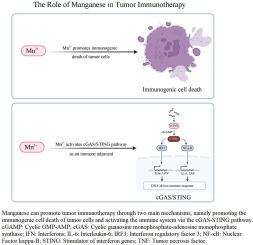
Cancer immunotherapy has emerged as a promising complement to traditional treatments such as radiotherapy and chemotherapy. Although conventional therapies remain central to cancer management, the potential of immunotherapy is increasingly recognized. Immune checkpoint therapy, a key strategy in tumor immunotherapy, has demonstrated significant efficacy against solid tumors. However, its clinical application is hindered by its limited response rate, necessitating efforts to optimize its effectiveness. Recent studies have highlighted the pivotal role of the cyclic GMP-AMP synthase (cGAS) - stimulator of interferon gene (STING) pathway in immune checkpoint therapy. Manganese (Mn), an essential trace element, regulates the activity of CD8+ T and NK cells by modulating the cGAS-STING pathway. Furthermore, the combination of Mn with anti-programmed cell death protein 1 therapy has demonstrated promising anti-tumor effects. Mn also influences immunogenic cell death (ICD), further augmenting its potential as an adjunct to tumor immunotherapy. Despite a growing body of research on the role of Mn in modulating the cGAS-STING pathway and inducing ICD, comprehensive reviews that synthesize these findings and explore the potential of Mn in enhancing immune checkpoint therapy are still lacking. This review aimed to fill this gap by examining the immune mechanisms by which Mn enhances immune checkpoint therapy and its overall impact on tumor immunotherapy.
Abstract Image

靶向免疫检查点治疗:锰在肿瘤免疫治疗中的作用
癌症免疫治疗已成为传统治疗如放疗和化疗的一种有希望的补充。虽然传统疗法仍然是癌症治疗的核心,但免疫疗法的潜力越来越被认识到。免疫检查点疗法是肿瘤免疫治疗的一项重要策略,对实体瘤具有显著的疗效。但其有效率有限,阻碍了其临床应用,需要努力优化其疗效。近年来的研究强调了环GMP-AMP合成酶(cGAS) -干扰素基因刺激因子(STING)通路在免疫检查点治疗中的关键作用。锰(Mn)是一种必需的微量元素,通过调节cGAS-STING通路调节CD8+ T和NK细胞的活性。此外,Mn联合抗程序性细胞死亡蛋白1治疗已显示出良好的抗肿瘤效果。锰还影响免疫原性细胞死亡(ICD),进一步增强了其作为肿瘤免疫治疗辅助药物的潜力。尽管越来越多的研究表明Mn在调节cGAS-STING通路和诱导ICD中的作用,但综合这些发现并探索Mn在增强免疫检查点治疗中的潜力的综合综述仍然缺乏。本综述旨在通过研究Mn增强免疫检查点治疗的免疫机制及其对肿瘤免疫治疗的总体影响来填补这一空白。
本文章由计算机程序翻译,如有差异,请以英文原文为准。
求助全文
约1分钟内获得全文 求助全文
来源期刊
Cancer pathogenesis and therapy
Cancer pathogenesis and therapy Surgery, Radiology and Imaging, Cancer Research, Oncology
CiteScore
0.80
自引率
0.00%
发文量
0
审稿时长
54 days

×
引用
GB/T 7714-2015
复制
MLA
复制
APA
复制
导出至
BibTeX EndNote RefMan NoteFirst NoteExpress
×
提示
您的信息不完整,为了账户安全,请先补充。
现在去补充
×
提示
您因"违规操作"
具体请查看互助需知
我知道了
×
提示
确定
请完成安全验证×
copy
已复制链接
快去分享给好友吧!
我知道了
右上角分享
点击右上角分享
0
联系我们:info@booksci.cn Book学术提供免费学术资源搜索服务,方便国内外学者检索中英文文献。致力于提供最便捷和优质的服务体验。 Copyright © 2023 布克学术 All rights reserved.
京ICP备2023020795号-1
ghs 京公网安备 11010802042870号
Book学术文献互助
Book学术文献互助群
群 号:604180095
Book学术官方微信
小红书


