
A Highway Vehicular Channel Model for OTFS Performance Evaluation
IF 8.4
2区 计算机科学
Q1 ENGINEERING, ELECTRICAL & ELECTRONIC
引用次数: 0
Abstract
In vehicular communications, accurate modeling of real-world radio propagation channels is essential. To this end, we propose a novel stochastic model, named Vehicular-Tapped Delay-Line (V-TDL) that accurately captures the statistical behavior of multipath channels characterized by path-dependent gains, delays, and Doppler shifts. V-TDL supports diverse traffic conditions and road geometries by generating channel instances through well-established probability distributions. Also, it effectively models the parameters of the distributions through realistic geometry-based simulations, achieving the accuracy of a ray-tracing-based model while maintaining the low complexity of a purely stochastic approach. In contrast to existing models, V-TDL accounts for the correlation between propagation paths. Our findings show that this correlation is inherent in high-speed vehicular environments and neglecting it leads to a significant overestimation of channel diversity and system performance. We compare our model to existing alternatives to assess the performance of OTFS and OFDM modulations. The results demonstrate that, unlike traditional models such as the 3GPP EVA, V-TDL captures variations in channel diversity influenced by traffic intensity and road geometry, which impact the OTFS and OFDM performance. Although OTFS is penalized by path correlation, it consistently outperforms OFDM in all evaluated vehicular environments, confirming its suitability for high-speed vehicular communication scenarios.用于OTFS性能评价的公路车辆通道模型
在车载通信中,对真实世界无线电传播信道的精确建模是必不可少的。为此,我们提出了一种新的随机模型,称为车辆抽头延迟线(V-TDL),它准确地捕获了以路径相关增益、延迟和多普勒频移为特征的多径信道的统计行为。V-TDL通过建立良好的概率分布生成通道实例,支持不同的交通条件和道路几何形状。此外,它通过基于真实几何的模拟有效地模拟分布参数,在保持纯随机方法的低复杂性的同时,实现了基于光线跟踪的模型的准确性。与现有模型相比,V-TDL考虑了传播路径之间的相关性。我们的研究结果表明,这种相关性在高速车辆环境中是固有的,忽视它会导致对信道多样性和系统性能的严重高估。我们将我们的模型与现有的替代方案进行比较,以评估OTFS和OFDM调制的性能。结果表明,与3GPP EVA等传统模型不同,V-TDL捕获了受交通强度和道路几何形状影响的信道分集变化,这些变化会影响OTFS和OFDM性能。尽管OTFS受到路径相关性的影响,但在所有评估的车辆环境中,它始终优于OFDM,证实了其适用于高速车辆通信场景。
本文章由计算机程序翻译,如有差异,请以英文原文为准。
求助全文
约1分钟内获得全文
求助全文
来源期刊
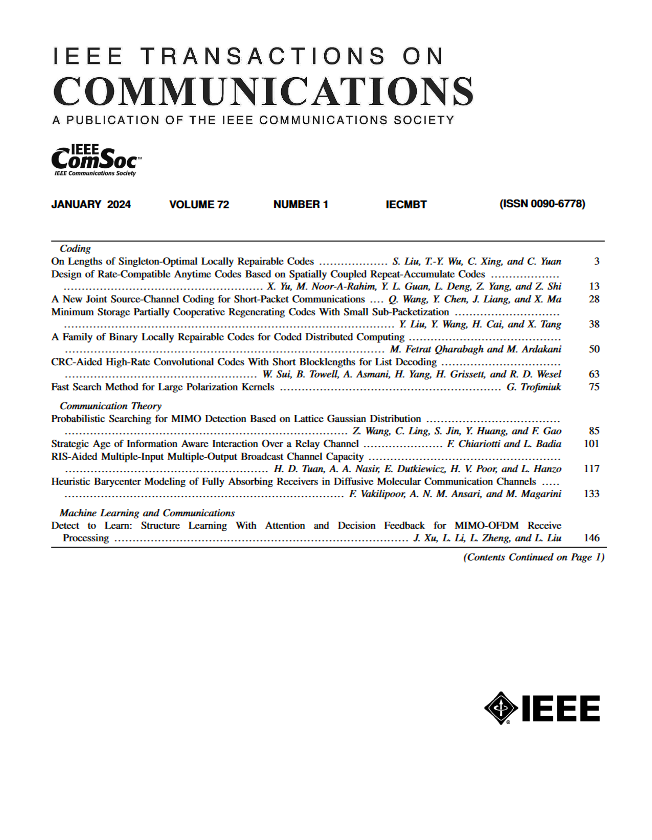
IEEE Transactions on Communications
工程技术-电信学
CiteScore
16.10
自引率
8.40%
发文量
528
审稿时长
4.1 months
期刊介绍:
The IEEE Transactions on Communications is dedicated to publishing high-quality manuscripts that showcase advancements in the state-of-the-art of telecommunications. Our scope encompasses all aspects of telecommunications, including telephone, telegraphy, facsimile, and television, facilitated by electromagnetic propagation methods such as radio, wire, aerial, underground, coaxial, and submarine cables, as well as waveguides, communication satellites, and lasers. We cover telecommunications in various settings, including marine, aeronautical, space, and fixed station services, addressing topics such as repeaters, radio relaying, signal storage, regeneration, error detection and correction, multiplexing, carrier techniques, communication switching systems, data communications, and communication theory. Join us in advancing the field of telecommunications through groundbreaking research and innovation.
 求助内容:
 应助结果提醒方式:


 京公网安备 11010802042870号


