
Federated Learning for 6G Security: A Survey on Threats, Solutions, and Research Directions
IF 34.4
1区 计算机科学
Q1 COMPUTER SCIENCE, INFORMATION SYSTEMS
引用次数: 0
Abstract
The Sixth-Generation (6G) are already in the horizon, owing to advents of communication technologies towards enabling intelligent applications and services. Federated Learning (FL) is a distributed Artificial Intelligence (AI) technology that underpins 6G communication technologies and applications. Interestingly, FL is also a promising contender to enhance 6G security. This paper presents a comprehensive and up-to-date review of FL-enabled 6G security. The paper explores security threats in FL for 6G, threats in FL for 6G, and threats shared across FL and 6G. Subsequently, how FL can be utilized to strengthen 6G security in the Radio Access Network (RAN), Open RAN (O-RAN), network edge, and network orchestration and core is presented. In addition, FL is for 6G application and service security across various emerging applications, ranging from Connected Autonomous Vehicles (CAVs) to the envisaged metaverse applications. The paper then consolidates lessons learned, projects, and proposes future research directions to establish the role of FL in strengthening 6G security.面向6G安全的联邦学习:威胁、解决方案与研究方向综述
随着通信技术的发展,智能应用和服务得以实现,第六代(6G)技术已经出现。联邦学习(FL)是一种分布式人工智能(AI)技术,支持6G通信技术和应用。有趣的是,FL也是增强6G安全性的有力竞争者。本文介绍了全面和最新的fl支持的6G安全性审查。本文探讨了FL for 6G中的安全威胁、FL for 6G中的威胁以及FL和6G之间共享的威胁。随后,介绍了如何利用FL在无线接入网(RAN)、开放式RAN (O-RAN)、网络边缘、网络编排和核心等领域加强6G安全性。此外,FL适用于各种新兴应用的6G应用和服务安全,从联网自动驾驶汽车(cav)到设想的元应用。然后,本文总结了经验教训、项目,并提出了未来的研究方向,以确立FL在加强6G安全中的作用。
本文章由计算机程序翻译,如有差异,请以英文原文为准。
求助全文
约1分钟内获得全文
求助全文
来源期刊
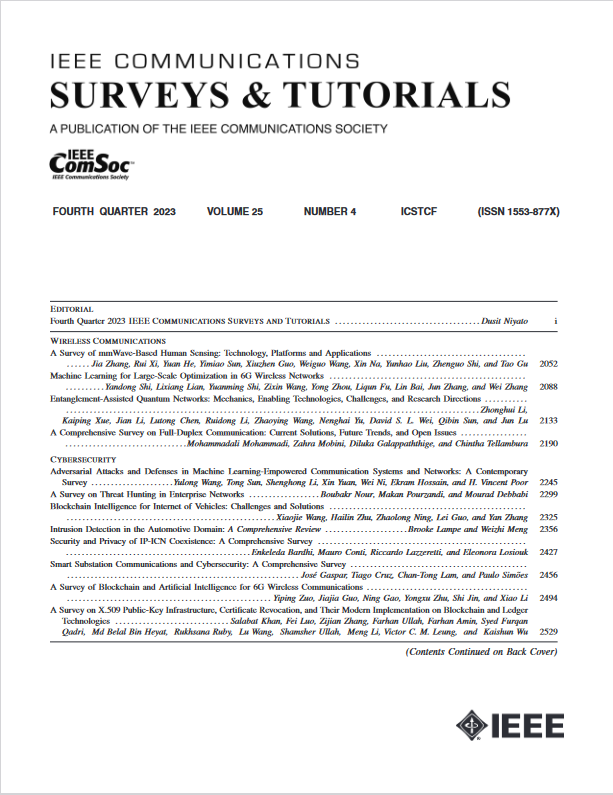
IEEE Communications Surveys and Tutorials
COMPUTER SCIENCE, INFORMATION SYSTEMS-TELECOMMUNICATIONS
CiteScore
80.20
自引率
2.50%
发文量
84
审稿时长
6 months
期刊介绍:
IEEE Communications Surveys & Tutorials is an online journal published by the IEEE Communications Society for tutorials and surveys covering all aspects of the communications field. Telecommunications technology is progressing at a rapid pace, and the IEEE Communications Society is committed to providing researchers and other professionals the information and tools to stay abreast. IEEE Communications Surveys and Tutorials focuses on integrating and adding understanding to the existing literature on communications, putting results in context. Whether searching for in-depth information about a familiar area or an introduction into a new area, IEEE Communications Surveys & Tutorials aims to be the premier source of peer-reviewed, comprehensive tutorials and surveys, and pointers to further sources. IEEE Communications Surveys & Tutorials publishes only articles exclusively written for IEEE Communications Surveys & Tutorials and go through a rigorous review process before their publication in the quarterly issues.
A tutorial article in the IEEE Communications Surveys & Tutorials should be designed to help the reader to become familiar with and learn something specific about a chosen topic. In contrast, the term survey, as applied here, is defined to mean a survey of the literature. A survey article in IEEE Communications Surveys & Tutorials should provide a comprehensive review of developments in a selected area, covering its development from its inception to its current state and beyond, and illustrating its development through liberal citations from the literature. Both tutorials and surveys should be tutorial in nature and should be written in a style comprehensible to readers outside the specialty of the article.
 求助内容:
求助内容: 应助结果提醒方式:

 京公网安备 11010802042870号


