
Improved Successive Cancellation Decoding of Long Polar Codes Through Perturbing a Posteriori LLRs and Its Theoretical Insights
IF 8.4
2区 计算机科学
Q1 ENGINEERING, ELECTRICAL & ELECTRONIC
引用次数: 0
Abstract
For polar codes, perturbing received information can enhance the successive cancellation (SC) decoding performance. This is an effective approach for realizing low-latency yet high performance for long polar codes, since all the perturbation-enhanced SC (PSC) decoding can be performed in parallel. This paper provides theoretical insights into soft information perturbation. It first reveals that the PSC decoding can be equivalently interpreted as perturbing the a posteriori log-likelihood ratios (LLRs) of information bits. Such a revelation leads to the design of an improved PSC (IPSC) decoding that yields a lower perturbation complexity. By better utilizing the decoding a posteriori LLRs, a set of possibly erroneous estimations can be formed and further perturbed, resulting in the proposed hybrid PSC (HPSC) decoding. During each new SC decoding attempt, it takes turns to flip the first erroneous bit within the SC decoding estimations by introducing a biased perturbation, while the subsequent erroneous estimations are corrected through random perturbations. Our simulation results validate that, for various codeword lengths and rates, the proposed IPSC decoding can achieve a similar performance as the conventional PSC decoding, but yield a significantly reduced perturbation complexity. With the same number of decoding attempts, the proposed HPSC decoding outperforms the thresholded SC-flip (TSCF) decoding and the dynamic SC-flip (DSCF) decoding.通过扰动后验llr改进的长极码连续对消译码及其理论见解
对于极化码,对接收信息进行扰动可以提高连续对消码的译码性能。这是实现长极码低延迟高性能的有效方法,因为所有的扰动增强SC (PSC)解码可以并行执行。本文提供了软信息摄动的理论见解。它首先揭示了PSC解码可以等效地解释为扰动信息比特的后验对数似然比(LLRs)。这样的启示导致改进PSC (IPSC)解码的设计,产生较低的扰动复杂性。通过更好地利用后检llr解码,可以形成一组可能错误的估计并进一步扰动,从而产生所提出的混合PSC (HPSC)解码。在每次新的SC解码尝试中,通过引入有偏扰动轮流翻转SC解码估计中的第一个错误位,而随后的错误估计通过随机扰动进行纠正。我们的仿真结果验证了,对于各种码字长度和速率,所提出的IPSC解码可以实现与传统PSC解码相似的性能,但产生显着降低的扰动复杂性。在相同的解码尝试次数下,HPSC解码优于阈值SC-flip (TSCF)解码和动态SC-flip (DSCF)解码。
本文章由计算机程序翻译,如有差异,请以英文原文为准。
求助全文
约1分钟内获得全文
求助全文
来源期刊
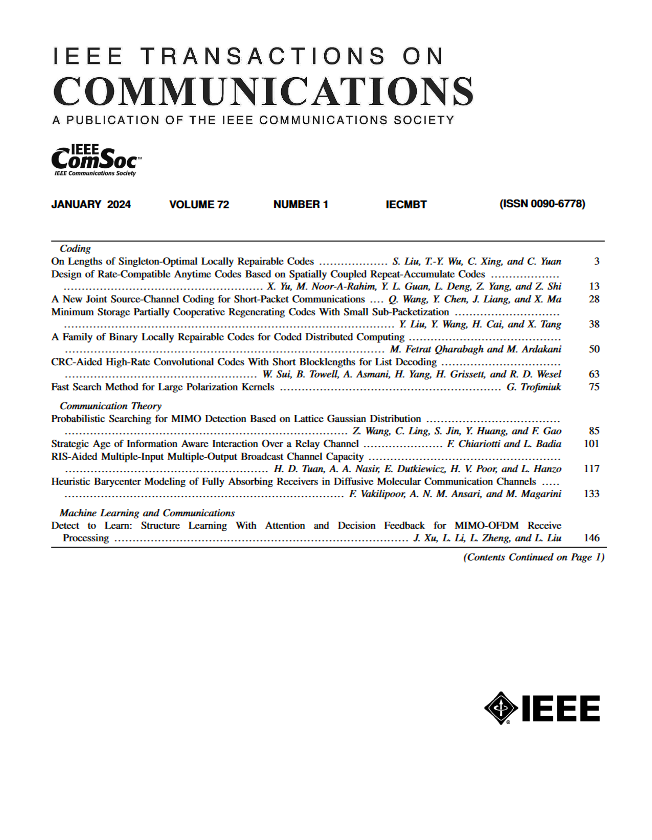
IEEE Transactions on Communications
工程技术-电信学
CiteScore
16.10
自引率
8.40%
发文量
528
审稿时长
4.1 months
期刊介绍:
The IEEE Transactions on Communications is dedicated to publishing high-quality manuscripts that showcase advancements in the state-of-the-art of telecommunications. Our scope encompasses all aspects of telecommunications, including telephone, telegraphy, facsimile, and television, facilitated by electromagnetic propagation methods such as radio, wire, aerial, underground, coaxial, and submarine cables, as well as waveguides, communication satellites, and lasers. We cover telecommunications in various settings, including marine, aeronautical, space, and fixed station services, addressing topics such as repeaters, radio relaying, signal storage, regeneration, error detection and correction, multiplexing, carrier techniques, communication switching systems, data communications, and communication theory. Join us in advancing the field of telecommunications through groundbreaking research and innovation.
 求助内容:
 应助结果提醒方式:


 京公网安备 11010802042870号


