
An Analytical Framework for HAPS Downlink Coverage Based on Stochastic Geometry
IF 8.4
2区 计算机科学
Q1 ENGINEERING, ELECTRICAL & ELECTRONIC
引用次数: 0
Abstract
The high-altitude platform station (HAPS), which is anticipated to play a key role in future networks, has drawn increasing attention in both industry and academia. In this paper, a realistic downlink communication scenario is introduced in which an aerodynamic HAPS flies along a circular trajectory and serves handheld users in an urban environment. Stochastic geometry-based analysis is conducted, along with the assimilation of approximations using simulation data to incorporate the circular aperture antenna model of the HAPS. Analytical expressions are derived for the coverage probability and the ergodic capacity, and the validity of these expressions is demonstrated through extensive Monte Carlo simulations. Although there are slight gaps in the performance analysis, the general tendencies between the analysis and simulation results show a close match. The impact of aerodynamic parameters such as flight radius and altitude on the coverage probability is demonstrated to be relatively marginal to that of communication system parameters such as the number of simultaneous service users and the total transmission power. In terms of ergodic capacity, both aerodynamic parameters show improved performance as their values decrease, with the altitude being more dominant. Although smaller flight radii are favorable for improving network performance, such configurations impose additional constraints on aircraft design, highlighting the need to carefully consider the limitations of size, weight, and power (SWaP). A discussion on real-world HAPS design is supplemented in order to offer practical guidelines for balancing communication performances with the SWaP constraints of the HAPS.基于随机几何的HAPS下行覆盖分析框架
预计在未来网络中发挥关键作用的高空平台站(HAPS)已引起工业界和学术界越来越多的关注。本文介绍了一个真实的下行通信场景,其中空气动力学HAPS沿着圆形轨迹飞行,并在城市环境中为手持用户提供服务。基于随机几何分析,利用仿真数据同化近似,纳入了HAPS的圆孔径天线模型。推导了覆盖概率和遍历容量的解析表达式,并通过大量的蒙特卡罗模拟验证了表达式的有效性。虽然在性能分析上有细微的差距,但分析结果与仿真结果的总体趋势非常接近。与同时服务用户数和总发射功率等通信系统参数相比,飞行半径和飞行高度等气动参数对覆盖概率的影响相对较小。在遍历能力方面,两个气动参数的值越小,性能越好,且高度的影响更大。虽然较小的飞行半径有利于提高网络性能,但这种配置对飞机设计施加了额外的限制,强调需要仔细考虑尺寸、重量和功率(SWaP)的限制。补充了对现实世界HAPS设计的讨论,以便为平衡通信性能和HAPS的SWaP约束提供实用指南。
本文章由计算机程序翻译,如有差异,请以英文原文为准。
求助全文
约1分钟内获得全文
求助全文
来源期刊
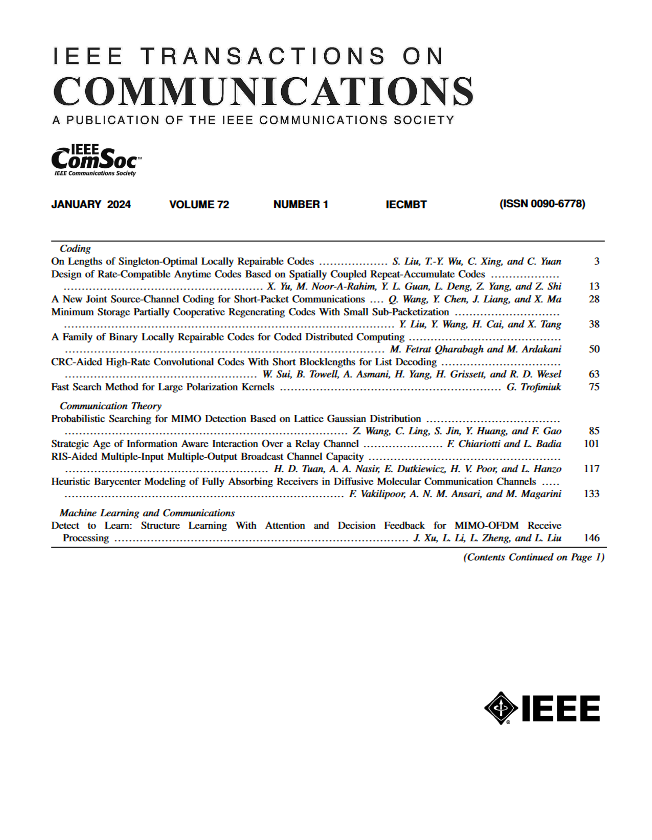
IEEE Transactions on Communications
工程技术-电信学
CiteScore
16.10
自引率
8.40%
发文量
528
审稿时长
4.1 months
期刊介绍:
The IEEE Transactions on Communications is dedicated to publishing high-quality manuscripts that showcase advancements in the state-of-the-art of telecommunications. Our scope encompasses all aspects of telecommunications, including telephone, telegraphy, facsimile, and television, facilitated by electromagnetic propagation methods such as radio, wire, aerial, underground, coaxial, and submarine cables, as well as waveguides, communication satellites, and lasers. We cover telecommunications in various settings, including marine, aeronautical, space, and fixed station services, addressing topics such as repeaters, radio relaying, signal storage, regeneration, error detection and correction, multiplexing, carrier techniques, communication switching systems, data communications, and communication theory. Join us in advancing the field of telecommunications through groundbreaking research and innovation.
 求助内容:
 应助结果提醒方式:


 京公网安备 11010802042870号


