
SFTRAP: Satisfying Fidelity Threshold Routing and Adaptive Purification for Throughput Maximum in Quantum Network
IF 8.4
2区 计算机科学
Q1 ENGINEERING, ELECTRICAL & ELECTRONIC
引用次数: 0
Abstract
The core function of quantum networks is to establish high-fidelity quantum entanglement for long-distance communication. However, the main challenge is to efficiently allocate resources under limited conditions, maximize throughput, satisfy end-to-end (E2E) fidelity requirements, and prevent quantum decoherence caused by inefficient routing algorithms. Current research focuses on optimizing either throughput or fidelity, with a lack of approaches that optimize both simultaneously; furthermore, existing algorithms suffer from high computational complexity. To tackle these challenges, this study proposes a Satisfying Fidelity Threshold Routing and Adaptive Purification Strategy (SFTRAP). SFTRAP maximizes throughput for each request by selecting multiple paths and dynamically choosing links for entanglement purification based on the current state of link resources, thus minimizing throughput loss while satisfying fidelity threshold. The strategy also adaptively adjusts the number of purification rounds according to the fidelity threshold, thereby optimizing the time required for deep purification and enhancing algorithmic efficiency. For multi-request scenarios, SFTRAP employs a priority sorting mechanism that takes into account both path cost and path freedom, which refines request scheduling and path selection to create more efficient request combinations, thus further boosting the overall network throughput. Simulation results indicate that SFTRAP surpasses state-of-the-art methods in terms of both throughput and algorithmic efficiency, highlighting its potential for optimizing resources in quantum networks.SFTRAP:满足保真度阈值路由和量子网络吞吐量最大值的自适应净化
量子网络的核心功能是为远距离通信建立高保真量子纠缠。然而,主要的挑战是在有限的条件下有效地分配资源,最大限度地提高吞吐量,满足端到端(E2E)保真度要求,并防止低效路由算法引起的量子退相干。目前的研究主要集中在优化吞吐量或保真度,缺乏同时优化两者的方法;此外,现有算法的计算复杂度较高。为了应对这些挑战,本研究提出了一种令人满意的保真度阈值路由和自适应净化策略(SFTRAP)。SFTRAP通过选择多条路径,并根据链路资源的当前状态动态选择链路进行纠缠净化,最大限度地提高每个请求的吞吐量,从而在满足保真度阈值的同时最小化吞吐量损失。该策略还根据保真度阈值自适应调整净化轮数,从而优化深度净化所需时间,提高算法效率。对于多请求场景,SFTRAP采用考虑路径成本和路径自由度的优先级排序机制,优化请求调度和路径选择,创建更高效的请求组合,从而进一步提高整体网络吞吐量。仿真结果表明,SFTRAP在吞吐量和算法效率方面都超过了最先进的方法,突出了其在量子网络中优化资源的潜力。
本文章由计算机程序翻译,如有差异,请以英文原文为准。
求助全文
约1分钟内获得全文
求助全文
来源期刊
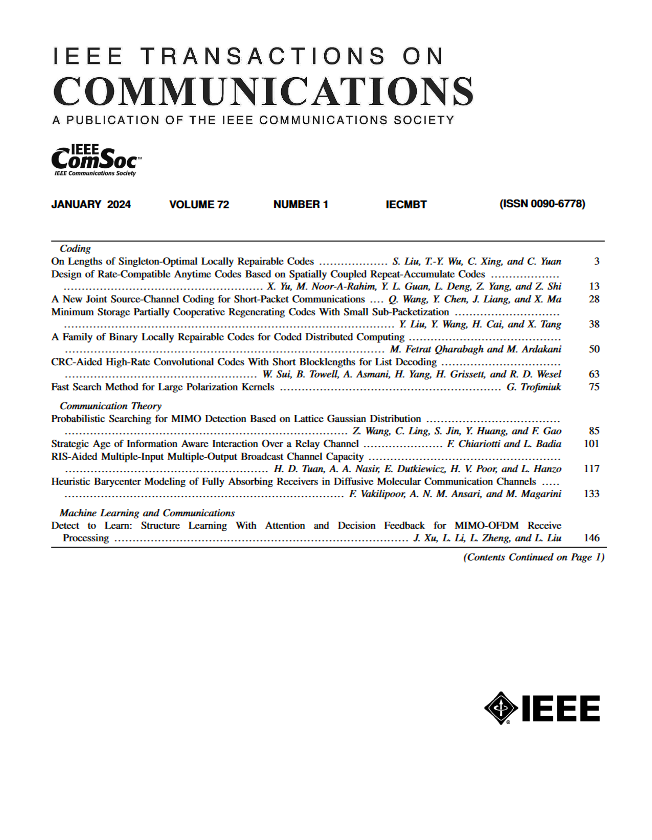
IEEE Transactions on Communications
工程技术-电信学
CiteScore
16.10
自引率
8.40%
发文量
528
审稿时长
4.1 months
期刊介绍:
The IEEE Transactions on Communications is dedicated to publishing high-quality manuscripts that showcase advancements in the state-of-the-art of telecommunications. Our scope encompasses all aspects of telecommunications, including telephone, telegraphy, facsimile, and television, facilitated by electromagnetic propagation methods such as radio, wire, aerial, underground, coaxial, and submarine cables, as well as waveguides, communication satellites, and lasers. We cover telecommunications in various settings, including marine, aeronautical, space, and fixed station services, addressing topics such as repeaters, radio relaying, signal storage, regeneration, error detection and correction, multiplexing, carrier techniques, communication switching systems, data communications, and communication theory. Join us in advancing the field of telecommunications through groundbreaking research and innovation.
 求助内容:
 应助结果提醒方式:


 京公网安备 11010802042870号


