
Nonlinear dynamic modeling of trochoidal milling with engagement loss-induced time-varying delay
IF 18.8
1区 工程技术
Q1 ENGINEERING, MANUFACTURING
International Journal of Machine Tools & Manufacture
Pub Date : 2026-03-01
Epub Date: 2026-02-11
DOI:10.1016/j.ijmachtools.2026.104377
引用次数: 0
Abstract
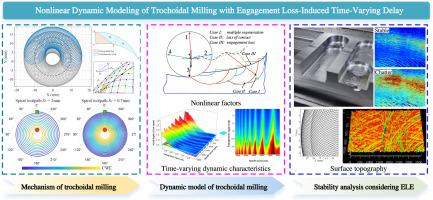
Engagement loss is a geometric-temporal switching mechanism that renders the chip thickness evolution nonsmooth and the delay state dependent and time-varying, thereby acting as a system nonlinearity. However, prior research has predominantly relied on regenerative chatter theory while neglecting the effect of cutter-workpiece engagement loss, resulting in inaccurate dynamic models for trochoidal milling. This paper develops a precise dynamic model for trochoidal milling that incorporates engagement loss effects and enables analysis of process nonlinear dynamics. First, the characteristics of the double trochoidal path are analyzed, and the mechanism by which engagement loss arises during milling is elucidated. On the basis of the above analysis, a novel numerical method is proposed to accurately calculate engagement loss rate resulting from variations in cutter-workpiece engagement conditions. Subsequently, a nonlinear dynamic model for trochoidal milling is developed using a time-domain simulation approach, which incorporates both time-varying delay and engagement loss effects. An adaptive prediction time-domain algorithm is then introduced, utilizing slope guidance to iteratively predict the initial axial depth of cut. The algorithm significantly narrows the search range for stability boundaries and enhances computational efficiency. Finally, the proposed model is validated through horizontal spiral and trochoidal milling experiments and compared with classical stability predictions. Results indicate that engagement loss reduces the overlap of regenerative waviness and modulates the effective delay, which weakens or intermittently breaks the regenerative loop and thereby raises the stability limit. The proposed time-varying mixed-delay dynamic model predicts milling stability with high accuracy.
含啮合损耗时变延迟的摆线铣削非线性动力学建模
接合损耗是一种几何-时间切换机制,它使芯片厚度演变变得非光滑,并且延迟状态依赖于时变,从而表现为系统非线性。然而,以往的研究主要依赖于再生颤振理论,而忽略了刀-工件啮合损失的影响,导致齿面铣削动力学模型不准确。本文建立了包含啮合损失效应的精密摆线铣削动力学模型,使加工过程的非线性动力学分析成为可能。首先,分析了双摆线轨迹的特点,阐明了铣削过程中啮合损失产生的机理。在此基础上,提出了一种精确计算刀具与工件啮合条件变化所导致的啮合损失率的数值方法。在此基础上,采用时域仿真方法建立了考虑时变时滞和啮合损失效应的齿面铣削非线性动力学模型。然后引入了一种自适应时域预测算法,利用斜率导向迭代预测切割的初始轴向深度。该算法大大缩小了稳定边界的搜索范围,提高了计算效率。最后,通过水平螺旋铣削和摆线铣削实验验证了该模型,并与经典稳定性预测结果进行了比较。结果表明,接合损失减少了再生波的重叠,调节了有效延迟,使再生环减弱或间歇性断裂,从而提高了稳定性极限。提出的时变混合延迟动态模型对铣削稳定性的预测精度较高。
本文章由计算机程序翻译,如有差异,请以英文原文为准。
求助全文
约1分钟内获得全文
求助全文
来源期刊
CiteScore
25.70
自引率
10.00%
发文量
66
审稿时长
18 days
期刊介绍:
The International Journal of Machine Tools and Manufacture is dedicated to advancing scientific comprehension of the fundamental mechanics involved in processes and machines utilized in the manufacturing of engineering components. While the primary focus is on metals, the journal also explores applications in composites, ceramics, and other structural or functional materials. The coverage includes a diverse range of topics:
- Essential mechanics of processes involving material removal, accretion, and deformation, encompassing solid, semi-solid, or particulate forms.
- Significant scientific advancements in existing or new processes and machines.
- In-depth characterization of workpiece materials (structure/surfaces) through advanced techniques (e.g., SEM, EDS, TEM, EBSD, AES, Raman spectroscopy) to unveil new phenomenological aspects governing manufacturing processes.
- Tool design, utilization, and comprehensive studies of failure mechanisms.
- Innovative concepts of machine tools, fixtures, and tool holders supported by modeling and demonstrations relevant to manufacturing processes within the journal's scope.
- Novel scientific contributions exploring interactions between the machine tool, control system, software design, and processes.
- Studies elucidating specific mechanisms governing niche processes (e.g., ultra-high precision, nano/atomic level manufacturing with either mechanical or non-mechanical "tools").
- Innovative approaches, underpinned by thorough scientific analysis, addressing emerging or breakthrough processes (e.g., bio-inspired manufacturing) and/or applications (e.g., ultra-high precision optics).
 求助内容:
求助内容: 应助结果提醒方式:

 京公网安备 11010802042870号


